The Origins of Opportunity

I’ve been deep into future studies / futurology over the past few weeks. It’s an intriguing field for me at both a professional/academic level and a personal level. How can we better understand the future? Are there core methodologies that we can employ to optimize our current positioning and decision-making? How can we be better prepared for the future? What’s inevitable and what’s not? Where lies the line between info-driven forecasting and innate intuition?

Although the netweb has helped to grow and organize both the futurological information and the community through which that information is developed and shared, it seems as though the field itself remains cloudy. I must hope that at some level I can build upon the existing thoughts of others and contribute new thoughts of my own so that at least the window to the future becomes more clear.

One cornerstone of future studies is in how to evaluate, filter though, and create opportunity from statements about the future. And so I wonder: from where does opportunity arise, and how can this recognition be leveraged to inform (and in some cases, influence) the future? In general, how can we characterize the origins of opportunity?

  1. Is it through early recognition? This is not beating others to the finish line, but rather beating others to the starting line. Can we identify gaps sooner than others?
  2. Is it through resourceful timing? Often opportunity arises in not being first, not being last, but somewhere in between. The earliest adopter may have his/her vision obscured through too many details, the latest adopter may be left with the crumbs. And often we find much opportunity in the failure of others – developing the right trials from the errors of others.
  3. Is it through pure knowledge and intelligence? Can brute force brainpower create the most opportunity? Or is it more dependent on the ability to apply one’s knowledge, no matter how limited it may be? Is it about having the right skill sets and tools, tactics and strategies?
  4. Is it though pure luck? Can being in the right place at the right time govern our ability to find and harness opportunity? Is pure luck within our beyond our control?

It’s simplest to think that opportunity may arise as a result of any combination of these factors. Therefore, to maximize our opportunities, we should focus on being in the right places, having the right tools, being with the right people, understanding timing as an approach, building the right knowledge base, and building an overall recognition for the many faces of opportunity.

If we can learn to recognize opportunity and better understand where it may arise, we can begin to gain a better picture of the future. Then, we can work to inform that picture with data and models to ensure that we take full advantage of those opportunities to better our self, our communities, our world, and that of tomorrow.

Principles of Forecasting

I just finished reading a couple books about future studies and the nature of predictions and forecasts: (1) Future Savvy, by Adam Gordon and (2) The Future of Everything, by David Orrell. From the former of the two, I wanted to pull a good portion of the content from Chapter 11 and structure it here for use in future posts and projects. In Chapter 11 of his book, Gordon outlines the important questions to ask of any forecast. As decision makers and leaders, analysts and synthesizers, and organizations and citizens, it’s critical that we learn to properly evaluate and filter statements about the future so that we can optimize our decisions and, ultimately, our positioning for the future.

With that as a quick intro, here are the questions we should ask of any prediction or forecast. As Gordon states of forecasts: “they are not in themselves valuable, they are only valuable alongside a clear way to separate the wheat from the chaff”.

Purpose

  • What is the purpose of the forecast? Is the forecast upfront about its purpose?
  • Is the forecast future-aligning or future-influencing?
    • Is the forecast widely publicized?
    • Does it specify action to take in the external world?
    • Is it a forecast of extremes?

Specificity

  • Is he forecast mode predictive – spelling out what will happen – or speculative, illuminating possible alternatives?
  • Is there too much certainty?
  • Is there enough certainty? Is the forecast hedging?
  • Is the forecast clear about the pace of change? Does it specify timelines or does it leave the question hazy?

Information Quality

  • How extensive and how good is the base data?
    • Is the data up to date?
    • Does the forecast use secondary data?
    • Is the data real or a projection?

Interpretation and Bias

  • Are the forecast’s biases natural or intentional?
  • What is the reputation of the forecaster and forecast organization? Does the forecaster have anything to lose by being wrong?
  • Are bias-prone contexts at hand?
    • Is the forecast sponsored?
    • Is self-interest prominent?
    • Are ideology and idealism prominent?
    • Does the forecast focus on a “single issue” future?
    • Is editorial oversight bypassed?

Methods and Models

  • Does the forecast specify its methods?
  • Does the forecaster imply the method is too complex, too arcane, or too proprietary to share?
  • Do forecast proponents trumpet their unique or “new and improved” methods?

Quantitative Limits

  • Is the use of quantitative methods appropriate?
  • Is a machine doing the thinking?

Managing Complexity

  • Does the forecast oversimplify the world?
  • Does the forecast acknowledge systemic feedback?
  • Does the forecast anticipate things that could speed up the future, or push it off track? Does it account for triggers and tipping points?
  • Does the forecast expect exponential change?

Assumptions and Paradigm Paralysis

  • Has adequate horizon scanning been done?
  • Are the assumptions stated? Is the forecaster aware of his or her own assumptions? Is the forecaster willing to entertain alternative assumptions?
  • Do the forecaster’s assumptions appear valid and reasonable?

Zeitgeist and Groupthink

  • Is the zeitgeist speaking through the forecaster?
  • Is the forecast jumping on the bandwagon?
  • Does the forecast rely on “experts”?
  • Does the forecast do stretch thinking? Does it allow us to break free from the “official future”?

Drivers and Blockers

  • Are change drivers and enablers identified? Or are trends simply projected?
  • Are blocking forces identified and fully accounted for? Is friction factored in?
    • Have utility questions been asked and adequately answered?
    • Are there proposing or opposing stakeholders, particularly powerful individuals and powerful organizations?
    • Does the forecast challenge social, cultural, or moral norms?
    • Whose side is the law on?
    • Is the forecaster in love with the technology?
    • Does the forecast underestimate the time to product emergence? Does it overestimate the pace at which people’s habits change?
    • Does the forecaster assume change? Does the forecast underestimate the full hump change must overcome? Does the forecaster recognize what doesn’t change?

A Profile of Portugal

The love of my life and I are taking a vacation later this year to Portugal! I figured I would organize and share some Portugal facts/stats as we continue to research and solidify our trip…

Major Dates

  • 1143 – Kingdom of Portugal Recognized
  • 1578 – Battle of Ksar El Kebir in Morocco, in which the Portuguese King and (pretty much) the entire Portuguese nobility were lost. That resulted in Portugal being annexed by Spain for 60 years. (info from Rod Carvalho)
  • 1755 – Major, Devastating Earthquake
  • 1803-1815 – Napoleonic Wars
  • 1822 – Independence of Brazil
  • 1910 – Deposition of the Monarchy, Republic Proclaimed
  • 1974 – Left-Wing Military Coup
  • 1975 – Colonial Independence (Angola, Mozambique, East Timor)
  • 1976 – Constitution Adopted
  • 1986 – Becomes Member of EU (formerly the EC)

Fun Facts

  • During the Napoleonic Wars, Portugal was, for a time, Great Britain’s only ally on the continent.
  • Also during the Napoleonic invasions, the Portuguese royal family moved to Brazil and Rio de Janeiro was, albeit for a brief period, the capital of the Portuguese Empire. Such empire was named the United Kingdom of Portugal, Brazil and the Algarves. (again thanks here to Rod Carvalho!)
  • The oldest alliance in the world, still in force, is the Anglo-Portuguese Alliance, signed in 1373.
  • The Vasco de Gama Bridge in Lisbon is the longest bridge in Europe.
  • Portugal is a global leader in renewable energy with its solar energy farm in Alentejo.
  • It is illegal for a bull to be killed in Portuguese bullfighting.
  • The Estoril Casino, 20 km outside of Lisbon, is the largest gambling outlet in Europe.

Famous Portuguese

  • Henry the Navigator (explorer)
  • Vasco da Gama (discovered the sea route to India)
  • Bartolomeu Dias (first person to sail round the southern tip of Africa, which he named the Cape of Good Hope)
  • Ferdinand Magellan (first to complete a circumnavigation of the world, which he did in 1522)
  • Pedro Alvares Cabral (discoverer of Brazil)
  • José Mourinho (soccer coach, Inter Milan)
  • Nelly Furtado (singer)
  • Luis Figo (soccer player)
  • Cristiano Ronaldo (soccer player)
  • Click here for more (via Wikipedia)…

Statistics

  • Total Area: 92,090 sq km (ranked #110, slightly smaller than Indiana)
  • Land Area: 91,470 sq km
  • Water Area: 620 sq km
  • Capital: Lisbon
  • Structure: 18 Districts, 2 Autonomous Regions (Azores, Madeira)
  • Land Boundary: 1,214 km (with Spain)
  • Coastline: 1,793 km
  • Highest Altitude: 2,351 km (Ponta do Pico in the Azores)
  • Population: 10,707,924 (July 2009 est., ranked #76)
  • Population Growth Rate: 0.275% (ranked #178)
  • Population Density: 115 ppl / sq km (ranked #89)
  • Median Age: 39.4 years
  • Life Expectancy at Birth: 78.21 years (ranked #47)
  • HIV/AIDS Prevalence Rate: 0.50% (ranked #74)
  • Religious Breakdown: 84.5% Roman Catholic, 9.0% unknown, 3.9% none, 2.2% other Christian
  • Literacy: 93.3%
  • Education Expenditures (% of GDP): 5.5% (ranked #50)
  • Human Development Index: 0.909 (ranked #34)
  • Happy Planet Index: 37.5 (ranked #98)
  • Euromoney Country Risk Rating (Low=Best): 82.43 (ranked #24)
  • Military Expenditures (% of GDP): 2.3% (ranked #72)
  • GDP: $232.2 Billion (ranked #50)
  • GDP – Per Capita: $21,700 (ranked #56)
  • Exports: $41.42 Billion (ranked #52)
  • Export Partners: Spain (25.6%), Germany (12.6%), France (11.1%), Angola (5.9%), UK (5.3%)
  • Imports: $58.79 Billion (ranked #40)
  • Import Partners: Spain (28.9%), Germany (11.6%), France (8%), Italy (4.9%), Netherlands (4.4%)
  • Unemployment Rate: 9.2% (ranked #103)
  • Total Airports: 65 (ranked #76)
  • Annual Air Traffic (2006): 11,722,211 (ranked #20)
  • Railways: 2,786 km (ranked #59)
  • Roadways: 82,900 km (ranked #55)
  • Internet Hosts: 1.967 Million (ranked #33)
  • Internet Users: 4.476 Million (ranked #45)
  • Cell Phone Users: 14.91 Million (ranked #44)
  • Freedom Press Rating (Low=Free): 16 (ranked #16)

Links

A World Of Readers, Thinkers, And Sleuths

“Let your mind wander through time and space, and follow its trail with curious grace.”

With regards to reading books, I’ve gone through several phases in my life. I enjoyed them as a young kid, then hated them in middle school, and was swamped by them in high school. I read mostly magazines and equations in college. But in grad school, I learned to find time for books outside of class and homework, and began understanding them more clearly. And now, well, I don’t really have a definition for it… but I’ll try.

I love books. I absolutely love books and I think they love me. Old books, new books, bright books, dusty books, hardcovers, paperbacks, biographies, picture books, ones with funky-looking text, ones with big characters, cookbooks, humorous musings, philosophical contemplations, new takes on old theories, old takes on novel wonders, manuscripts, adventures, essays, creative ramblings, confessions, ones with good names, and especially the nameless ones. There are so many books to love, and I love them all. I love that I can love them all. They are there for me when I want them and there for me when I don’t want them. I can read when I’m happy, read when I’m sad, read when I’m puzzled, or read when I’m mad. I don’t have a deadline for a book and I’m not tested when I’m done with it. I can pick it up when I want, and can forget about it if I want to do that too.

The book store is one of my favorite places. I really can’t believe how many books have been written. These are the words and thoughts of people from all over the world, on all types of topics, in a sometimes-organized-often-disorganized effort to better understand our world. These are the words of the millions of deceased – those that saw what I could not see – and willingly tried to explain it to a world of readers with whom they have no acquaintance.

It’s also funny that book stores are categorized, because the case can be made to fit any book under a thousand headings. That being said, I’m always surprised at how well most authors can maintain the scope and focus of a single book. I find my mind wandering constantly and, as a result, feel that this is the natural way for me to write and express my thoughts and feelings. Scope and focus are nice if and only if scope and focus are how you feel you can best express your thoughts and feelings to the world.

With that in mind, let me express a small array of thoughts:

1. Books, and literacy in general, provide a channel through which we all can better understand the world in which we live.

2. Reading and embracing books at a young age (including picture books) fosters creativity, analytical thinking, and a drive for discovery and understanding.

3. No book is a bad book, and everyone is an author. We all have something to say, and everything said is worth a read.

4. Writing and reading enables self-realization coupled with the ability to wear other people’s shoes. Books connect and network our planet – the living, the dead, and the unborn.

Lastly, I want to quickly describe a couple web resources that help organize that which we read while making it a most economical endeavor. Aside from all the free content I can get from the web, these are a few of the mechanisms I use to discover, monitor, research, and purchase books:

  • Amazon – I use the built-in “Wish List” feature to maintain a collection of every book in which I’ve had some interest in purchasing or researching more. The Amazon iPhone app is also great – for adding books to the wish list and even purchasing books within a few clicks. I’ll usually walk around the book store, find a title I like, read the front/back covers, flip through a few pages, then look it up right away on the Amazon iPhone app, read some reviews, and either add it to my wish list or immediately purchase a used copy (for around 1-50% of the in-store/new price). Amazon itself is also a fantastic place to find similar books, related but higher-rated books, or books on any other random topic in which you might have a short- or long-term interest.
  • Google Books – I use a lot of Google products because I like having many dimensions of my life synced in the cloud under my one Google profile. Google Books is another one of these and is where I keep track of what I’ve read, what I’m reading, and what I want to read. I can read reviews (including those from Amazon), write reviews, add personal notes, and even read excerpts (if not all) of the book online. A very nice online, personal library.

That’s about it for now. Love books. Read books. Write in your books. Share them with others. Talk about your books. Recommend your favorites. Have fun with them!

The Personal Finance System and Reasonable Economic Fasting

Understanding personal finance requires more than a regular checking of balances and a paying of bills. It requires:

  1. Conscientious recognition of all inputs and outputs of your personal financial system
  2. Analytical recognition of the internal and external factors that contribute to changes in your personal finance system
  3. Deliberate manipulation of the controllable factors when your short and long-term financial strategies dictate necessary change(s)
  4. Careful planning for and reaction to the uncontrollable factors in order to mitigate risks to your system and strategy

Personal finance can be depicted as a system because, well, it’s a system. There are inputs and outputs to your system. You make and you spend. You gain and you lose. There are internal and external factors that can change its overall state. Markets fluctuate. Rates change. Job success merits a wage increase. A loss of a job diminishes income. A health problem or car accident can lead to unintended expenses. The state of your system is directly affected by the collective impact of both controllable and uncontrollable factors.

Fortunately, this system is quantifiable and is readily measured. Through various ways and means, you can determine the state of your system at any present moment. For the oh-so-organized, you can determine the state of your system at any moment in the past. And for the oh-so-very enabled (I think you know where I’m going with this), you can peer into the state of your system for any multitude of moments in the future.

With this notion, there should be an overall strategy to your system – a place where you want to be financially and how you aim to get there. Your aim will be based on the financial knowledge you have built over time, with regards to the controllable and uncontrollable factors contributing to your system. And to your benefit, your knowledge will only increase over time, making your strategy more targeted and the desired future state that much more accurate and achievable.

So you recognize that there’s more to understanding your finances than the ATM and your wallet. Where should you start? Perhaps with what I call “reasonable economic fasting”.

What is your financial baseline? In other words, how can you determine the bottom line steady state of your system? Without needless purchases and expenditures, how much do you have, how much comes in, and how much goes out? Spend as little as possible, and organize your bottom line financial system.

For a specified period of time (a week, two weeks, one month, etc), don’t make those needless purchases. Do carry on with your basic grocery, health care, and sufficient living expenses. But don’t get those Don Mattingly rookie cards off eBay (although I would call them a basic need), trade a book with someone rather than buy a new one, and cook your own steak and potatoes rather than dish out $35 for a nice plating. Find your financial baseline, and I guarantee you’ll gain some new knowledge with regards to your personal finance system:

  • The Value of Money – How much is a dollar worth to you? How much is a dollar worth to you compared to yesterday?
  • The Value of Saving – How much is a dollar saved worth to you? Given your baseline, what is your maximum savable amount per pay period (the least hopefully not being less than $0.00)? A dollar can go a long way if it goes away for a long time.
  • The Value of Spending – How much is a dollar spent worth to you? Do all your baseline expenses amount to what you pay for them?
  • Controllable & Uncontrollable Factors – At your financial baseline, you should be able to determine which fluctuations in your bottom line are a result of uncontrollable factors versus controllable ones. Which expenses sustain your desired lifestyle, and which are a result of it?

In the end, it comes down to simple recognition and organization. Take the time to understand what goes in and comes out of your personal finance system, and try to analyze the impact of key controllable and uncontrollable factors affecting that system. If needed, find your financial baseline as a starting spot, and use some intuitive planning to craft your strategy. After all, thought planning is free.

Learning In The Clouds

No, I’m not talking about daydreaming although I have previously expressed my love for and interest in daydreaming as a necessary practice. But here, I’m talking about education and the internet.

It is well understood that education as a discipline has made positive strides in recent decades, but still has many leaps to take. There exists an issue of a profound educational gap between demographics, an issue of comprehensive standards through which student understanding can be measured, and an issue of standards and processes by which teachers can be evaluated for feedback and professional growth, to name a few.

But for this topic, let’s set these issues aside and assume internet access is available for all students and schools. How can the internet be leveraged as an enabler of quality education? How does the existing cyber framework and status of collaborative tools enable efficient and effective education?

Key Themes

  1. Writing/typing enables memory and understanding: As stated in my previous post “Spectrum Logic”: “To put something on paper and organize the information as to make visual sense – in words, lines, colors, and curves – is to recognize some understanding and to create a basis for new insight and discovery.”
  2. Differing opinions and verbiage, on any topic, provide full-spectrum input, fuel discussion, and parallel what’s to be expected in the professional world.
  3. Technical skills are essential. This includes understanding technical concepts, the digital organization of information, social networking, and collaboration.
  4. Relationships are a key to happiness and provide a medium for professional growth. Digital relationships formalize relationships and provide concrete structure between multiple people, enabling this growth in an organized manner.
  5. Exploring and understanding the depths of the internet and related technologies forges new intellectual connections, and more importantly, personal interests.

Core Components

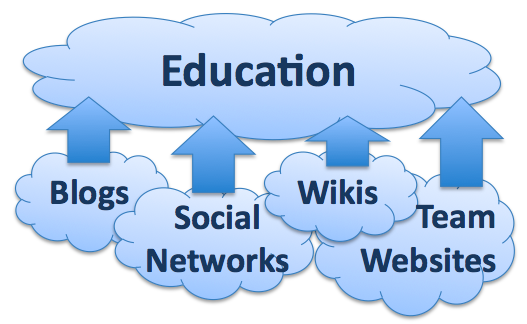
Blogs – As a central medium for information exchange, blogs can be used as a fantastic teaching tool. Imagine a class where after each lesson, different students memorialize class notes, in their own words, in blog posts for the rest of the class to see. Posts can be categorized, commented on, and used as a fantastic medium for discussion. Come test time, the notes are in there for all to see and use as study material.

Wikis – At their core, wikis provide a semi-structured environment for the capture of knowledge. Yes, Wikipedia seems complete, but that’s not the point. Imagine a class that started with a blank wiki, and had an objective to create a new knowledge framework around class material. This would not only prove to be great study material, but would also teach students a good deal about Web 2.0, digital organization of information, and parallel the growth and interconnectedness of new knowledge through links, references, and version control.

Social Networking – Private and/or public, social networks establish relationships, organize contact information, and provide a framework through which individuals can learn about other individuals and interact with them. Whether on a similar interest or topical matter, social networking for a class could be incredibly useful for building new relationships, and easier interaction with peers and professors. You can never replace a hallway conversation or a whiteboard tutorial, but this could better enable those circumstances to take place.

Personal/Team Websites – Personal and/or team websites enable individuals to provide some level of scope to their interests and personal attributes while teaching hands-on technical skills. Building a website teaches organization, visualization, data management, marketing, and a whole boat load of other concepts. Whether as a class or as individuals, website creation forges new intellectual connections and practical skills that directly translate to the professional world.

In the end, there’s a world of opportunity on the web, and as education tackles its outstanding issues as a whole, it’s only beneficial to use and leverage the internet as a medium to foster new learning and create new opportunity for students across the US and the world.

Links

Spectrum Logic

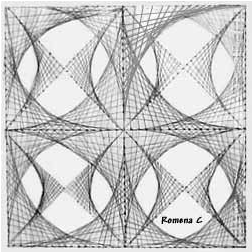
The visual representation of information is critical for both learning and teaching. To put something on paper and organize the information as to make visual sense – in words, lines, colors, and curves – is to recognize some understanding and to create a basis for new insight and discovery.

Logic is the study of reasoning, the systematic approach to reaching a conclusion, or the examination of competing arguments with regards to a central issue or question. Logic can be broken down into deductive and inductive reasoning, one drawing conclusions from specific examples and the other drawing conclusions from definitions or axioms. Logic can also be broken down into analysis and synthesis, one examining individual component parts and the other combining component parts into a whole. In any event, logic is a way to get from questions to answer, disbelief to belief, and data to insight.

One such type of logic is visual logic, or what I’ll call “spectrum logic”. It’s the combination of the visual representation of information and the many realms of logic. The reason I use the term “spectrum” is two-fold. First of all, it’s by definition the representation of a full range of possible values/conditions for a given topic. And second of all, it suggests continuity along its range and therefore implies a high level of seamlessness and efficiency.

So in the world of analysis and problem solving, how do we apply spectrum logic? Well, just follow every possible visual path from any origin within your visual space and try to optimize your path to the result. Place your problem in the center of a sphere/cube and run the full spectrum of paths to that center point. Left to right and right to left, bottom-up and top-down, outside in and inside out, spiral inward and spiraling out. Think about the component parts that make up the visual space, and the conditions that fall along each path. Why is your problem so complex? What makes it so complex? Can you qualify your problem in color, words, shape, and text? Can you quantify it and its components? Is it made up of many unknown dimensions or a few known ones? Picture your problem, logically break it apart, and put it back together. Take a diverse set of paths to and from your problem, and find out which one gives you an optimal set of insights in return. Hopefully, if the answers and conclusions are not clear, you’ll at least have learned something in the process.

Brain And Gut Purchases, Cars Included

There are some self-propelled feelings that are in a world of their own: accepting a new job offer, graduating from school, winning an intramural championship, and the first drive in a new car (among others). By self-propelled, I mean that they take a lot of individual effort (in addition to that of several friends, teammates, colleagues, and family members) to make happen. In more obvious words, it’s the toughest goals that feel best when attained.

With that, buying a car is NOT EASY. It takes a lot of time to research, compare, test drive, communicate with dealers/sellers, and work the numbers. When the numbers are worked, they’re usually big. It’s a major financial commitment that can’t be made in a vacuum. There are tons of options out there. How do you know that the car you get is the perfect car for you. When all is considered, it’s a lot to consider.

But in the end, the reward is great. The feeling is awesome. I’ll start with the end product, then give some advice…

I ended up with a 2007 Lexus IS 250 with 19K miles on it. It’s AWD, 6-Cyl, 22/28 mpg, 201 HP, nav system, keyless ignition, backup camera, blue exterior, black leather interior. I got it from CarMax with an extended 6 yr / 72K mile warranty. I LOVE IT. It’s sporty, practical, and very much me. My picture above kind of stinks given the storm we had this weekend, but when cleaned and washed… wowzas. That feeling of pulling out of the lot all registered and complete was accomplishment, happiness, and relief all in one.

I started my research months ago on both the types of new cars and the available purchasing options and incentives. My first realization was that it can get confusing fast and it would take the good ol’ organizational toolbox to best assess my options. Spreadsheets, calculators, and lots of notes…

In general, here is some advice for a car buyer:

1. Be open to everything. Don’t convince yourself that you like something to make the process easier. It’s a lot better to back-track and get frustrated now than to be unhappy with a purchase later. I started with wanting a gas-guzzling, new SUV and ended up with a small, used sedan.

2. Do the math. Don’t believe anything til you have proven it to yourself. If you need to make a decision for a dealer within the next 10 minutes, don’t. It will be your car, and there’s lots of them out there. Most times, the numbers are the best truths on paper. Set limits, estimate expenses, and make your car fit your budget.

3. Diversify your sources of advice. Many people have purchased cars before and therefore have lots of (different) lessons learned. As with many choices in life, the best advice you can get is a lot of different advice from credible sources. Thanks especially to Dad and Christine here though.

4. Last of all, but most importantly, make your purchase with both your brain and your gut. It’s a “One Brain” purchase, requiring logic and everything non-logical. Aside from making the numbers work, you need to find the right balance between power, style, comfort, fuel efficiency… and happiness. When you see you car, you need to be happy it’s your car.

So when it feels right, you’ll know. If you don’t know, then it won’t feel right. How’s that for logic?

On Dreams And Dreaming

“Dreams are nature’s answering service – don’t forget to pick up your messages once in a while.” – Sarah Crestinn

Of all the things that affect humans on a near-daily basis, how many remain as mystical as dreaming? The nature and purpose of dreams have been debated since the beginning, and yet, we still have no conclusion or consensus.

In his published essay on Enron (and now in his book What The Dog Saw), Malcolm Gladwell makes reference to National Security expert Greg Treverton’s famous distinction between puzzles and mysteries. Mysteries do not have simple, factual answers. And although puzzles really don’t either, they are by process and intelligence, well, solvable. When the right amount information is found, puzzles can and will eventually be solved. Mysteries on the other hand, “require judgments and the assessment of uncertainty, and the hard part is not that we have too little information but that we have too much.”

Dreams are a mystery. Dreams are not a puzzle. We will not one day realize the complete physiology and meaning of dreams to its fullest extent so that we can close the text book on dreams. They are a mystery and will remain a mystery. Yes, we may continuously add new findings and hypotheses – either through scientific research or epiphanies, but I believe dreams are inherently a mystery. They are not meant to be fully discovered.

That being said, there are plenty of facts out that characterizing dreams and their nature. Here are some:

  • We dream on average of one or two hours every night. And we often even have 4-7 dreams in one night.
  • One third of our lives is spent sleeping. In our lifetime, we will have spent about 6 years of it dreaming. That is more than 2,100 days spent in a different world.
  • Five minutes after the end of the dream, half the content is forgotten. After ten minutes, 90% is lost.
  • Dreamers who are awakened right after REM sleep, are able to recall their dreams more vividly than those who slept through the night until morning.
  • Men tend to dream more about other men, while women dream equally about men and women.
  • Everybody dreams. Simply because you do not remember your dream does not mean that you did not dream.
  • If you are snoring, then you cannot be dreaming.
  • Studies have shown that our brain waves are more active when we are dreaming than when we are awake.
  • Blind people do dream. Whether visual images will appear in their dream depends on whether they where blind at birth or became blind later in life.
  • Back in the Roman Era, striking and significant dreams were submitted to the Senate for analysis and interpretation.
  • The word dream stems from the Middle English word, dreme which means “joy” and “music”.

References/Links

The New Garage of Analytics

Analytical consulting requires more than a computer, some data, and some coding. It requires effective organization, proper communication, innovative methods, and what I call “meaning motivation” – the innate desire for insight, the curiosity for understanding, an appetite for intellectual exercise.

That having been said, I’d like to organize a new garage of analytics. These are some of the toolboxes necessary for solving complex problems in a ever complex world. These are the toolboxes we access for effective organization, proper communication, method innovation, and meaning motivation.

And in terms of process, math aligns us to break complex problems into those that are much simpler to understand and digest while still seeing the big picture and the end goal. This very much follows that concept. No problem will be exactly like another, but if we follow a similar digestion process to attack complex problems, well, at least our stomach will not be upset.

The Organizational Toolbox

The Sociological Toolbox

The Analytical Toolbox

The Visualization Toolbox

The Balance Toolbox – A step away is sometimes the best step forward.

  • Artistic Expression
  • Fitness/Exercise
  • Learning
  • Reading
  • Sleeping
  • Talking
  • Traveling
  • Writing