The Power of Anticipation

In today’s society, gaining an inch can be like gaining a mile.

Soccer takes a lot of skill and athleticism. You need to be able to dribble, pass, shoot, tackle, communicate, see, sprint, etc. But as I’ve stated before (“mind bend it like beckham” – 2/11/2009) it’s just as much a mental game as it is a physical one. You need to think like your opponent and play somewhat of a guessing game, connecting dots before there’s any visible relationship between them. You need to forecast outcomes, intellectually seeing into the future guided by the data that’s available.
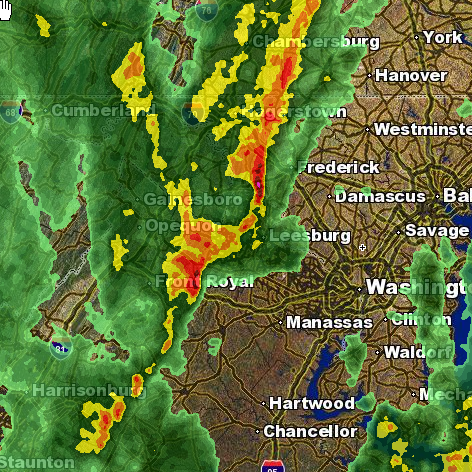
This sort of anticipation is an imperative ability for success in the future – within any endeavor. In business, anticipation means a gaining a leading edge on the competition. For defense, it means preparation and contingency plans for what might be likely to occur. In decision-making its gaining threshold confidence in your decision – using as much relevant information to guide a range of actions, opinion,s and ultimately, outcomes. And not to mention, it helps us grab our umbrella when running out the door.

Predictive analytics, although a seemingly new, hot topic today, has been around forever. Prophets, Mayans, Nostradamus, Pythia, lunar calendars, and the Akashwani – in a historical sense the predictions were informed by a variety of sensory stimuli coupled with intuition and a variety of other external factors. Nowadays, it’s really not that different. Today, we have data and semi-sophisticated mathematical processes that parallel conscious perception and intuition. We can quantify much of what could not have been quantified in the past.

“Predictive analytics encompasses a variety of techniques from statistics, data mining and game theory that analyze current and historical facts to make predictions about future events.

In business, predictive models exploit patterns found in historical and transactional data to identify risks and opportunities. Models capture relationships among many factors to allow assessment of risk or potential associated with a particular set of conditions, guiding decision making for candidate transactions.” (Wikipedia)

It’s imperative that people embrace predictive analytics to inform decision-making. Math doesn’t have to make the decision – that’s mostly for humans – but the math can give a comprehensive picture that outlines components of the decision and also tells us what the decision may lead to (or may have led to in the past) in terms of primary, secondary, and tertiary outcomes. Bruce Bueno de Mesquita is a great example of this, using computer algorithms to predict world events of the future – war, proliferation, conflict, etc. Decisions are not made by computer models, but humans are briefed of probable scenarios in order to make better-informed decisions.

I’ve said this before – math can be simple when it’s made to be simple. It’s a toolbox of problem-solving techniques and thought processes to help guide real-world decisions and understanding. It’s important to not be afraid of the math – start small and grow your mathematical toolbox over time. Take it head on and don’t be overwhelmed. We all have something to learn and we all have something to gain by embracing prediction and anticipation.

So whether it’s sport, meteorology, national security, or adding garlic to the pan, find a way to anticipate. In doing so, my prediction is that you’ll be better off…

Links

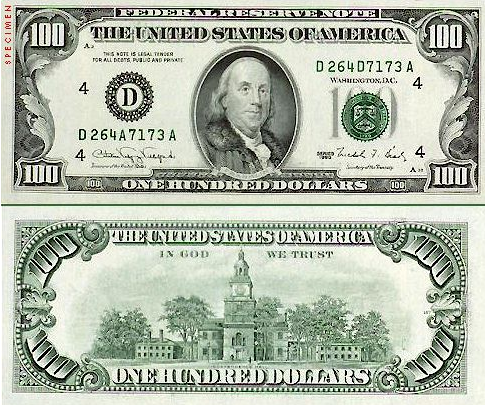
All About The Number 100

In celebration of my 100th post coming earlier this week, I figured I would discuss the number 100!!! I know, what a way to celebrate…

Applications

The number of yards in a football field.
The minimum number of yards for a par 3 hole in golf.
The number of years in a century.
The number of cents in a dollar (or pence in a pound sterling)
The boiling temperature of water at sea level, in Celsius.
The atomic number of fermium which is made by blasting plutonium with neutrons (named after the great nuclear physicist Enrico Fermi).
The number of senators in the United States Senate.
The number of tiles in a standard Scrabble set.
The basis for percentages (100% represents wholeness, purity, and perfection).
In China, tradition holds that the naming of a newborn panda must wait until the cub is 100 years old.
Pythagoreans considered 100 as divinely divine because it is the square (10^2) of the divine decad (10).
Nostradamus’ work titled “Centuries” contains 10 chapters of 100 verses each.
There are 100 squares in the 10×10 Euler (Latin or Graeco-Roman) Square. A Latin square consists of sets of the numbers 0 to 9 arranged in such a way that no orthogonal (row or column) contains the same number twice. See the image above for an example of a colorful Gaeco-Roman Square for n=10 (the capability for which was discovered by E.T. Parker of Remington Rand in 1959, disproving earlier Eulerian conjectures that a 10×10 square was impossible).

In Language

“Cem” – Portuguese
“Cent” – French
“Cento” – Italian
“Cien” – Spanish
“Honderd” – Dutch
“Hundert” – German
“Hundra” – Swedish
“Hundre” – Norwegian
“Hundred” – English
“Hundrede” – Danish
“Hyaku” – Japanese
“Miyya” – Arabic
“Sad” – Farsi
“Sada” – Estonian
“Sata” – Finnish
“Sto” – Croatian, Czech, Polish
“Száz” – Hungarian
“Yibai” – Chinese
“Yüz” – Turkish

Note: “Cent” is the largest number in the French language that is in alphabetical order. And funny enough, when you spell out 2*5*10=100 in French, it’s all in alphabetical order too! (deux*cinq*dix=cent)

A Mathematical Investigation

100 = 2^2 * 5^2 (factorization of 100)
100 = (1 + 2 + 3 + 4)^2
100 = 1^3 + 2^3 + 3^3 + 4^3 = 1 + 8 + 27 + 64
100 = The sum of the first nine prime numbers (2+3+5+7+11+13+17+19+23)
100 = The sum of four pairs of prime numbers (47+53, 17+83, 3+97, 41+59)
100 = The sum of the first ten odd numbers (1 + 3 + 5 + 7 + 9 + 11 + 13 + 15 + 17 + 19)
100 = 2^6 + 6^2 making it a Leyland Number.
100 can be expressed as a sum of some of its divisors making it a semi-perfect number.
100 is divisible by the number of primes below it (25) making it a polygonal number.
100 is divisible by the sum of its digits (in both base 10 and base 4) making it a Harshad Number.
100 is the 854th to 856th digits of pi.
100 is the 3036th to 3038th digits of phi.

In numerology, 100 equals “I LOVE WISDOM TRUTH BEAUTY”
(9) + (3 + 6 + 4 + 5) + (2 + 5 + 1 + 3 + 2 + 7) + (5 + 9 + 1 + 4 + 6 + 4)

Sources / Links

A Visualization Of Deadliest Earthquakes Since 1900

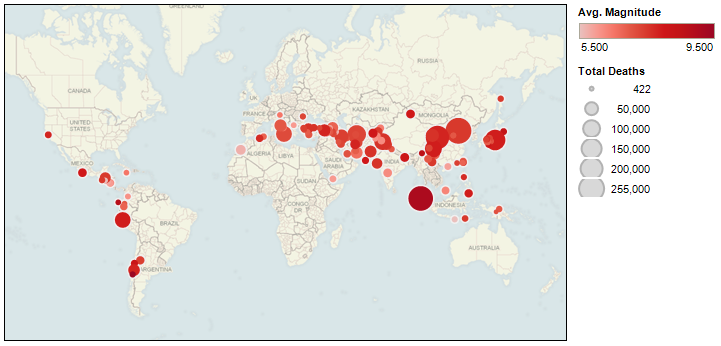
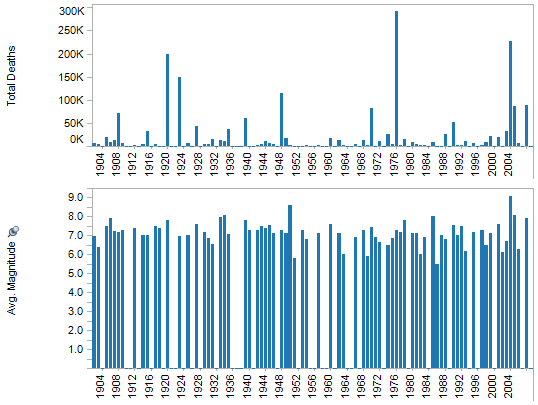
Earlier today, The Guardian DataBlog resourcefully provided a link to USGS earthquake data. The table lists all individual earthquakes that have caused 1,000 or more deaths, since 1900. Data elements include date, location, latitude, longitude, deaths, and magnitude. Below are some summary tables and a map that visualize this data. You can also click here for some USGS maps of the Haiti earthquake.

Map of Deadliest Earthquakes, 1900-2009
Dot Size = Total Deaths,
Dot Color = Average Magnitude

Summary of Deadliest Earthquakes by Year, 1900-2009

Summary of Deadliest Earthquakes by Month, 1900-2009

Investigation of Relationship Between Earthquake Magnitude and Deaths, 1900-2009

As a note for the right-side plot, I’ve cut out the earthquakes causing more than 20,000 deaths to just look at those causing between 1,000 and 20,000 deaths. Looking at the entire data set, the correlation coefficient for earthquake magnitude and total deaths is about 0.286 which represents a weak positive relationship between the two variables. Obviously, the existence of a relationship does not imply that a higher magnitude earthquake causes more total deaths, but it is insightful to identify a relationship between the two variables to inspire more investigation. Moving forward, one might investigate the data for clusters based on geo-location, decade, or season (controlled for hemisphere).

My thoughts and prayers go out to those affected by the Haiti earthquake.

Links

How Fast (Or Slow) Is The Speed Of Light?

A Little Background

The first recorded discussion regarding the speed of light was in and around 300 B.C. where Aristotle quotes Empedocles as theorizing that the light from the sun must take some time to reach the Earth. Almost two millennia later during the Scientific Revolution (circa 1620 A.D.), Descartes theorized that light was instantaneous. At about the same time, Galileo gave a more general thought that light was much faster than sound but not instantaneous, offering up some ideas as to how it might be tested using lanterns and telescopes. At what point would these theories actually be tested and how?

About half a century after Descartes and Galileo, the Danish astronomer Ole Römer began measuring the actual speed of light through observation of Io, one of Jupiter’s moons. He recognized that as the Earth and Jupiter moved in their orbits, the distance between them varied. The light from Io (reflected sunlight) took time to reach the earth, and took the longest time when the earth was furthest away.  When the Earth was furthest from Jupiter, there was an extra distance for light to travel.  The observed eclipses were furthest behind the predicted times when the earth was furthest from Jupiter.  By measuring the difference in time and using a little math, the speed of light could essentially be calculated.

From that point forward, numerous scientists tackled this quest through a diverse set of accompanying theories and experiments. The speed of light would be more accurately determined, leading to wide applications in optics, astronomy, and physics. For example, in the early 1900’s, the speed of light became a foundational component of Einstein’s theories (general and special) of relativity, proven to relate energy to mass (E=m*c^2 where c = speed of light). As a result of these applications, the calculation of the speed of light was a major platform for new scientific discovery and enlightenment.

So How Fast Is It?

Well, the measured speed of light in a vacuum is exactly 299,792,458 meters per second, often approximated as 300,000 kilometers per second (3.0 * 10^8 m/s or 3.0 * 10^5 m/s) or 186,000 miles per second. Outside of a vacuum where there might be atoms and molecules that act as impeding forces, the speed of light slows down based on the refractive index of the material. For a given substance with refractive index (n), the actual speed of light (v) is given by v=c/n where c is the constant speed of light in a vacuum. Of note:

v(air) = 299,704,764 m/s (n=1.0002926 at standard room temperature)
v(water) = 224,900,568 m/s (n=1.3330)
v(salt) = 194,166,100 m/s (n=1.544)
v(diamond) = 123,932,392 m/s (n=2.419)

Let’s put the speed of light, in air, in a bit of context…

The circumference of the Earth is about 40,000 km on average. That means that light could travel around the Earth 7.5 times in a second.

The distance between the Earth and its moon is about 380,000 km on average. It takes light about 1.27 seconds to travel from one to another. Click here for a demonstration.

On the size of our solar system, it takes light from the sun about 8 seconds to reach Earth, 43 minutes to reach Jupiter, and nearly 7 hours to pass the orbit of Pluto.

On the size of our galactic realm, the Milky Way is a spiral galaxy. Our solar system is located on what is called Orion’s arm, about 25,000 light years from the center of the Milky Way’s center. One light year is the distance light travels in one Earth year. In more earthly terms, that’s about (3*10^5 km/s)*(60 s/min)*(60 min/hr)*(24 hrs/day)*(365 days/yr) = 9,460,800,000,000 kilometers. And I thought a marathon was far.

Beyond our Milky Way galaxy and looking at our Local Group of galaxies, it extends about 4 million light years across. That means for light to run from a galaxy one side of our Local Group to a galaxy on the other side of our Local Group, it takes 4 million years. Yikes.

And our Local Group of galaxies is part of a larger “supercluster” that is 150 million light years across. The dinosaurs roamed Earth from 230 million to 65 million years ago. In other words, light from the Ursa Major and Virgo galactic clusters still hasn’t reached us if it was emitted during the extinction of dinosaurs. Makes light seem pretty slow now, no?

Whether quick relative to earthly distances or slow through vast cosmic voids, even light has meaning. It provides perspective, foundation, discovery, and well, light.

For more on the speed of light and the depths of the universe and time, I highly recommend Bill Bryson’s A Short History of Nearly Everything (it’s my favorite book).

Beef Bourguignon

Beef Bourguignon
Difficulty: Easy
Prep Time: 30 min
Cook Time: 4-8 hours

Ingredients

2-3 lbs beef (boneless pot roast)
4-6 bacon strips
4 cloves garlic
1 onion
2 handfuls baby carrots
2 handfuls mushrooms
1-2 cups red wine
Herbs de provence
Fresh ground black pepper
Parsley
Salt

Directions

Lay 2-3 strips of bacon in the bottom of the crock pot with the minced garlic and onions (cut in 1/3″ wide rings). Place the beef (cut into 4 large slabs if desired) into the crock pot. Throw mushrooms and carrots on top. Pour in the red wine and add spice to the desired taste/smell. Cook on high in crock pot for 4-5 hours or low for 6-8 hours or until meat tender and carrots soft.

Enjoy with fresh buttermilk biscuits and whipped, buttery mashed potatoes on the side.

Technology And Intelligence In The Next Decade

The below is an essay I wrote for my Technology and Intelligence class in early 2008 (STIA-432 at Georgetown University). It is meant to describe a few of the current problems faced and the nature of those problems, but not to offer up solutions. In the past year we have certainly seen the continuation of existing challenges coupled with the emergence of new ones. Today’s scientific and technological paradigm is by no means a simple one. But I do believe that with the collaboration of bright minds and the continued objective to ride and guide the progressive technological waves of the 21st century, substantial risks will be mitigated.

If History Could Tell

Since the establishment of the Office of Strategic Services in 1942 and subsequently the Central Intelligence Agency in 1947 (via the National Security Act), a core mission has been the collection and analysis of strategic, actionable information. This process has always required technology in the form of communications equipment, navigational tools, security systems, listening devices, and many more. Historically, the Intelligence Community as a whole has been way ahead of the technological curve, and in most cases, has established and controlled the curve. With information security and access to federal funds, various agencies have been given the ability to turn novel ideas into useful instruments for collection, analysis, and dissemination. However, history has become the past, and no longer dictates the way in which the world of technological development can move forward. Federal and international regulations, advancement in information theory, collaborative networks, and the global information age via the internet have all contributed to rapid, world-wide technological development that is no longer behind the IC on the tech curve. In the next decade, the Intelligence Community has the potential to fall even or behind any lines of global technological development, and as a result will find new struggles in all sources of intelligence, whether clandestine or not. Some arguments state that the IC, with some elements of special authority granted to preserve national security interests, will flourish as a developing technical lab for operations. However, the best and the brightest technical and analytical minds are not necessarily organized within the IC anymore, but rather are connected without boundary via the internet. Open-source development and the speed at which the commercial world can access capital may eventually move the IC technical approach to the back of the line.

The Whole is Greater Than the Sum of the Parts

Collaborative technologies have particularly flourished in the past five years. Social networking sites such as MySpace, Facebook, and Flickr, knowledge management platforms such as Microsoft SharePoint and TheBrain Technologies, and the entire blogosphere have accelerated communications without any distance barriers to get around. Information is passed, shared, and edited with the click of a button. SourceForge, an online network for open-source software development, has brought a vast array of new technologies to a market that never before existed. This lack of predictability for the technological market puts the IC in “catch-up” mode. Wikipedia, as well as other information warehouses, accelerates knowledge consumption for the individual – not just a business or state entity. With a horizontal, access-free, organizational structure, these applications have few barriers. Although the IC works to chase these technologies with A-Space and Intellipedia, an accompanying hierarchical structure and tiered-access system could truly dampen collaboration on a technological front.

Getting Small Could Lead To…

As the world grows in size and energy, the capability to pack information, data, and logic into smaller and smaller units continues to develop. Through nanotechnology and quantum computing, academic research groups as well as large corporations have minimized size requirements and increased processing speed in the same products. The associated power that now exists in these products outside of the Intelligence Community weakens the IC’s ongoing ability to leverage such products for foreign surveillance tactics with communications, imagery, measurements, and signals collection.

…A Much Bigger Problem

In the next decade, the IC and the United States as a whole will face incredible security and technological challenges. The tension will be increased as national policy will have to deal with finding a balance between civil liberties and national security interests. With recent information warfare events such as hacks into Pentagon computers, developmental advantages can change in an instant. International policies will also affect development within the U.S. government and could unfortunately give an edge to non-governmental organizations that have easier ability to practice CBRN weapons testing (with high-tech delivery instruments), removed from many international regulations. Unfortunately, if the Intelligence Community is to drift toward a more reactionary state, the technological and security risks become increasingly more serious.

A (New) Final Thought

It’s just as important to anticipate the wave as it is to ride and guide the wave. Surfers find waves through reaction AND proaction. The same goes for the collection, analysis, and technological development. There is more historical and real-time data than ever before. Deterministic and probabilistic models are more advanced than ever before. We can do something with all this data to find patterns and indications of technological risk. At the same time, we have more intellectual and psychological understanding of cultures around the world, and the associated mechanisms of travel, prayer, consumption, loyalty, and desire than ever before. Pairing one with the other gives us the connect-the-dot power that can truly shape our understanding and awareness of the world and the technological risks that threaten our security and sustainability as people.

The New Garage of Analytics

Analytical consulting requires more than a computer, some data, and some coding. It requires effective organization, proper communication, innovative methods, and what I call “meaning motivation” – the innate desire for insight, the curiosity for understanding, an appetite for intellectual exercise.

That having been said, I’d like to organize a new garage of analytics. These are some of the toolboxes necessary for solving complex problems in a ever complex world. These are the toolboxes we access for effective organization, proper communication, method innovation, and meaning motivation.

And in terms of process, math aligns us to break complex problems into those that are much simpler to understand and digest while still seeing the big picture and the end goal. This very much follows that concept. No problem will be exactly like another, but if we follow a similar digestion process to attack complex problems, well, at least our stomach will not be upset.

The Organizational Toolbox

The Sociological Toolbox

The Analytical Toolbox

The Visualization Toolbox

The Balance Toolbox – A step away is sometimes the best step forward.

  • Artistic Expression
  • Fitness/Exercise
  • Learning
  • Reading
  • Sleeping
  • Talking
  • Traveling
  • Writing

The Intersection Of Expertise

As I begin my job search (25 applications in 2 days so far!) I keep asking myself how to describe what I’m looking for in a job and in what realm do I wish to work? There is no specific job title that describes my experience and education (e.g. “doctor” or “software engineer”) and there is no one department in which I’ve worked or wish to work (e.g. “Operations” or “Logistics” ). Yes, I have an academic background in mathematics & statistics yet it’s difficult to communicate why I have that academic background. I do not necessarily want to become a statistician but rather I fully understand the quantitative nature of things and the power that numbers, math, and quantitative methods have in all aspects of business, government, and life.

So where does this leave me? Well, unemployed and confused, for one. But that’s okay with me. I’m confident that with my capabilities, no matter how hard they may be to communicate in an application or even to a recruiter, I’ll find the position that leverages my abilities and motivation.

That being said, I think I’m at least getting close to describing where I stand, and in real-world terms. It’s at an intersection of sorts – between quantitative methods, scientific and technological realms, and the human element. It’s interdisciplinary – can fit within any group or team or stand alone as an independent researcher or consultant. It’s also dynamic – parallels the speed with which modern business operates and the flexibility required to optimally support the needs and requirements of many types of personnel.

I’ve used a similar image a few times, in posts on knowledge innovation and math in 2010 and beyond. Here I’ve intersected three main topics while including some of my strengths in the middle. Now if I could only match those to a job title…

At what intersection do you operate?

The Ultimate Personal Dashboard

With some great technological advancements in the past decade, why am I still organizing my life in bookmarks and spreadsheets?

The next great technology needs to get more personal. We need to drop the rectangular web browser and think in higher dimensions. Let’s say iGoogle meets Macbook Dashboard meets a much better version of the new Yahoo! homepage meets the iPhone application platform. I’m talking about a secure, personal, customizable dashboard/portal through which one can live. It’s where I’ll track my information, both from the web and my mind to better organize and optimize my life. It’s where I’ll see and interact with my personal data in a comprehensively insightful yet very organized environment.

Right now, how do I track my information? Some is on the web, some is on my hard drive, and some is on paper. I have over 200 username and password combinations I use to login to various sites. I’ve got at least 250 bookmarks in 15 top-level categories. I’ve got spreadsheets that summarize my finances and visuals I’ve created to try and learn about them. For now, when I need to know something, I find the appropriate link, look up my account credentials (if not stored), and then investigate. But for those in a similar place in life, are my personal needs really that different?

If I list out all the things I do online, all the things I read online, all the information I organize on my computer, all the personal resources I access online, and all the questions I might have about myself, can I begin to minimize some clutter? Can I get Google Reader, Macbook Dashboard, iGoogle widgets, social network widgets, and personal spreadsheets in a secure, organized interface? Please?

Base

  • Accounts – Search logins by account, email, username, password, notes, date added, date updated
  • Address Book – Contact Info, birthdays, anniversaries
  • Links – Yahoo!, Google, GMail, CNN, Wolfram|Alpha
  • System Stats – Files/Folders, latest backup, storage space
  • Weather – Today’s weather, 7-day forecast, full interactive radar/satellite map

Financial

  • Bills – Due dates, billing cycles, average costs due
  • Energy Monitor – Monitor your home utilities, set “green” goals
  • Finances Monitor – Monitor stocks, IRAs, retirement, savings, checking, credit card
  • PayPal – Request/receive payments, see pending invoices
  • Subscription Management – Expected issues, renewal dates,

News/Events

  • Coming Soon – Movie releases, Tickets on sale, Upcoming concerts (Thrillist, Ticketmaster, Fandango)
  • Google Reader Tracker – Total unread, shared items, etc.
  • Local – Weekend Events (Going Out Guide, Eventful, etc.), Breaking News
  • News – CNN News Pulse
  • Sports – Scores/News

Social Media/Networking

  • Brand Monitor – See sentiment for desired keywords/terms
  • Discussion Board Monitor – Track your posts and comments, desired forums
  • Hot Topics – See trend topics and most searched items
  • Notifications – Facebook, LinkedIn, Twitter
  • Social Timeline – LinkedIn Updates, Twitter Lists, Status Updates
  • Web Analytics – Twitter Stats, Google Analytics

Entertainment

  • Movies – Times, upcoming releases, IMDB search, RottonTomatoes rankings
  • Music – Playlists, connect with Grooveshark albums, iTunes Radio, etc.
  • Photos – Flickr/Picasa portlet
  • Sports – Fantasy team tracker, favorites scoreboard, breaking news
  • TV – Guide, schedule of favorites, DVR control

Health

Lists

  • Map – Where I’ve Been, Where I want to go
  • Reading List – What I’ve Read, What I’m Reading, Connect to Amazon
  • Recipes – Saved links, suggested items, BigOven link
  • Shopping – Grocery (connect with PeaPod), Retail deals/coupons
  • Tasks / To-Do
  • Watch Lists – eBay Auction, StubHub
  • Wish List – Amazon, iTunes, Retail Stores

Utilities

  • Calculator
  • Currency Conversion
  • Dictionary/Thesaurus (Wordnik)
  • Flight Tracker
  • Job Tracker – Monster, USAJobs, search agents
  • Maps – My placemarks, directions, search locations
  • Shipment Tracker – UPS, USPS, FedEx, etc.
  • Translator

This is just a list of things I do, need, have, and want. Obviously there are a lot more to be added. It’s important to note that all of these widgets/portlets have a similar foundation that parallel the major dimensions (in light blue) I spoke about in my earlier post on the boundaries of the human condition:

Accounts – List of all companies/organizations. Information is tagged by the company and all info can be found with regards to that account, when needed.
Dates/Time – Many things are calendar-based and should be aggregated to a personal, customizable calendar view
People – Address Book is a foundational database. People can be searched throughout for linkages and notes.
Places – With the current technological trend, many needs are location-based (including news and tweets). Personal organization dashboards should leverage geo-tagging for contextualization of information to the user.

It’s also important to note that most people want information in 3 forms: a quick preview, an expanded summary, and an interactive tool. This follows closely with a recent social trend – high variability in the speed with which we move. Sometimes we want a snapshot of our current personal information because that’s all that we have – a few seconds of time. At other times, we may have a few minutes of free time, most likely coupled with a defined question or purpose:

“How much do I have in my checking account?”
“What will the weather be like this weekend?”
“Need to transfer rent money to roommate.”
“Did my package arrive safely?”
“Who has a birthday in the next month?”
“What are the hot news items of the day?”
“I want to buy a book from my Amazon wish list.”
“To which country should I travel next summer?”

And finally, this cannot be overwhelming. It needs to be there when you need it but not short circuit your mood if you don’t check it for three weeks. All charts and graphics need to be simple and interactive and customizable, but also intelligent in design to attract the most novice of digital users.

So what will the next decade bring us? Will personal desktop technology be able to fully leverage the vast amounts of data we have online, on our computers, and in our heads? Will the world become more stat-conscious, and learn to take insight from the graphical display of life data? Will the desire for a less-click lifestyle drive better personal dashboards for secure, centralized organization? I hope so.

Negative Space Is A Positive Thing

“It weighs, therefore it is.” – on the study of carbon dioxide by Joseph Black (c. 1756)

I’m currently reading The Invention of Air by Steven Johnson. It’s about the life, work, beliefs, time, and impact of Joseph Priestley – an 18th century scientist and theologian. With his life’s work, Priestley can be credited with enabling what Thomas Kuhn called a “paradigm shift” in his book The Structure of Scientific Revolutions. He did this through transparency of his experiments, thoughts, and findings, and the creation of information networks similar to the coffee shops and online forums we see today.

What I find very interesting about Priestley’s work was that he was interested in negative space – the ether surrounding the things we see and touch and feel. Although physically clear, air’s purpose and nature were not. It was not until Priestley questioned the negative space of Earth that the human race began to fully grasp the purposes of plant life, respiration, and chemistry.

Aside from with air, negative space can be found in every subject in all throughout history. In art it’s a resting place for the eye in a painting or photo. In music, it’s a purposeful section of silence. In science, it was the hypothetical medium through which electromagnetic waves travel. In Taoism is was the inaction that served more purpose than action.

Negative space is more representative than anything. It’s the unclear existences, the non-obvious relationships – that which eludes the immediate naked eye. But when sought after, the negative space provides power and energy. It shifts science into new paradigms, pushes art into new dimensions, and builds new meaning from otherwise empty space.

We should continuously embrace the negative space and utilize it for the power and meaning it can hold. Whether in a logo, painting, thought, vision, scene, or air we breathe, it’s often the negative space that brings us life.

Links