Negative Space Is A Positive Thing

“It weighs, therefore it is.” – on the study of carbon dioxide by Joseph Black (c. 1756)

I’m currently reading The Invention of Air by Steven Johnson. It’s about the life, work, beliefs, time, and impact of Joseph Priestley – an 18th century scientist and theologian. With his life’s work, Priestley can be credited with enabling what Thomas Kuhn called a “paradigm shift” in his book The Structure of Scientific Revolutions. He did this through transparency of his experiments, thoughts, and findings, and the creation of information networks similar to the coffee shops and online forums we see today.

What I find very interesting about Priestley’s work was that he was interested in negative space – the ether surrounding the things we see and touch and feel. Although physically clear, air’s purpose and nature were not. It was not until Priestley questioned the negative space of Earth that the human race began to fully grasp the purposes of plant life, respiration, and chemistry.

Aside from with air, negative space can be found in every subject in all throughout history. In art it’s a resting place for the eye in a painting or photo. In music, it’s a purposeful section of silence. In science, it was the hypothetical medium through which electromagnetic waves travel. In Taoism is was the inaction that served more purpose than action.

Negative space is more representative than anything. It’s the unclear existences, the non-obvious relationships – that which eludes the immediate naked eye. But when sought after, the negative space provides power and energy. It shifts science into new paradigms, pushes art into new dimensions, and builds new meaning from otherwise empty space.

We should continuously embrace the negative space and utilize it for the power and meaning it can hold. Whether in a logo, painting, thought, vision, scene, or air we breathe, it’s often the negative space that brings us life.

Links

Looking Back On 2009

What do you hope to accomplish in 2010?

On January 1st of every year since 2007, I’ve listed ten things I would like to accomplish in the coming year. There’s no punishment for not completing an item and there’s no reward for completing it either. However, I like to use it as a foundation for the year to come and for something to look back on in memory to see where my desires stood at the beginning of each year.

I actually did pretty well in 2009, accomplishing 8 out of my 10 items. Here they are:

1. Go Camping – Although Christine and I went to Wintergreen, Virginia for hiking etc. in the early fall, I’m not sure I can count this as we stayed in a resort cabin and not a tent at a campsite. The campfire, scenery, smell, feel, and enjoyment were all there though!

2. Write and Submit a Poem to a PublicationSubmitted some selected poems from The Adsideologist to Strong Verse, and online poetry magazine.

3. Shoot Under a 95 in Golf – Shot a 94 at East Potomac (par 72) in the early summer. Must have been the hot dogs and beers!

4. Go Skydiving – I’m not really upset to have missed this one though. I’ll find plenty of other adventure gigs with less risk (see “Human Catapult” and “Flanas Flyer” circa 1998-1999)…

5. Memorize 50 Digits of Pi – 3.14159265358979323846264338327950288419716939937510… I had it down perfectly in January but lost it soon thereafter. I’m close enough so I’m counting it.

6. Get a Pet – I became a lucky father of Lil Santino the Fish (he’s on Twitter too) in March. He is a good boy and is a lot less stressed after leaving his job at Long John Silvers back in July.

7. Go to the New Yankees Stadium – Say the Yanks lose to the Rays 9-7 on Saturday, June 6. Bummed to see a loss but such a great experience, especially considering they won the big one this year for the 27th time!

8. Consolidate Investments – Moved three old 403b accounts into a traditional IRA. It was a long process, a lot of paperwork, and time spent on the phone, but very much worth it.

9. Volunteer/Coach – Started volunteering at The Reading Connection and have been coaching an indoor soccer team (not to mention we won the championship).

10. Begin and Continue to Publish a Personal Blog – Check!

Not too bad! So what’s on my 2010 list? That’s for me to know and you to possibly find out at some point in the future. Until then, have a safe, healthy, and happy 2010!

Boundaries Of The Human Condition

“That ideas should freely spread from one to another over the globe, for the moral and mutual instruction of man, and improvement of his condition, seems to have been peculiarly and benevolently designed by nature, when she made them, like fire, expansible over all space, without lessening their density at any point, and like the air in which we breathe, move, and have our physical being, incapable of confinement or exclusive appropriation.” – Thomas Jefferson

There exist many concepts and rules by which we are bound, some of which we may be aware and some of which we may not be aware. Those concepts and rules of which we are aware exist throughout nature and space because we can observe them and learn them, manipulate them and control them, and hear them and speak them. Those concepts and rules of which we are not aware exist because we cannot observe them and learn them, manipulate them and control them, and hear them and speak them. In a sense, we are bounded by that which we can know and cannot know – although those boundaries can and will change throughout the course of history.

It’s interesting to think about our intellectual boundaries, limits, and intersections because they can be sliced and diced a thousand and one different ways. To a chef, his or her capacity may be bound by a colander, letting some things in and others out, clogged and dirty at times and crystal clear at others. To a biologist or chemist, he or she may see it as some semi-permeable membrane that expands and contracts, filters substances based on the needs of the whole system. And to an astronomer, the boundaries may be the vast unknown of our universe: with new discovery always comes more knowns coupled with more unknowns.

Regardless of the profession, it’s valuable to think about. For me, I’ll gladly wear the shoes of a different scientist each waking day but to start, here are a couple different categorizations of our intellectual boundaries, just to jot some thought.

Spatial Dimensionality

Think of our intellectual capacity as bounded by one big room. This room can grow as it’s supported by more material, can shrink with the absence of structural connections, and can lose energy with a loss of insulation, cracks in the windows, etc. It can become more complex or simple in a hour’s time with the addition or removal of new features and can take on a new look and persona with the manipulation of a few simple characteristics such as paint and fixtures. You get the point.
Walls – The walls are the support and protection, and are the primary means by which we are bound. The walls are our rules of lateral movement, being, and knowing. In a room of infinitesimal walls, we’ll find just as many corners (getting us ever close to the perfect circle) but we’ll still be limited by a surrounding perimeters. In our room, the walls are our physical concepts, our school subjects, our theorems and laws, our rules of society.

Floors – The floors are our foundation. Without the floor we would not be able to maintain our position and as a result, move from one position to another. The floors are our foundation for thought – our family, our circumstance, our physicality – our reference point.

Ceilings – The ceiling is our limit. The ceiling provides cover and security, shape and reflection, and a foundation for belief and new thought. The ceilings are our hypotheses and conjectures, our gateway to the unknown as much as it they’re the gateway for belief and clarity of vision.

Corners – The corners are the intersections of life, the crossroads of knowledge and new thought. Every corner is formed by the other structures mentioned above. The corners are the relationships, the interdisciplinary nature of life, the idea that everything is connected.

Existential Dimensionality

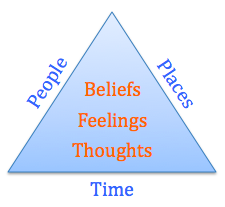
Now think a bit differently. Think that our intellectual capacity is bounded by core concepts which, when intersected, form feelings, thoughts, beliefs, and understanding. The core concepts are the things we should study – the basics of existence from which we should gain our foundations. I spoke about studying people earlier, with an overview of Archimedes. For the places, I’ll talk about some of my 2010 visits in the near future. And for time, we’ll it’s the scale by which we can make sense of history, and the perception and reasoning that comes with it. The triangulation of these three things gives an enclosure of feelings, thoughts, and beliefs that form the boundaries of our intellectual capacity.

People – We are who we are as much as we are who we’re with (and who used to be with us). To feel, learn, and think, we must understand how other people feel, learn, and think (or felt, learned, and thought). This is core to society, law, science, religion, and everything else.

Places – We are who we are in the place that we are. If I were in a different place right now, my actions, feelings, thoughts, and beliefs may be different as a result. Place is a part of circumstance which most certainly contributes to our thoughts and beliefs.

Time – We are who we are because of the historical context in which we live. Time forms this context and provides structure to the way we think, how we can act, and as a result, what we might think and believe.

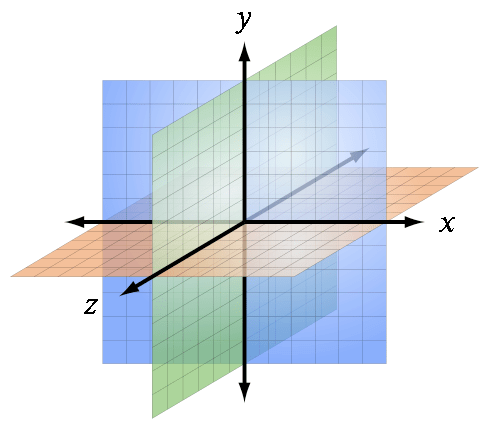
Feelings, Thoughts, & Beliefs – Our coordinates at any one time (say, x=people, y=place, z=time) describe who we are. The result of who we are is an output of feelings, thoughts, and beliefs. These form the boundaries, limits, and intersections of our intellectual capacity. Change coordinates, and we’ll find new outputs. And the most important thing to note: as with mathematical coordinate systems, there’s no limit to our coordinate system space, only to a local solid surrounding a group of coordinates. Limits may exist on my axes, by not on the coordinate system as a whole.

Links

Current DC Snow Snapshot & Stats

Well there’s lots of snow in DC! Reports say this will surpass total snowfall of any storm in the past decade, and we may have to look even farther back than that. Right now (9:30 AM ET) there is about 10 inches or so, and it’s still coming down fast and fluffy. Woohoo!

To put this in perspective, let’s look at some average monthly snowfalls for the Washington, DC area vs the rest of the United States. Data is from the National Oceanic and Atmospheric Administration (NOAA) National Climatic Data Center (NCDC) and represents the past 40 years of data for DC and (on average) 52 years for the rest of the United States. Total stations is 276, many from the weather stations at regional/national airports. Here is the raw data set (before I cleaned it up for visualization).

To note, the total average annual snowfall for Washington, DC is about 19.5 inches, while the total average annual snowfall for the rest of the United States is about 32.2 inches. This does, however, include some extreme values from Alaska (and Puerto Rico for some zeros too). The maximum annual snowfall was at Valdez, Alaska with 326.0 inches. If I was to do this comparison again, I might trim some extremes from both sides of the data set, but now it’s time to go play in the snow.

The Secret Sauce

Everyone needs a secret sauce, a blend of ingredients that when experienced, defeats all stress and evokes bliss.

Every palate is unique. The perfect combination of flavors is different for every person. The feelings evoked by a single bite may be bliss or miss, depending on a multitude of factors. As a result, every palate has its own “secret sauce”. This is that perfect combo that trumps everything.

For me, my secret sauce is exactly that – a sauce. My Nono (grandfather) has made hundreds of pans of his sauce over the years, filling his house with the smell of awesome and the aura of glee. It’s a perfect blend of vegetable and meat, spice and heat, tang and sweet. I, like so many, have taken his recipe to try and duplicate it, but to no avail. That’s a distinguishing characteristic of the secret sauce – it’s part sauce and part human. What makes it so great is that my Nono makes it and nobody else. The flavor can be closely duplicated, but the feelings and the experience as a whole cannot. I love the fact that it is made by him, he has been making it for so long, and it has made so many people full and happy over the years. That combination, with the flavor, makes me as happy as can be.

And so there’s a secret sauce of life; a secret sauce for personal delight. For each and every individual there is a unique combination of feeling and experience, not to be duplicated by any other individual, that defeats stress and evokes pure, inner bliss. Surely it could require some physical component such as a a place or a meal or a friend or a game, but it’s not about the food but the mood. The feeling and experience, like that which I own when having my Nono’s pasta sauce, is unique to me and is all I need. For you, maybe it’s Ragu. But it doesn’t matter. We need to know what our secret sauces are and how we can find them. Only then are the ingredients of the world used for the most genuine condition, the most fundamental of purposes, the being of happy.

Links

Everything Is Connected

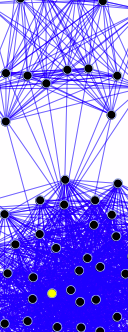
Whether it’s love and hate, birds and weather, past and future, or me and you, there are connections – both hidden and in plain sight – in everything. More than ever, we are finding that the world is a web, and I’m not just talking about the internet. That being said, the internet does help us bring some new connections to the surface through data sharing, communication, and information retrieval.

Math is a valuable support mechanism for these types of connections, especially when credible data exists that is representative of both sides of the river. It often can build the bridge to connect the shores, although it cannot always build traffic between the two.

I’ve posted before on the connections of seemingly unrelated phenomena. How can we determine where connections should (and should not) exist? How can we determine the strength and impact (both direct and potential) of such connections? What are the implications of humans controlling such connections and manipulating the bare characteristics by which some things are connected? These are questions to which we may never have an answer, but it’s important to at least ask the questions and attempt the answers. You never know where a new bridge might appear.

Whether its physical, metaphysical, mathematical, sociological, technological, chemical, theological, biological, philosophical, etc. the connections do exist. To start, we know scientific law covers the physical: Newton’s Law of Universal Gravitation tell us that every object in this universe attracts every other object with a force that is directly proportional to the product of their masses and inversely proportional to the square of the distance between their centers. For the others, well, let’s just say the bridges are infinite and are always under construction.

People Studying People

Society is people. Whether it’s business growth, intellectual advancement, government, mass media, artistic culture, knowledge transfer, sports successes, health care, economic development, or charity, it all starts with people. Therefore, in order to learn about how society is shaped and how it can change, it’s imperative that we learn as much as we can about the people who have come before us.

One purpose of my blog is to organize information about influential people of the past and present to try and pass this information on to others. Adsideology very much follows this notion – that life is about people, and we should study people to become people. I do recognize that the more diverse the people, the more wholesome the information gained. However, I’ll probably start with some mathematicians as I’ve recently bought a few books on the great ones in history.

As a start, let’s think of some numbers. Solely focusing on Earth, how many people have ever lived? Most estimates fall around 100 billion total. The interesting note about this number is that with a current population of over 6.7 billion, this means that almost 7% of people ever born in the history of Earth are living today. In other words, only 93% of people ever born have ever died! Pretty wild to think about, right?

On Knowledge Innovation

I want to quickly mention a correlating note regarding knowledge innovation for the future – how new thought can best be stimulated given the current state of society. It is clear that one pillar of innovation will always be people – the human component. Even in a world growing in reliance on information services, the human component will always remain. I’ve posted previously on the need for the human component in future mathematics initiatives as well as the need for expanded human intervention for optimized search technologies. The fact is, the human component will always be there. Common sense, yes, but commonly understood, maybe not.

Links

Welcome To The New KevinBerardinelli.com

Please update your bookmarks, RSS readers, etc. and point them to my new site http://kevinberardinelli.com

I have integrated both my blog and my personal website using WordPress as a platform. I previously used Blogger/Blogspot, Google Sites, and a standard html code hosted on a Georgetown web server to make my life public. But now I’m giving the reigns to WordPress as the platform. Hopefully I’ll be able to host the code myself in the near future, but for now I’m happy with the change. If you have any questions about how to use WordPress, how to purchase and manage your own domains, how to blog, or how to start a website, just ask and I’ll be glad to help!

My site will have everything in one spot, new blog posts, scores/schedules/stats for my intramural sport teams, my Twitter feed, my recipes, and other content on topics I’m interested in, such as math and technology.

As a note, my domain http://www.adsideology.com will soon forward to http://kevinberardinelli.com so please use the latter for all your records. Thanks!

Past Images of My Site and Blog


the mind as a map

The human mind should work much like modern mapping and camera technology – zoom, pan, adjust, layer, interact – and export too.

At any moment, the majority of minds fall into one of two categories: big and strategic, or focused and tactical. But as changing times require changing minds, the third category has emerged: the dynamic and balanced. This category can be seen as a mix of the first two, instantaneously being able to function based on the attributes of the surrounding medium.

These minds are very much like new cameras, mapping applications, GPS tools, and related emerging technologies. They build a informative picture for a user, based off organized databases and knowledge bases, and allow a level of functional interaction to continuously feed new information to that user. These functionalities, when applied to the human mind, are all essential for continued growth in a rapidly changing (and unpredictable) society.

Zoom

  • Act as a lens. Be able to zoom in and out from a single focal point. For any given topic, the mind must be able to pay attention to the smallest of details while still being able to see the big picture. Understand the color and shape of the individual puzzle pieces while at the same time seeing where that piece fits into the full picture on the puzzle box.
  • Re-focus instantaneously at every level of zoom. Purposely making pictures blurry can provide useful in some instances, but the act of focusing should be natural and automatic. 
  • Like looking at a Magic Eye or a lovely Seurat, be able to find the right level of zoom where the picture is most clear.
  • “Zoom Analytics” as I’ll call it, should be embraced as a common analytical method. It’s always been a mathematical problem solving technique, but not universally taught.

Pan

  • Need to be able to swiftly move from topic to topic, and connect those that are related.
  • Moving back to a previously-visited topic should bring quicker loading of that memory.

Adjust

  • The mind must continuously grow in dimension and adjust for core characteristics. Recognize patterns and contrasts, shapes and sizes, color and form and adjust the view and output accordingly.
  • Toggle perspective and angle to see the infinite sides of any one picture. Perspective is everything.

Layer

  • If the brain consisted of data and memory silos, the main interface should be able to integrate any combination of data and memory into a single comprehensive picture.
  • It should be able to see localized data as well as aggregate data for larger constructs. Filter data and memory based off a set of parameters, re-organize it, and feed it into the common operating picture.

Interact

  • The picture is not static. The brain must by dynamic in nature, allowing a constant influx of new information and updating of old information. 
  • Re-organization of data and memory should be consistent with the changing society in which we live. When a scientific/technological revolution occurs, the way in which our information is processed and stored must be compatible with the changes in society.

Export

  • Not every tool can do every task. That’s why exporting is good. Create a new data set from which you, or someone else, can work. Export a map or a picture that can be analyzed by another set of eyes. For the human, you must be able to transfer stored information to others, and most importantly, communicate it effectively. English is English, math is math, kml is kml.
  • Language is good because it is a standard by which we can effectively communicate. Choosing words wisely is something that should be practiced on top of a common linguistic standard. It’s one thing to speak the same language, but another to foster understanding.

And so, truly finding a balance between big and small perspectives is important. It’s important for making wise decisions, being a team player, being an effective manager, giving valuable advice, and finding optimal direction in life. So as much as you make sure you can get deep in the weeds, make sure you can easily get out.

“It’s not what you’re looking at that matters, it’s what you see.” – Henry David Thoreau

life optimization through estimation

The ability to accurately estimate a target value is an asset to any brain. Learn to hone this ability, embrace it, and use it to optimize your life.

Our lives are surrounded by invisible data – most of it in units of time, energy, space, and money. Essentially, our brains are huge folded databases that store this data, and use it to make decisions, plan ahead, and live each day. But as with many types of data, there exists some uncertainty about that data. Unknowns about how long, how big, how much, from where, until when, should i, almost enough, maybe tomorrow… well you get the picture. Our life data is filled with unknowns.

That’s why estimation is essential. Without it we’d get lost, fall behind, and lose our sense of security and awareness. Whether we know it or not, our brains constantly work to estimate and approximate values, given set of life data at that moment in time. And whether we know it or not, our brains run predictive models to assess hypothetical scenarios, basically using present life data to predict future life outcomes.

These are important realizations, and strong connections of human nature to an innate mathematical realm. Estimation is both an art and a science, as it takes creativity and thought supported by various numerical methods. Having the mathematical ability to estimate proves useful in most situations, but without the artistic component, you lose the ability to understand and contextualize your estimation.

The main point here is that estimation should be embraced as part of human nature, supported by numerical methods. This is how we can optimize our life – by recognizing the units with which our lives are measured each day, and reducing as much uncertainty in those values as humanly possible. It will not make you completely successful and happy and secure, but it will get you close.

Examples

Here are some random examples of estimation from my life. The methods of estimation vary, but the fundamental questions being asked all have outcomes of an unknown nature.

1. Shopping: Budgeting $150 for a dinner party, break budget down to categories of purchases then allocate funds accordingly. Estimate totals and percent of total budget category to make decisions on necessity.
Outcome: Go bigger on the dinner and ask a couple guests to bring desserts.

2. Sports: Ten minutes left in the game, down by 2 goals. Have two full lines of players so will sub soon and again with 4 min left. Need at least 1 goal every 4 minutes leaving a 2 min buffer to protect the tie and go for a win, should allocate 60% of strategy to offense and 40% to defense for next 8 minutes. If I’m in for 6 min and need 60% offensive mindset, how inclined should I be to make a run towards the goal, leaving my defensive position?
Outcome: Win

3. Personal Finance: How much to take out at the ATM? Need to estimate expenses for the week – lunch, happy hour, gas, dinner, cab to meeting, etc. How often will I use my credit card? Am I more inclined to spend if I have cash? Will I be near another ATM this week if I need more cash? How conservative should I be in my spending given the holiday season is arriving?
Outcome: Take out $60 and bring lunch.

4. Daily Planning: Got a hour-long meeting at 3:30pm, soccer game at 6:30pm. Assuming there will be traffic, it will take me 35 minutes to get home then 5 minutes to change, 10 to heat up leftovers, 10 to eat, and 15 to switch and fold laundry. Need 25 minutes to get to field and 15 min to warm up. Will I have enough time if my 3:30pm meeting goes long or do I need to put off the laundry and/or dinner?
Outcome: Always put off laundry, but never dinner 😉

Links

Estimating how much gold there is in the entire world
Estimating how much money there is in the entire world
Estimating the height of anything using geometry
A bit about estimation in statistics