Ask More Questions

What percent of spoken sentences are questions? How does this rate change with age? How does this rate vary based on personality, gender, level of education, or even time of day? Questions are the engine of curiosity and the fuel for understanding, innovation, and social connections. We need to ask more of them from the day we are born to the day we die.
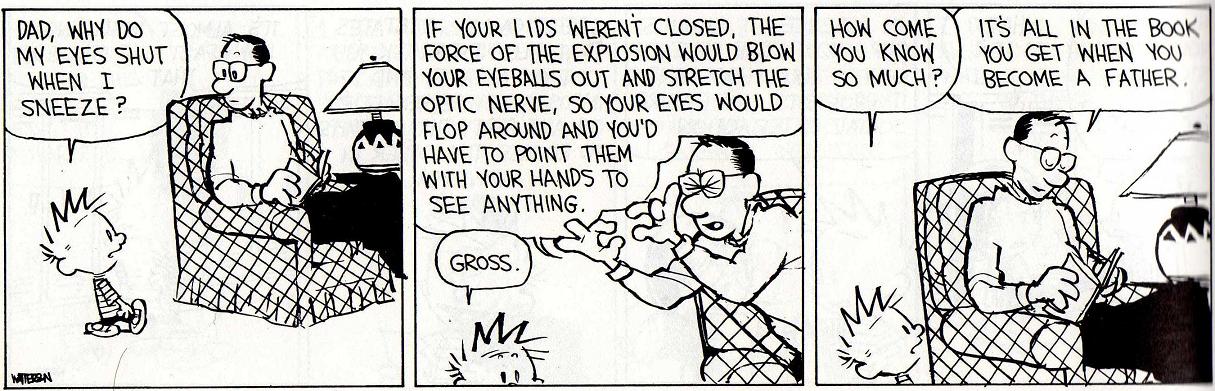
calvin question

So why are questions so important? Six obvious reasons:

  1. Education: At their core, questions are the basis for learning and understanding new concepts (as well as confirming one’s understanding of a particular concept).
  2. Advancement: Beyond the education of localized individuals, questions push the advancement of society at a regional and global scale, motivating large groups to build upon answers of the past to find new truths about life and living.
  3. Creativity: Some questions, no matter how tangential they may be to a core topic, are the sparks for creativity and innovative thought for both individuals and groups (no matter how large).
  4. Connections: Questions create dialogue and are two-way (and often multi-way) streets that create bonds between people.
  5. Assessment: Questions are tools through which one can gain a remarkable amount of information on an individual – seeing how they react and respond to certain situations – to determine fit for friendship, collaboration, leadership, or even love.
  6. Identity: Questions do not need to be spoken, but often are the most powerful when internalized in an effort to formalize one’s beliefs, attitudes, and values.

Relevant Links/Articles

Some Statistics on Civil Wars

The Economist: “How to Stop the Fighting, Sometimes” (11/09/2013)

File:Ongoing military conflicts.png

I’m always very impressed with how The Economist weaves statistics (seemingly very credible ones) into its articles. In some cases they are the baseline from which the writer provides opinion, context, and insight. In other cases, they are the context – supporting a strong central theory with some quantitative love.

The recent article on civil wars was both informative on the subject of civil wars as well as a prime example of how powerful statistics can provide essential context to a central theory. Some of the most interesting statistics extracted from the article include:

  • Of the 150 large intrastate wars since 1945, fewer than 10 are ongoing.
  • The rate at which civil wars start is the same today as it has been for 60 years; they kick off every year in 1-2% of countries.
  • The average length of civil wars dropped from 4.6 to 3.7 years after 1991.
  • From 1945-1989, civil war afflicted 18% of the world’s nations.
  • Since 1989, victory for one side has only occurred in 13% of cases (compared to 58% before 1989).
  • Since 1989, negotiated endings have occurred in almost 40% of cases (compared to 10% before 1989).
  • Leadership changes are a factor in the termination of between 25-40% of civil wars.
  • Since its founding, the UN has completed 53 peacekeeping missions. The 15 ongoing ones employ almost 100,000 in uniform.

It seems a good chunk of data came from the Centre for the Study of Civil War at the Peace Research Institute Oslo (PRIO). Very cool. Image is from Wikipedia and shows ongoing military conflicts around the world (major in red, minor in orange).

Project Management Body of Knowledge (PMBOK) Notes – Project Integration Management (Chapter 4)

Project Management Body of Knowledge (PMBOK) Guide 4th Edition
Chapter 4 – Project Integration Management

Core Definitions

  • Project Integration Management (PIM) – Includes the processes and activities needed to identify, define, combine, unify, and coordinate the various processes and project management activities within the Project Management Process Groups. PIM is utilized in situations where individual processes interact.
  • Project Charter – The project charter formally authorizes a project or a phase, documents initial requirements that satisfy the stakeholders’ needs and expectations, establishes a partnership between the performing organization and the requesting organization (or customer), and links the project to the strategy and ongoing work of the organization.
  • Statement of Work (SOW) – A narrative description of products or services to be delivered by the project.
  • Business Case (or similar document) – Provides the necessary information from a business standpoint to determine whether or not the project is worth the required investment.
  • Project Management Plan – The Project Management Plan, which may include one or more subsidiary plans, defines how the project is executed, monitored and controlled, and closed, and baselines schedule, scope, etc.
  • Change Requests – Documented requests which may modify project policies or procedures, project scope, project cost or budget, project schedule, or project quality as a result of issues found while project work is being performed.
  • Monitoring – Includes collecting, measuring, and distributing performance information, and assessing measurements and trends to effect process improvements. Continuous monitoring gives the project management team insight into the health of the project, and identifies any areas that may require special attention.
  • Control – Includes determining corrective or preventive actions or replanning and following up on action plans to determine if the actions taken resolved the performance issue.
  • Integrated Change Control – The process of reviewing all change requests, approving changes and managing changes to the deliverables, organizational process assets, project documents and the project management plan.

General Notes

  • (4.0) Project Integration Management (PIM) Processes:
    • Develop Project Charter
    • Develop Project Management Plan
    • Direct and Manage Project Execution
    • Monitor and Control Project Work
    • Perform Integrated Change Control
    • Close Project or Phase
  • (4.1) Projects are authorized by someone external to the project such as a sponsor, PMO, or portfolio steering committee. The project initiator or sponsor should be at a level that is appropriate to funding the project.
  • (4.3) The Direct and Manage Project Execution process includes creating project deliverables, staffing/training/managing project team members, establishing/managing project communications channels (internal and external to project team), documenting of corrective actions, preventive actions, and defect repairs, and much more.
  • (4.5) Changes may be requested by any stakeholder involved with the project, should always be recorded in written form and entered into the change/configuration management system, and may require information on estimated time and/or cost impacts.
  • (4.6) Closing a project may include actions/activities necessary to: a) satisfy completion or exit criteria for the phase or project; b) transfer the project’s products, services, or results to the next phase, production, and/or operations; and c) collect project or phase records, audit process success or failure, gather lessons learned and archive project information for future use by the organization.

A Universal Concept Classification Framework (UCCF)

Background

Whether it’s for building the perfect chapter title, analyzing existing literature, or maybe just a personal etymological adventure,  there is usefulness in providing quantitative context to words and concepts. Should such a framework exist, it should be easy-to-understand and broadly applicable for authors, students, and other individuals alike.

The Universal Concept Classification Framework (UCCF) proposed below involves five categories in which any word/concept can be scored. Each category’s score has range [0,20], spanning the full spectrum of possible values across each category. Where possible, the highest possible score for each category (20) should represent the more complex end of the spectrum (see below). The individual scores can then be summed to give a combined UCCF Score with range [0,100].

The individual category scores as well as the combined UCCF Score provide an easy way for readers and writers to understand and analyze the relative impact of certain words/concepts on readers, among other applications.

Universal Concept Classification Framework (UCCF)

  • Get (Concrete=0, Abstract=20): Low scores represent words/concepts that are concrete, tangible, well-defined, and easy to understand. High scores represent words/concepts that are abstract and open to interpretation.
  • Act (Controllable=0, Uncontrollable=20): Low scores represent words/concepts that are controllable, created, and/or driven by an individual, group, or machine. High scores represent words/concepts that are by nature uncontrollable.
  • Dim (Independent=0, Dependent=20): Low scores represent words/concepts that are independent of other words/concepts and can stand alone for meaning and interpretation. High scores represent words/concepts that are complex, very dependent upon other words/concepts, and are often very interconnected to support interpretation.
  • Set (Known=0, Changing/Unknown=20): Low scores represent words/concepts that are very well known and not subject to change in meaning or interpretation across time, language, and society. High scores represent words/concepts that change rapidly or may be universally undefined across time, language, and society.
  • Rad (Plain=0, Intriguing=20): Low scores represent words/concepts that are plain and without dimension. High scores represent words/concepts that are multidimensional, mysterious, and full of intrigue.

Limitations/Applications

No framework is without fault, and especially in the measurement of unstructured information, the UCCF certainly has limitations. However, it’s a quick and easy way to begin to better understand words/concepts, and I believe this type of methodology has broad applications.

One example is in the building of book titles and chapters, where authors may want to represent a broad spectrum of word types. One type of chapter may want to maximize combined UCCF Scores, others may want to keep combined UCCF Scores to a minimum, and a third type may want to have words that cover the widest range of combined UCCF Scores.

Another application may be in the analysis of certain authors, languages, or successful books in general. Do authors write about similar concepts according to the UCCF? Is there a correlation between successful books and the UCCF Scores represented by certain titles? These types of questions could be investigated using a new quantitative approach.

In general, applying simple quantitative methods to abstract ideas can provide a new way for thinking and contextualizing decisions, such as choosing book titles, and analyzing content and content creators, such as popular authors/bloggers.

A Simple Method for Analyzing Books

A recent Pew Research Center study found the following:

  • Americans 18 and older read on average 17 books each year. 19% say they don’t read any books at all. Only 5% say they read more than 50.
  • Fewer Americans are reading books now than in 1978.
  • 64% of respondents said they find the books they read from recommendations from family members, friends, or co-workers.
  • The average reader of e-books read 24 books (the mean number) in the past 12 months; the average non-e-book consumer read an average of 15.

The first bullet above is pretty remarkable. Using 17 books/year with, let’s say, 40 years of reading (above the age of 18), that’s 680 books read in adulthood. That’s a lot.

This got me thinking about how we decide which books to buy and how our decisions on which books to buy adapt with each book that we read. Are we in tune with our changing desires and interests and is our feedback loop from both positive and negative reading experiences, well, accurate and efficient?

Some time ago, I began collecting data on my book reading experiences to allow me to analyze exactly that. Given the Pew study, I figure I’ll share my methodology in hopes it makes sense to someone else. Star ratings such as that on Amazon are certainly helpful, but my hope is to perfectly understand what works for me as to make my decisions on reading material accurate, efficient, and part of a lifelong journey for knowledge and inspiration.

Known Data Elements (Both Categorical and Quantitative)

  • Author
  • Type (Non-Fiction vs Fiction)
  • Genre (Thrillers/Suspense, Science/Technology, Current Affairs & Politics, etc.)
  • Number of Pages (using hardcover as a standard)
  • Date Published

Personal Data Inputs (upon book completion)

  • Date Completed
  • Tags/Notes
  • Readability, Flow, & Structure (RFS) – A score ranging from [0.0, 5.0] subjectively assigned to a book based on ease-of-read and the overall structure of the book.
  • Thought-Provoking, Engagement, & Educational Value (TEV) – A score ranging from [0.0, 5.0] subjectively assigned to a book based on how mentally stimulating it was in terms of knowledge and thought.
  • Entertainment, Suspense, & Likeability (ESL) – A score ranging from [0.0, 5.0] subjectively assigned to a book based on the entertainment value and overall likeability of the story, characters, and/or information presented.

Those three metrics (RFS, TEV, ESL) allow one to create a overall score for the book. My overall score is a simple sum of the three metrics, divided by the maximum possible score (15.0), and expressed as a percentage (ranging from 0% to 100%). Although I have not yet conducted any correlation studies or categorical analyses using my data (which I have for 42 books starting in Aug 2004), below is a snapshot. As for my next book, it’ll probably be a self-help guide to drop the data obsession. 🙂

Title Author Pages RFS [0,5] TEV [0,5] ESL [0,5] SCORE [0,100%]
A Short History of Nearly Everything Bill Bryson 560 4.5 5.0 4.5 93%
The Alchemist Paulo Coelho 208 4.5 4.5 4.5 90%
Life of Pi Yann Martel 336 4.5 4.0 4.5 87%
Moneyball: The Art of Winning an Unfair Game Michael Lewis 288 4.0 4.5 4.0 83%
Born to Be Good: The Science of a Meaningful Life Dacher Keltner 352 4.0 4.5 3.5 80%
The Tipping Point: How Little Things Can Make a Big Difference Malcolm Gladwell 288 4.0 4.0 4.0 80%
The Next 100 Years: A Forecast for the 21st Century George Friedman 272 4.0 4.5 3.5 80%
Super Freakonomics: Global Cooling, Patriotic Prostitutes, and Why Suicide Bombers Should Buy Life Insurance Steven Levitt; Stephen Dubner 288 4.0 4.0 4.0 80%
Super Crunchers: Why Thinking-By-Numbers is the New Way To Be Smart Ian Ayres 272 4.0 4.0 4.0 80%
The Art of Strategy: A Game Theorist’s Guide to Success in Business & Life Avinash Dixit; Barry Nalebuff 512 4.0 4.5 3.5 80%
The Long Tail: Why the Future of Business is Selling Less of More Chris Anderson 256 4.0 4.0 3.5 77%
Outliers: The Story of Success Malcolm Gladwell 309 4.0 4.0 3.5 77%
Body of Lies David Ignatius 352 4.5 3.0 4.0 77%
A Walk in the Woods: Rediscovering America on the Appalachian Trail Bill Bryson 284 3.5 4.0 3.5 73%
Kill Alex Cross James Patterson 464 4.5 2.5 4.0 73%
The Increment David Ignatius 400 4.0 2.5 4.5 73%
A Whole New Mind: Why Right-Brainers Will Rule the Future Daniel Pink 272 4.0 4.0 3.0 73%
Blink: The Power of Thinking Without Thinking Malcolm Gladwell 288 3.5 4.0 3.0 70%
Physics of the Impossible: A Scientific Exploration into the World of Phasers, Force Fields, Teleportation, and Time Travel Michio Kaku 352 3.5 4.0 3.0 70%
The Bourne Dominion Eric van Lustbader 432 3.5 2.5 4.5 70%
Fortune’s Formula: The Untold Story of the Scientific Betting System That Beat the Casinos and Wall Street William Poundstone 400 3.0 4.0 3.5 70%
The Godfather Mario Puzo 448 3.5 2.5 4.5 70%
The Sicilian Mario Puzo 410 3.5 2.5 4.5 70%
The Invention of Air: A Story of Science, Faith, Revolution, and the Birth of America Steven Johnson 272 3.0 4.0 3.0 67%
The Drunkard’s Walk: How Randomness Rules Our Lives Leonard Mlodinow 272 3.0 3.5 3.5 67%
Cross Fire James Patterson 432 4.0 1.5 4.5 67%
The Social Animal: The Hidden Sources of Love, Character, and Achievement David Brooks 448 3.5 4.5 2.0 67%
The Golden Ratio: The Story of PHI, the World’s Most Astonishing Number Mario Livio 294 3.0 4.0 2.5 63%
Physics for Future Presidents: The Science Behind the Headlines Richard Muller 354 3.0 3.5 3.0 63%
The Future of Everything: The Science of Prediction David Orrell 464 3.0 3.5 3.0 63%
The Department of Mad Scientists Michael Belfiore 320 3.0 3.0 3.5 63%
For the President’s Eyes Only: Secret Intelligence and the American Presidency from Washington to Bush Christopher Andrew 672 3.0 3.5 3.0 63%
Born Standing Up: A Comic’s Life Steve Martin 209 4.0 2.0 3.0 60%
Science is Culture: Conversations at the New Intersection of Science + Society Adam Bly (Seed Magazine) 368 2.5 3.5 3.0 60%
1491: New Revelations of the Americas Before Columbus Charles Mann 480 2.5 3.5 2.5 57%
The Curious Incident of the Dog in the Night-Time Mark Haddon 226 3.0 3.0 2.0 53%
Group Theory in the Bedroom, and Other Mathematical Diversions Brian Hayes 288 2.0 3.5 2.0 50%
Euclid in the Rainforest: Discovering Universal Truth in Logic and Math Joseph Mazur 352 2.0 3.0 2.5 50%
This is Your Brain on Music: The Science of a Human Obsession Daniel Levitin 320 2.5 3.0 1.5 47%

The Future of Analytics and Operations Research (WINFORMS Panel Discussion)

Program/Title: The Future of Analytics and Operations Research
Organization: Washington, DC Chapter of the Institute for Operations Research and the Management Sciences (WINFORMS)
Date/Time: Tue February 21, 2012 1800-2030 EST
Description: The exponential explosion in the amount of data available has spawned a new field: “analytics.” This recent arriviste is forcing the operations research (OR) community to reconsider how we work, with both clear benefits and risks – not only in areas like data integrity, but the very foundations of statistical problem-solving. How do we define analytics, and how does analytics relate to OR? What is the future of analytics? We’ll ask these provocative questions and others to three of our best OR intellectuals in the Washington DC area.

General Notes / Topics of Discussion

  • The difference between having an “outcomes focus” versus a “process focus”
  • Scope of similar disciplines – analytics and operations research – are they competing or allied?
  • Communication to decision makers critical – how are these skills being developed in both disciplines?
  • Philosophy of science / having the “soft skills” – is this taught, learned, or experienced?
  • When to shy away from problems – lack of customer support, intended answer, etc.
  • The difference between problems and messes… which is worse?
  • Defining constraints/limitations and discussing assumptions (e.g. acceptable solutions under certain budget constraints)
  • The importance of defining (and redefining) the problem. Critical in today’s business climate.
  • Ideal skills: Hacker skills, subject matter expertise, communication skills, ability to listen, wargaming, organizational psychology, humility, natural curiosity
  • Other related disciplines: Data Science, Statistics, Business Analytics, Big Data, etc. – how do these affect the operations research community?

Further Reading / Related Links

2012 MLB Baseball Season Predictions

Well it’s Spring, baby! Time for some MLB predictions…

AL East Final Standings
New York Yankees 96-66
Boston Red Sox 92-70
Tampa Bay Rays 90-72
Toronto Blue Jays 81-81
Baltimore Orioles 65-97

Post-Season Predictions
AL East: Yankees
AL Central: Tigers
AL West: Angels
AL Wild Cards: Red Sox, Rays
Just Missed: Rangers

NL East: Phillies
NL Central: Brewers
NL West: Giants
NL Wild Card: Diamondbacks, Marlins
Just Missed: Nationals

ALCS: Yankees over Angels
NLCS: Phillies over Diamondbacks

World Series: Yankees over Phillies

GAO Reports of Interest (Feb 2012)

Reducing Duplication, Overlap and Fragmentation, Achieving Savings, and Enhancing Revenue
2012 Annual Report: GAO-12-342SP, February 28, Link
Follow-up on 2011 Report: GAO-12-453SP, February 28, Link
More Efficient and Effective Government Report: GAO-12-449T, February 28, Link
Tags: Government Operations

Department of Homeland Security: Additional Actions Needed to Strengthen Strategic Planning and Management Functions
GAO-12-382T, February 3, Link
Tags: Homeland Security

Maritime Security: Coast Guard Needs to Improve Use and Management of Interagency Operations Centers
GAO-12-202, February 13, Link
Tags: Homeland Security

Humanitarian and Development Assistance: Project Evaluations and Better Information Sharing Needed to Manage the Military’s Efforts
GAO-12-359, February 8, Link
Tags: Information Management, International Affairs

Cybersecurity: Challenges in Securing the Modernized Electricity Grid
GAO-12-507T, February 28, Link
Tags: Information Security

Information Technology: Departments of Defense and Energy Need to Address Potentially Duplicative Investments
GAO-12-241, February 17, Link
Tags: Information Technology

Information Technology: Potentially Duplicative Investments Exist at the Departments of Defense and Energy
GAO-12-462T, February 17, Link
Tags: Information Technology

Afghanistan: Improvements Needed to Strengthen Management of U.S. Civilian Presence
GAO-12-285, February 27, Link
Tags: International Affairs

Uncertain Political and Security Situation Challenges U.S. Efforts to Implement a Comprehensive Strategy in Yemen
GAO-12-432R, February 29, Link
Tags: International Affairs

Warfighter Support: DOD Needs Strategic Outcome-Related Goals and Visibility over Its Counter-IED Efforts
GAO-12-280, February 22, Link
Tags: National Defense

The Department of Energy’s Office of Science Uses a Multilayered Process for Prioritizing Research
GAO-12-410R, February 24, Link
Tags: Energy, Science and Technology

Emergency Communications: Various Challenges Likely to Slow Implementation of a Public Safety Broadband Network
GAO-12-343, February 22, Link
Tags: Telecommunications

Three-Layer “ChiQuiAvo” (Chicken, Quinoa, & Avocado) Fajitas

Three-Layer “ChiQuiAvo” Fajitas

Ingredients
Chicken Breast
Onion
Bell Pepper
Jalapeno
Salsa (recommend Medium)
Black Beans
Quinoa
Avocado
Tomato
Lime
Soft Tortilla Shells (recommend whole wheat)
Herbs/Seasonings (Cilantro, Oregano, Cumin, Chili Powder, Salt)
Hot Sauce (recommend Frank’s or Texas Pete’s)

Directions
There are three main layers/parts to this, each customizable to your tastebuds (and mood):

  1. Chicken, Onions & Peppers – Cook full chicken breasts with chopped onions and peppers, herbs/seasonings, and some salsa (for other flavorful liquid) in crock pot on low for 6-8 hours. When ready, drain excess moisture (leaving some) from crock pot, shred chicken, and add additional herbs/seasonings to taste. Let sit in crock pot on warm.
  2. Quinoa & Black Beans – Cook separately, then combine (or leave separately). Corn can be added too if desired.
  3. Avocado, Tomato, Onion, & Lime – Chunk, chop, squeeze, and mix. Ideally, this should sit covered in fridge for 30 min before use.

Assemble/layer the above across a soft tortilla shell, garnish with fresh cilantro (optional), squeeze some lime, dash some hot sauce, and devour multiple. Chase with a good nap 🙂

GAO Reports of Interest (Jan 2012)

Science, Technology, Engineering, and Mathematics Education: Strategic Planning Needed to Better Manage Overlapping Programs across Multiple Agencies
GAO-12-108, January 20, Link
Tags: Education, Science and Technology

Science, Technology, Engineering, and Mathematics Education: Survey of Federal Programs (GAO-12-110SP, January 2012), an E-supplement to GAO-12-108
GAO-12-110SP, January 20, Link
Tags: Education, Science and Technology

Chemical, Biological, Radiological, and Nuclear Risk Assessments: DHS Should Establish More Specific Guidance for Their Use
GAO-12-272, January 25, Link
Tags: Homeland Security

Critical Infrastructure Protection: Cybersecurity Guidance Is Available, but More Can Be Done to Promote Its Use
GAO-12-92, December 9, Link
Tags: Homeland Security, Information Security

Chemical Assessments: Challenges Remain with EPA’s Integrated Risk Information System Program
GAO-12-42, December 9, Link
Tags: Information Technology, Natural Resources and Environment

Defense Contracting: Improved Policies and Tools Could Help Increase Competition on DOD’s National Security Exception Procurements
GAO-12-263, January 13, Link
Tags: National Defense

Elections: Views on Implementing Federal Elections on a Weekend
GAO-12-69, January 12, Link
Tags: Government Operations

2011 Tax Filing: Processing Gains, but Taxpayer Assistance Could Be Enhanced by More Self-Service Tools
GAO-12-176, December 15, Link
Tags: Tax Policy and Administration