happy pi day!!!

Shapes. Spirals. Belief. Skepticism. Hunger. Conflict. Love. Anger. Space. Time.

All are forever and irrational – think about it. It’s exemplary of why pi is so unique. Irrationality is a concept applicable to many aspects of life, and to mentally grasp what it means to be irrational is an exercise in itself. In a numerical sense, pi is the ratio of a circle’s circumference to its diameter. Simple, right? But a circle, so perfect, is no ordinary thing.

Today is Pi Day, March 14th (3/14). Take a minute or two and do a web search for “pi”. Read the wikipedia article. You’ll see it’s not just a number but a reflection of many aspects of life.

Don’t you notice why so many desserts are round? That’s what everyone enjoys about them; you can have your pi and eat it too.

garden layout

Well, here’s my tentative garden layout. You’ll notice a nice spot for a few camping chairs I bought today as well as a cooler and my tool chest. I’m debating on whether to use a large umbrella or to try and build a strong canopy to create the shade. 

The specific vegetables, herbs, and fruits that I have listed are subject to change, but are most likely to be the real deal. I still have a LOT of work to do in the coming weeks to till the soil and build the beds, but I’m very much looking forward to it. Let’s hope for a successful season in the garden and I’ll be sure to post updates on my progress!

on color

Color is an aspect of everyone. Everything you do involves color. Even if you can’t see it, you can always feel it, smell it, hear it, and even think it. Think about the sun and you think blazing hot orange, the soothing heat, glowing sky, radiating warmth, sometimes dry air, sometimes humid and dense air. Think about baseball and you think bold green grass contrasted with light sandy dirt, the bold uniform colors, the red seams gripping your fingers as they are protruding from the ball, the crack of the wooden bat as the white ball contrasts through the blue summer sky. You get the point – and you can do this with any color or object or verb or thought.

The idea is that color is critical in development of a healthy psyche. The education/schooling system (along with the home) need to leverage color to stimulate the mind and ensure children are absorbing what they are being taught, in the environment which surrounds them.

Research in color can go a long way. I found an interesting synopsis of a study done within a School Planning and Management group. It talks about developing positive color schemes within schools at appropriate age groups and within appropriate subject areas. For example, the primary colors that work with young children aren’t so fashionable for the mind of a teenager. Teens want the cool colors of ultramarine, baby blue, orange, etc. The article also talks about using variety in color, using contrasting colors to make an effective presentation, and trying not to over-stimulate the student.

In my opinion, color should be a part of every lesson plan, and engaging the mind in this manner is essential to developing the balance in psyche that leads to a happy and healthy society.

“The purest and most thoughtful minds are those which love color the most.”
– John Ruskin

the visual toolbox

I thoroughly enjoyed Jock Mackinlay’s recent paper on “Designing Great Visualizations”. He contextualizes his insights with a good historical background of the true pioneers such as William Playfair, Dr. John Snow, Charles Minard, and Jacques Bertin as well as more recent theoretical and technological drivers such as Edward Tufte, Ben Schneiderman, Chris Stolte, and Mackinlay himself.

I’m in total agreement that the visual toolbox grows with a better understanding of data fundamentals and software extensibility. His explanations of data types (nominal, ordinal, and quantitative) and possible representations of data (position, length, area, angle, time, space, shape, color) help explore the complexities of human perception and data analysis. To take it further, I included an image describing a good 4-step personal framework for applying my own visual toolbox.

For me, this read is good timing too. As I’m currently reading Daniel Pink’s A Whole New Mind there is an interesting connection between those intricacies of perception, visualization, analysis, and the study of your brain’s hemispherical alignment (here’s one test to see what you might be). How do left brainers interpret an image, as opposed to a right brainer? Based on Pink’s book, the delivery, interpretation, and outcome might all be different. Good stuff.

geometry in soccer

Soccer is a beautiful game of people and sciences: psychology (see post: mind-bend it like beckham), biology, and among others, mathematics. In particular, geometry can be found in almost all aspects of the game. To the standard viewer, these applications may not seem obvious. It probably looks like a bunch of people kicking a ball towards a common goal trying to keep another team from scoring on their own. That’s true, but it’s the science and language of movements that make one team beat another.

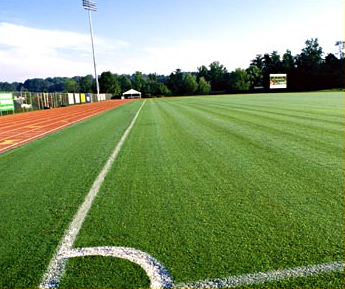
First, the simple applications of geometry and topology in soccer. The field is rectangular in shape with other shapes creating boundaries, halves, penalty boxes, corners, and goals. The field is geometrically symmetrical. The ball is semi-spherical adding it’s own element in shot curvature, reflections, etc. The shot itself must take on a very calculated velocity (angle + speed). Passing with a give-and-go, long ball, or off the wall indoors are all derivatives of geometric shapes. Using a wide-angled pass is less probable to be intercepted than a “square” pass. The wall aims to accomplish much of what a goalie does against a breakaway: take away the angle. Setting up a wall at 1o yrds or a goalie coming off a line reduce the target for a shooter. The cross must be a calculated trajectory, usually bending in or out to give more advantage to the goal-scoring team. Bending out allows for a more forward angle versus a completely perpendicular cross which is much tougher to head towards a desired target. These are some simple components of soccer in which geometry “takes shape”.

Let’s also think about team formation and spatial distribution around the field. Formation is not random, and it’s known that having the optimal formation at any one time greatly increases the chance of achieving an objective, whether that’s scoring a goal, playing stiff defense, maintaining possession, or slowing the game pace.

Connectedness: How many neighbor nodes does the person with the ball have? How passing options are there currently? The more interconnected the 11 nodes might be, the more optimized the network.

Compactness: The team should be like an accordion that can open and close, adapt and react, become dense and spread out. Localized compactness assists in defense, spreading out opens up for offense.

In passing, triangular formation creates multiple opportunities to give-and-go. Moving without the ball to create shapes builds the passing support network that creates scoring chances. Thinking ahead of reflected or return passes based on complementary angles off your teammate will get you the ball back in stride. Combine this geometric intuition with a good mental game is key.

In all, having a locally-connected space and visualizing complementary angles is advantageous for any team. The name of the game is adaptation and proaction. Thinking 3 passes ahead, using all sciences in your toolbox both mentally and physically, and anticipating the faults of your opponent will surely increase the probability of a win. Having a kick ass shot doesn’t hurt either.

organizational cycling

It is imperative for every organization to align around common procedures. Whether it’s sales, product management, operations/production, client relations, beta testing, etc. establishment of a framework is beneficial in many ways. This is not to say that independence is a bad thing, however, no matter if the organization is big or small, a good balance of procedural alignment and individual direction is a recipe for success.

Ideally, most processes can fit into 4 main boxes forming a circle of logical steps. Binning concepts into 4 boxes allows for intuitive realization of processes. Studies in numerology have generally put 5 or 7 as good numbers for the human brain to process, however it is my opinion that 4 is a good cyclical standard. This is because it is even and natural to break down into two pairs, where a pair is then recognized as one (e.g. ying and yang, ernie and bert, salt and pepper).

I think the sales meeting cycle is a good example of a process in need of procedural definition. the image is an example of a 4-step sales meeting cycle, binning components within the process and looping for continuous flow. This is just a framework to follow that can assist in other organizational elements, such as quality control, effective communication, annual reviews, strategic sales assessments, and technical developments. If each participating member/employee can think along each step, their brain will be triggered with preparation needs, innovations, self-confidence, and self-awareness. Especially in sales, these are all positive elements in moving forward as a team.

Anyways, the point here is that whether in a start-up or very old organization, it’s important to get things on paper, and procedural frameworks are a good start. These are not to be hard-coded into our brains, but general cycles to follow and refer to when necessary. Visually, they will trigger the effective communication and commonality needed for teamwork, and allow for innovation and confidence needed for positive individual contribution. balance is beautiful.
“Last night I was laying in bed looking up at the stars and sky and I thought to myself, where the heck is the ceiling?”

interconnectedness

I just read the Global Risks 2009 report from the World Economic Forum. It details the breadth of risks faced by the entire globe in addition to full descriptions of new and emerging risks such as global governance gaps. It also, with some hints to their algorithms & methodology in Appendix II, plots the risks based on likelihood and severity (in terms of dollars and/or lives lost). Finally, it shows the interconnectedness of such risks with a good little link analysis diagram, where thickness of the connectors depict the strength of connection.
It’s a good (but lengthy) read for anyone trying to understand the state of the world, and a good follow-up to Obama’s speech last night. He mentioned several of these risks and this report surely helps contextualize the risk network. In a sense, no one problem can be solved independently, but must be considered in conjunction with several other problems.

With regards to Obama’s speech in general, I’d like to focus on the optimism posed in his closing remarks. I love the ending and think it should resonate throughout his presidency and beyond:

“We are not quitters.

These words and these stories tell us something about the spirit of the people who sent us here. They tell us that even in the most trying times, amid the most difficult circumstances, there is a generosity, a resilience, a decency and a determination that perseveres, a willingness to take responsibility for our future and for posterity.

Their resolve must be our inspiration. Their concerns must be our cause. And we must show them and all our people that we are equal to the task before us.

I know that we haven’t agreed on every issue thus far, and there are surely times in the future when we will part ways. But I also know that every American who is sitting here tonight loves this country and wants it to succeed. That must be the starting point for every debate we have in the coming months, and where we return after those debates are done. That is the foundation on which the American people expect us to build common ground.

And if we do — if we come together and lift this nation from the depths of this crisis, if we put our people back to work and restart the engine of our prosperity, if we confront without fear the challenges of our time and summon that enduring spirit of an America that does not quit, then someday years from now our children can tell their children that this was the time when we performed, in the words that are carved into this very chamber, “something worthy to be remembered.” Thank you, God bless you, and may God bless the United States of America.”

Great finish, Obama. As an added point, the line about starting and finishing every debate with the acknowledgement of common goals and foundations should especially resonate all over. In a classroom, soccer field, corporation, or on the street – there is always some common goal, foundation, or bond that should keep everyone together. Whether this is what Newton was describing with his Law of Universal Gravitation between two masses, who knows.

“An expert is a person who has made all the mistakes that can be made in a very narrow field.”
– Niels Bohr

this year in baseball


i just wanted to throw out some predictions for this coming year in baseball. to start, here are three small reasons the yankees will win the world series this year.

1. the numbers
39 appearances (26 wins) in 106 years = in world series once every 2.7 years and a championship every 4 years. last appearance was in 2003. bound to happen.

2. the stadium
thing is awesome. no better way to bless the place than with a championship.

3. the young guns
more big names means deflected pressure and attention from cano, melky, damon, nady (if they are all still around for the year). if they can each put together some decent season numbers, the support is in place for those big names and the success runs full circle (or diamond).

Another thought: Cubbies make the World Series (but lose it to NYY)

2009 Predicted AL East Regular Season Standings
Yankees 101-61
Red Sox 95-67
Rays 84-78
Blue Jays 80-82
Orioles 72-90

the power of context

Well I’m truly working on reading for pleasure more often. I’m generally seasonal in my reading: I’ll go through weeks of consistent, nightly reading, followed by periods of addictions to Good Eats and Unwrapped (11pm and 11:30pm on Food Network) without reading. Oh well, both are fun, quality decompressors before hittin’ the hay…

That being said, I’ll hopefully post some excerpts from books I’m reading and try to provide some of my original insight if it’s not too weird.

Right now I’m trying to finish up Malcolm Gladwell’s The Tipping Point, which talks about the social epidemics that surround us in our lives (e.g. Blue Clue’s and NYC crime in 1980’s and 1990’s). The book digests the onset of such epidemics into three rules: The Law of the Few, The Stickiness Factor, and the Power of Context. You can read into these more on Gladwell’s own site and/or on Wikipedia which does a decent job of explaining the book.

With respect to The Power of Context, Gladwell says that human behavior is strongly influenced by the situational environment. For the NYC example, crime dropped when graffiti was cleaned off subway cars and fare-cheaters were booked. As the environment was cleaned, so were the behaviors of potential criminals.

In particular, I enjoy Gladwell’s relation of The Power of Context to Walter Mischel’s (Dept of Psych, Columbia / Wikipedia) research on personality psychology. Mischel’s research speaks to how people tend to perceive and define other people in simplified ways, such as aggressive, kind, honest, or patient. However, in reality we are all complex, multifaceted individuals who respond in different ways at different times depending on the dynamic elements of our environment (who we are with, what we are doing, where we are, when we are doing it).

To put this simpler, a person is not independent and mischievous on one day, and warm, honest, and dependent on the next day, but rather he/she is independent, mischievous, warm, honest, and dependent all together – and the impression given, of any of these traits and at any singular moment, is highly dependent upon the situation and the environment, or the context.

Pretty neat stuff – I guess it’s nice to see correlating theories and practical examples rolled up together.

“The only normal people are the ones you don’t know very well.”
– Joe Ancis

on love

Love’s great. It’s the reason people run, fight, cry, smile, think, sleep, and most of all, live. It’s the fuel that can’t be mined, refined, and sold, but is certainly clean and renewable. If you don’t have love, you just haven’t realized it’s there.

Some of my roommates and I watched Love Actually today – great flick. Hugh Grant makes a great Prime Minister and his girl Natalie is a cutey patootey. So is Aurelia, for some of the movie at least. I also like how Aurelia and the writer fall in love even though they speak completely different languages. A prime example of love knowing no bounds.

Anyways, Happy Valentine’s Day and remember, Cupid aint stupid, he’s just a baby and sometimes has bad aim.

“What lies behind us, and what lies before us are tiny matters compared to what lies within us.”
– Ralph Waldo Emerson