on complements

I’m a firm believer in complements – things coupled together, whether the relationship is apparent or not. This may not be a universal attribute, and I’m not stating it is. It’s also not limited to pairs, as complements are not two-dimensional. However, it’s a positive philosophical exercise to try and find symmetry where it may not exist so clearly, and it can certainly open up the mind beyond everyday theoretical boundaries. (1)

When I mean complements, I mean things that go together, complete each other, and make a whole. Some pairs may be opposites, yes, but complements are not two puzzle pieces forming a circle. Think of complements as spherical yins and yangs with a bunch of inner overlap.

So where can I start? How about a list of some pairs…

Characteristics – qualitative & quantitative, forward-thinking & retrospective, introverted & extroverted, hand-on & on-paper, leader & follower
Colors – black & white, light & dark, blue & orange, red & green
Words – stop & go, you & me, here & there, near & far, always & forever, mine & yours
Sounds – wind & calm, scream & whisper, ooh & ahh
Feelings – love & happiness, celebration & mourning, happy & sad, anxious & patient
Food – sweet & sour, harsh & smooth, rosemary & thyme, parmesan & romano, spaghetti & meatballs, peppers & onions, steak & wine
Partners – Jordan & Pippen, May & Walsh, Mario & Luigi, Robinson & Rodman (best NBA Jam duo), Brin & Page, Jerry & George

I believe symmetry and balance in nature is good. Breaking from that balance is also good and it’s usually is a driver of innovation, conversation, and collaboration.
Complementary teamwork is essential to making things work. The recognition of individual contributions to a team allow the spherical shape to form where overlaps provide the fuel to reaching a common end goal.

The same applies to relationships. Not one person can drive a couple to a life of love & happiness. It takes two (baby). That’s what makes couples so fun. People need other people. Not one person is a sphere but he or she needs to find a complement to build that sphere together. Sure the overlaps can create disagreement, but the result should be a more dense and stronger bond.

Well, I know I’m no Poe but I hope there is an adsideological takeaway here. Think about complements. Not everything you see, touch, or hear exists independently. Recognize individual contributions as one piece of a spherical success engine. And find your complement and don’t hesitate to make it permanent. Love & happiness will always follow.

(1) I do think the arguments made against the Qur’an on this topic are a bit absurd and biased. In some distant corner of the web-o-sphere there lies an argument that the Qur’an is wrong in stating everything exists in pairs. Not only do I think this is an invalid point of attack on a religious body, but the approach loses credibility with a lack of objectivity. One main argument is with gravity and that there is no counterpart. Well what a worldly view that is! Despite my love for the depths of physics, it still describes less than 1% of the universe. Pairs don’t equal opposites, and I know that I’ve walked on the ceiling in some of my dreams.
balancing education

Holistic education is a philosophy of education based on the premise that each person finds identity, meaning, and purpose in life through connections to the community, to the natural world, and to spiritual values such as compassion and peace. Holistic education aims to call forth from people an intrinsic reverence for life and a passionate love of learning.” 

– Ron Miller, founder of the journal “Encounter: Education for Meaning and Social Justice”

In my post titled “adsideology 2 and the one brain” I talk about the rise in interdisciplinary subjects and departments in higher education, and the need for the same in the K-12 educational system. Driving “thought mixtures” at an earlier age begins to weld the foundations of math, english, history, etc. while expanding the intellectual capacity of individuals at a young, developmental stage. Making connections for a new perspective of the world will better position the individual and those around the individual to find meaning, value, and purpose in life.

I think that’s why there needs to be a more balanced educational system. I’m not getting into the politics, inefficiencies, and the educational and opportunistic gaps that currently exist throughout the world, but am sticking to the foundation of education systems in general for now. Holistic education involves an understanding that self-actualization and the development of one’s character comes through different means and speeds. The grade number doesn’t matter, but building upon yesterday and striving for a better tomorrow does.

There needs to be more holistic education in the developmental years. The current K-12 education system emphasizes the teaching of facts, rules, skills, and discipline. However, it is missing the necessary methods of transformative learning and experiential learning. Sure, plenty of schools these days act as a community and teach about human interaction. But too much focus is on subject pillars and meeting quantifiable goals. The verticals, although important, need to be connected with horizontal layers of experience that encompass the facts and skills learned in the classroom. More emphasis should be put in teaching compassion, peace, self-respect, self-esteem, and community involvement. In my post titled “wearing other people’s shoes” I talk a bit about transformative learning and why that’s important for personal growth. A change in perspective can sometimes make all the difference, and that notion should be introduced at a young age.
I want to make it clear that holistic education is just one approach to a very large issue in education but by no means is the solution. The solution involves a balance in educational concepts and methods, and this balance should be institutionalized in the school system. A mesh of traditional, holistic, and other educational approaches is more dynamic. This allows for optimization of resources and methods for each individual student.
In the end, it’s the experiences and the relationships that make us who we are. It’s who and what we impact, not what we know. Understanding this at the earliest age will most certainly result in a life of significance, personal happiness, and community prosperity.
“Good grades show you’ve done your work; great deeds show you’ve learned your lessons.”
-Me
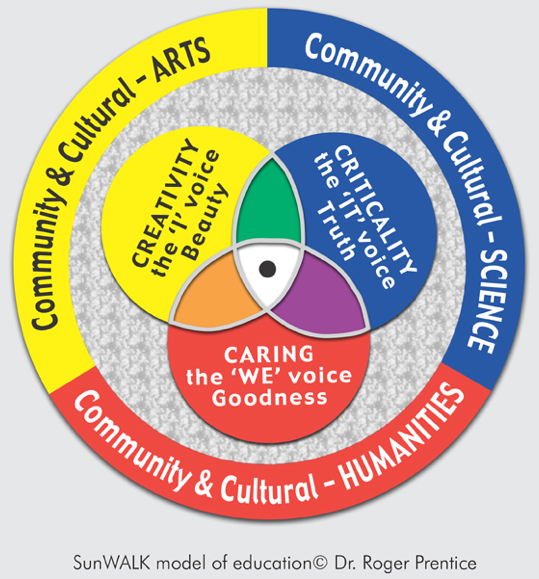
i. Top picture is the SunWALK pedagogical model of holistic education, by Dr. Roger Prentice. 
Arts, Science, Humanities + Creativity, Criticality, Caring.
ii. Bottom picture is from a Wake Alternative Break (WAB) trip I led in Spring 2005 to Virginia Beach. We were fortunate to work with the local parks & rec dept to clean up some parks and tutor in a local school. Good times.

a simple recipe that teaches a lot

In conjunction with my post on cooking, here’s a simple yet delicious dish to make. It touches on a lot of basic cooking concepts that serve as a foundation to many meals: marinating, chopping, sautéing, grilling, seasoning, and plating.

“Grilled Center-Cut Pork Loin With Fresh Tomato, Basil, Onion, & Squash Sauté Over Rotini

First I sautéed one sweet onion with one chopped summer squash, adding lots of garlic when the onions start to brown. I added spices including salt and black pepper, oregano, thyme, cayenne pepper (you can really add whatever you want here to get a taste that satisfies you). 
I then added fresh chopped vine tomatoes. When chopping, I usually remove the majority of innards & seeds as they bring too much acidity to the sauce. I like a thicker, chunkier consistency as the chunked tomatoes will cook down into a nice sauce texture and not make a soup on your plate. 
Then I added fresh chopped basil leaves and re-seasoned to taste. Cook on medium-low until it reaches a desired consistency. Such a great aroma.
Meanwhile, I grilled up butchered-thin, center-cut boneless pork loin that had been marinating for an hour or so (in italian herbs & spices, hot pepper vinegar, oil, spoon of dijon). Grilled on high heat to get some good crispy edges. 
Finally, I plated the tomato/basil/onion/squash over rotini, with the pork on side. I add lots of parmigiano reggiano to top and garnish with ground black pepper and a basil leaf or two on top. Served best with some good old 2% milk or a glass of your favorite red wine.

basil chili chicken rice

sometimes when i eat lunch
i ponder, what to add
is it bland? nah
but is it weak? yes!

i add red stuff to my meal
it is hot. not too much!
the aroma of pepper seed
the salt, tingles the tongue

mmm i blow on the top
to cool the rice and chicken
basil leaves, more please
a flavor, as it is in heaven

then down go the onion bulbs
and carrot tangled in egg
many thanks to the chef
a delightful lunch, indeed

on cooking

If I haven’t expressed it yet, I love to cook. I really love cooking. It’s a hobby, a need, a getaway, and a creative expression. I like the science behind it as much as the process, flavors, origins, and beauty of food and cooking. Vegetables, fruits, meats, cheeses, spices, sauces, pastas, rices, seafoods, herbs, and much more are all variables in a world of infinite combinations. Because something doesn’t show up in a recipe book or google search doesn’t mean it’s not good. It just means it may not have been done yet and you are the lucky one that gets to put it together!

As with a few other random things (flying, reading, creative writing, building, etc), I find it hard to believe some people don’t like cooking. I think it is more intimidation and laziness than a lack of know-how or anything else. There are so many simple yet delicious dishes one can make that the “I just don’t know how” excuse doesn’t work for me. Hit the store, talk to the butcher, ask a neighbor, jot ideas down, look at pictures, buy a book, and just go at it. If you mess up, you learn for next time.

You have to make cooking a lifelong learning process. Learn to enjoy sharing what you cook. Honest feedback from multiple palates is most valuable in adjusting for your next dish. The ongoing learning process can then move you to experiment more and trust your instincts and senses more than to just use your ability to read and follow directions. That doesn’t mean books won’t always help you.

As my mom says, everyone should have the ultimate reference book in their kitchen – The Joy of Cooking. For other old, traditional references, book sales, tag sales, and local festivals are great places for these. On the other hand, you can always find new, innovative approaches to cooking at the local book store. I just grabbed a good one the other day: Ratio – The Simple Codes Behind the Craft of Everyday Cooking (by Michael Ruhlman). If something inspires thoughts for your next cooking experience, it’s worth it.

Finally, I want to note that these days, easy access to food can almost be considered a privilege. For that reason, it’s certainly a privilege to have easy access to a wide variety of foods. So if you have a nearby grocery store, go look around. There are A LOT of foods out there that someone else might not have the chance to eat. If you get flustered, go grab some juicy California oranges and soft McIntosh apples and come back another time.

Here are links to two great food blogs to which I was referred by my friends Colleen (happy birthday!) and Heather (woop woop!). Colleen says she’ll have one of her own up soon…
Gluttony Is A Bliss
Smitten Kitchen

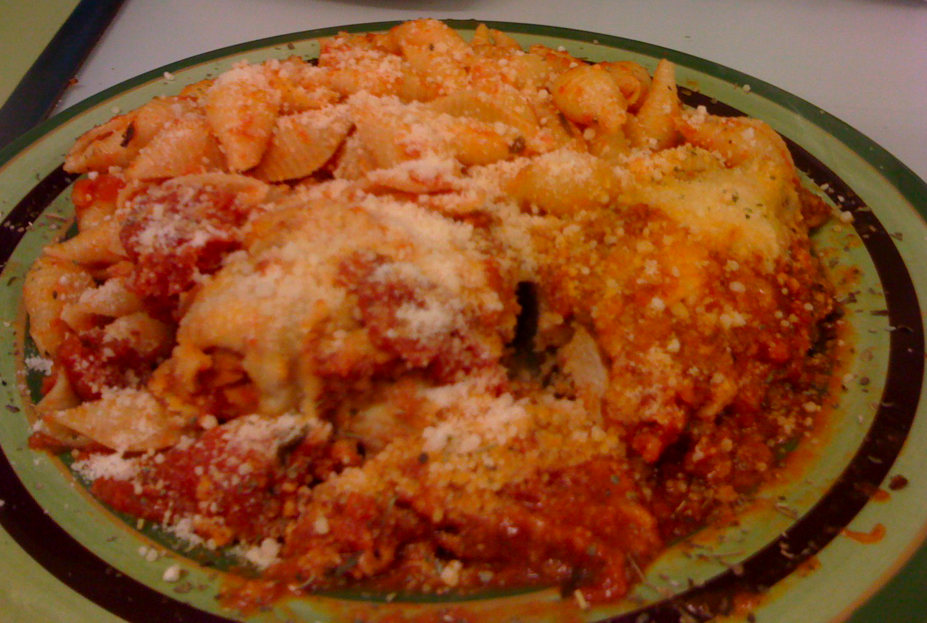
Note: Picture above is a homemade chicken parm and shells with homemade tomato sauce and fresh parmesan cheese. 

st maarten and anguilla

Well, I just got back last night from a great trip to St. Maarten. I was visiting my brother Andy, who is in med school down there, for a good 5 days / 4 nights. It was easily the best time I’ve ever had (or close to it), the most beautiful place I’ve been to in terms of look & feel, and certainly a much needed getaway from the states.

Our days consisted of drinking piña coladas in the AM and some heinekens in the PM, lounging at the beaches, touring the island, eating ribs, listening to music, traveling to Anguilla, playing beach volleyball, smoking great cigars, going to some good bars/clubs/restaurants, and taking our time to do everything. We were always full, sunny, warm, sandy, relaxed, and happy.
Considering it was pretty simple to get down there (flew through Charlotte, 1.5 and 3.5 hr flights – see SXM airplane landing here) I may just go back pretty soon. It’s really all about taking the step. I’m sure glad my brother took the step to get away and live/learn down there. I feel like a lot of people just can’t take that step, even if it’s just for the visit. Sure there are financial and other personal considerations/obligations that make that step seem too big to take, but trust that happiness and fulfillment will come with taking that step. If they don’t, then maybe try another staircase.

data visualization

The visualization of data exists at the intersection of art, science, and technology. The absence of one of these inputs leaves the viewer unsatisfied in terms of both comprehension and stimulation.

It takes both hemispheres of the brain to produce a truly outstanding graphic – a mesh of logical and analytical components with intuition and creativity. Creators must know the basics of audience, tone, color, consistency, and purpose while understanding technical and scientific limitations of particular data analyses and visualization methods/tools. Creators must also be their own best critic, and be able to ask the right questions at the right time. When done correctly, a final result should bring engaged thinking and meaning to a viewer, no matter how simple the underlying objective.

That being said, I wanted to post some interesting data viz resources to hopefully inspire new creativity and awareness around data visualization. Those are listed below. As a note, some were listed in the latest issue of AmstatNews (monthly publication for the American Statistical Association). All descriptions are from the respective websites and/or other related web resources.

Websites
Flowing Data – FlowingData explores how designers, statisticians, and computer scientists are using data to understand ourselves better – mainly through data visualization. Money spent, reps at the gym, time you waste, and personal information you enter online are all forms of data. How can we understand these data flows? Data visualization lets non-experts make sense of it all.
Gallery of Data Visualization – This Gallery of Data Visualization displays some examples of the best and worst of statistical graphics, with the view that the contrast may be useful, inform current practice, and provide some pointers to both historical and current work.
Gapminder – Gapminder is a non-profit venture promoting sustainable global development and achievement of the United Nations Millennium Development Goals by increased use and understanding of statistics and other information about social, economic and environmental development at local, national and global levels.
Graph Jam – Music & culture for people who love charts. Some recent posts include “Ways I spent my time while playing Oregon Trail in elementary school” and “Things that the Pinball Wizard does”.
IBM Many Eyes – As part of IBM’s Collaborative User Experience research group, the Many Eyes lab explores information visualizations that help people collectively make sense of data.
Information Aesthetics – Inspired by Lev Manovich’s definition of “information aesthetics”, this weblog explores the symbiotic relationship between creative design and the field of information visualization. More specifically, it collects projects that represent data or information in original or intriguing ways.
Junk Charts – Recycling chartjunk as junk art.
Marumushi Newsmap – Newsmap is an application that visually reflects the constantly changing landscape of the Google News news aggregator. A treemap visualization algorithm helps display the enormous amount of information gathered by the aggregator. Treemaps are traditionally space-constrained visualizations of information. Newsmap’s objective takes that goal a step further and provides a tool to divide information into quickly recognizable bands which, when presented together, reveal underlying patterns in news reporting across cultures and within news segments in constant change around the globe.
NameVoyager/NameMapper – This is the online home of Laura Wattenberg, author of the bestselling book The Baby Name Wizard and creator of award-winning tools that have helped the world look at baby names in a whole new way. Check NameVoyager and NameMapper which show temporal and geographic representations of any name in a simple, intuitive interface.
Optical Illusions and Visual Phenomena – Easy to spend lots of time here. These pages demonstrate visual phenomena, and ‘optical’ or ‘visual’ illusions. The latter is more appropriate, because most effects have their basis in the visual pathway, not in the optics of the eye.
Prefuse – Prefuse is an extensible software framework for helping software developers create interactive information visualization applications using the Java programming language. It can be used to build standalone applications, visual components embedded in larger applications, and web applets. Prefuse intends to greatly simplify the processes of representing and efficiently handing data, mapping data to visual representations (e.g., through spatial position, size, shape, color, etc), and interacting with the data. Flare is particularly cool.
Tableau Software Blog – Official blog for Tableau Software, a data visualization software company headquartered in Seattle. I’ve used Tableau Desktop for a few years now and can’t live without it now.
The Work of Edward Tufte and Graphics Press – Official Edward Tufte site. He is an American statistician and Professor Emeritus of statistics, information design, interface design, and political economy at Yale University. He has been described by some as “the da Vinci of Data”.
UC Berkeley Visualization Papers – A listing of papers from the visualization lab at UC Berkeley, from today back to 1995.
Visualization of Complex Networks – This site intends to be a unified resource space for anyone interested in the visualization of complex networks. The project’s main goal is to leverage a critical understanding of different visualization methods, across a series of disciplines, as diverse as Biology, Social Networks or the World Wide Web.

Well-Formed Data, Elastic Lists Demo – This is a demonstration of the “elastic list” principle for browsing multi-faceted data structures. There are additional options to create sparkline charts to show the temporal aspects of the data.
Papers / Presentations
7 Things You Should Know About Data Visualization – EduCause Learning Initiative
Artistic Data Visualization: Beyond Visual Analytics – Viégas & Wattenberg, IBM Research
Designing Great Visualizations – Jock Mackinlay, Tableau Software
Milestones in the History of Data Visualization – Friendly & Denis, York University

start using twitter

Overview What is it?
It’s an easy-to-use application that provides a unique method of networking, news gathering, and friend updates – all in an environment void of censorship or maybe professional restrictions (although there are some general guidelines to follow). Start by setting up your free account, editing settings, personalizing your page, and then researching the use a bit. TubbyBundle has a blog post that is a good resource for beginners, and hopefully the below info can help as well. As of the end of March 2009 there were over 9 million site visitors, a number more than twice that of Feb 09. It will grow more as an acquisition is close to integrating it with everyday Google products…

Definitions & Meanings What do I need to know?

Tweet – A single post of 140 characters or less using Twitter
Followers – People who follow your updates (depending on your settings, you can be open to the public, or require approval before someone becomes a follower)
Following – People whose updates you follow (depending on their setting, you may need to be approved before you can follow)

Mentions – Formerly known as “@Replies”, you can use the “@” symbol before a username to mention another twitter user in your tweet. Instead of mentioning that person by name, mention them by username using the “@” symbol before their username.
Re-Tweets – You can re-tweet something someone else posted. This is useful to spread a post to your network in cases where it may bring good value (and it properly cites the original user who posted it)
Direct Messages – You can write directly to another user that you follow (so nobody else can see that tweet but that user).
Hashtags – Unique way to follow certain topics. Follow the user “hashtags” and they will immediately request to follow you. Then the system can automatically index tags you apply to your tweets and you can follow other topics of your choosing. 
StrategyWhy am I using it and how will I use it?
Is this for business use or for personal use? Will I post news articles I find interesting? What topics would I consider interesting? Is there a niche to fill in my area of interest? Who do I want to be my audience i.e. who will I seek to follow? (news, NGOs, celebs, friends, strangers, experts, academics, etc). Consistencies are nice, but not absolutely necessary (punctuation, humor, cursing, tone, frequency, etc). In my opinion, the best strategy involves being multi-dimensional with some structure to your posts. Maintaining some level of frequency is important while using similar language/structure also helps portray your personality through each tweet, which is important to your followers. I like to post on math, science, me, hot topics, numbers, technology, blog posts, humor, sports, food, education, history. Wide range of stuff, but all within the realm of who I am. I like to post a few in the morning, few in the afternoon, and maybe in the evening on some sports or food or something of that sorts to bring the day to a close – an interesting way to decompress the day is to summarize in 140 characters – weird, right?
Additionally, link your Twitter account up with other social networking or personal applications such as Facebook, LinkedIn, personal blog, etc. Keep in mind the different audiences and who may have access to what you’re posting. If you’re Tommy Lee on Facebook but Martha Stewart on Twitter, either don’t link them or go see a psychiatrist.

Applications – What’s out there for me to use?
There are plenty of web applications, desktop applications, and phone applications to choose from. Check out the Twitter PBwiki page for a comprehensive listing. Some I’d recommend:

  • Web – Use the Twitter homepage or use Twitpic to post images.
  • Desktop – Spaz is a simple app to start if you don’t follow many people. TweetDeck is nice because you can categorize who you follow. I’d go with TweetDeck.
  • Phone – I use Twitterific on the iPhone. I’d change a lot of things on it but it works for now.


Other Resources

Spend some time on the Twitter PBwiki page listing additional resources. Click around on some as they are quite fun. Some good ways to find similar users in your location, follow topic trends, and find out how valuable your page really is. I won’t go through them all but I’ll list a few:
  • TweetValue – get a monetary value of your twitter page
  • Twitterank – see how your user rank gets better over time
  • TinyURL – shorten URLs to put in your tweets
  • Twitter Search – search the public timeline of tweets
  • TweetWheel – see connections b/n you and your friends
  • Twitter-Stats – see stats about you with a visual or two
  • WeFollow – user-generated Twitter directory
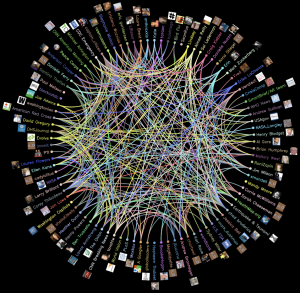
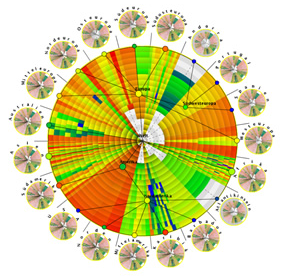
Visualization of those I follow and our shared connectivity (from TweetWheel)…
Lastly, have some fun finding value in Twitter. Go to the pages of your close friends and see who they follow, and follow them. Search on some topics and find people who post regularly on topics of interest. Find the news organizations you watch on TV. Find similar users in your area. Don’t follow everyone, but you’ll have the ability to build a network of direct contacts and a feed of real-time info that should be engaging and interesting to you as a daily web user.

a view from above

How can you not love the sky? I just took this picture from seat 15F on my flight to Chicago O’Hare. I always get a window seat when I fly because I need to see what’s out there below me and above us. This one shows some good cumulus puffs with the most awesome contrast of the clear blue sky. For loving science, and despite having multiple science classes devoted to clouds, weather, the atmosphere, and meteorology, clouds will always amaze me beyond the grasps of physical properties for some reason.

Some people are afraid of flying. I can understand why, as turbulence still makes me jittery and the ear-popping is less than comfortable. However, I can’t forgive others for not finding inspiration in flying 30,000 feet up in the air. It’s a world for imagination and reflection, not to mention a natural artistic wonder unique only to that altitude.

Perhaps the most fun parts of flying are the takeoff and approach, or in other words, zoom out and zoom in. It’s neat to see the houses get smaller and smaller as you zoom out. It’s fun to begin to recognize specific neighborhoods, buildings, or characteristics of the land as you zoom in. Swimming pools become stand outs in the summer. Snow truly looks like a blanket in the winter.

I like to think about history when I’m up in the sky. Scientists, astronomers, philosophers, and the rest of the general population never had the luxury to see above the clouds like I can. I wonder if science and discovery would have taken place differently had the Greeks been able to see down on the earth and up into the sky from 30,000 ft up in the air. I wonder if they’d serve grape leaves on their flights?

Either way, that was a good nap. Time to zoom in now.

“Above the cloud with its shadow is the star with its light. Above all things reverence thyself.”
–  Pythagoras

knowledge management and organizational learning

Organizations are built and sustained by the collective brain power of its members. But that collective brain power is only as good as the memory that serves it up. And so was defined knowledge management.

Fundamentally, knowledge management (KM) is the effective administration of people, processes, technology, and information.* In encapsulates the concept of organizational knowledge/learning, which is the collection of facts, methods, and expertise by a group of people for dissemination and use. These days, the wide scope of new organizational knowledge coupled with the speed at which it gets developed leads to a distinct requirement to capture and centralize the knowledge. As a result, innovators and thinkers will be enabled to collectively work toward building new products and technologies while feeding back into the cycle of strategic thought.

Knowledge is king. Storing, sharing, and learning from it is royalty. This realization has progressed over the past decade or so into a “google”plex dollar business (“googolplex” is my favorite number – i’ll post on it at some point). But why are some organizations and some people so resistant to implementing proper KM practices?
Knowledge management needs to be part of every company strategy and needs to be ingrained in each of its four main components: people, processes, technology, and information. It should branch into all departments – and for each become the engine of collaboration and the backbone of innovative thought. Whatever technology is implemented to enable effective knowledge management, it should have dedicated support, alignment with existing security protocols, and proper branding and marketability as an engaging tool to use.

The benefits must also be made visible. Incentivize users to contribute knowledge in a semi-structured form. Make it something that is talked about in meetings, used in positive performance evaluations, built into non-work related worlds (as a place to “escape”), and an activity that is comforting and welcome amongst all levels of employees.

Within specific job functions, it’ll open up opportunities for valuable feedback. Jeff Lash, from his “How To Be A Good Product Manager” blog, has a good post on knowledge sharing and its benefits within Product Management. Everyone has “lessons to share, but even more to learn” he says. This philosophy is applicable to everyone and every job function – technical development, analysis, sales, marketing, management, etc. That’s why KM is necessary for innovation and success and as part of an over-arching business strategy. The improvement of learning across the organization will be measurable in every day communication, work efficiency, and eventually, revenues. 

Lastly, it’s worth noting that with KM, the design and implementation effort is a topic of its own (of which I’m quite fond). But hey, strategize first.

*Other definitions can be found on the KM Forum.