on circles: simplicity and perfection

Within the bounds of modern human cognition, the circle is the most basic – but also the most perfect – shape.

I really enjoyed (and highly recommend) the recent New York Times piece titled “The Circular Logic of the Universe” by Natalie Angier. In this article, Angier makes reference to circles of both natural and man-made origin, discussing their physical characteristics and their often debated meanings.

Angier also uses the Russian artist and theorist Wassily Kandinsky‘s piece “Several Circles” (image above) as a foundation for her article. Wassily Kandinsky found interest in the abstract and concrete nature of shapes, delicately balancing geometry as a science and an art.

“The circle is the most modest form, but asserts itself unconditionally. It is simultaneously stable and unstable, loud and soft, a single tension that carries countless tensions within it.”

β€œThe circle, is the synthesis of the greatest oppositions. It combines the concentric and the eccentric in a single form and in equilibrium. Of the three primary forms, it points most clearly to the fourth dimension.”

Some of this stuff is pretty wild if you take a moment and think about it. Circles are everywhere and have been researched for millennia. The earliest known use of the wheel was around 3500 B.C. My current reading “Of Men and Numbers” by Janet Muir talks at length about Archimedes’ (and others’) mathematical discoveries and engineering feats regarding the circle well over two thousand years ago! Fast forward and we are still researching and finding new meaning in circles today – in engineering, cosmology, social science, mathematics and every other knowledge branch.

I guess it’s safe to say that new questions will continuously arise for which we may never find an answer – for all things, circles included. No matter how simple they seem or how perfect they look, the wheels will always go round and round.
spaghetti squash with meat sauce and zucchini

Spaghetti Squash with Meat Sauce and Zucchini

Prep Time: 15 Minutes
Cook Time: 60-80 Minutes
Difficulty: Easy/Medium

Background
So my father has been telling me about his spaghetti squash revelation and now he’s finally (and thankfully) forced it upon me. Upon arrival to the train station for my return trip to DC, he shoved a nice sized spaghetti squash into my bag and sent some accompanying instructions later that night via email.

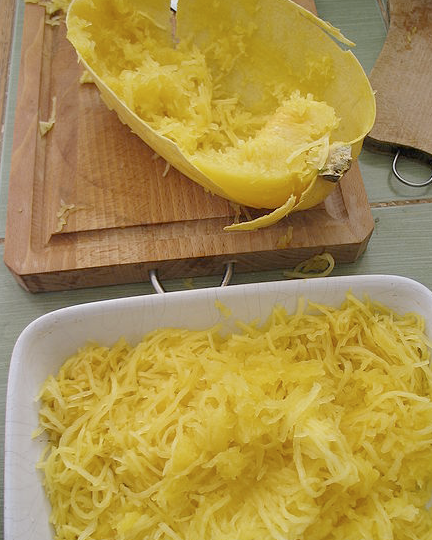
Spaghetti squash is very unique. It’s a vegetable but looks, feels, and even pretty much tastes like real spaghetti. It’s also quite healthy – only 75 calories per 8 cooked ounces and full of vitamins (folic acid, potassium, vitamin A, beta carotene). Check the Wikipedia article here.

Squash Prep & Baking
1. Wash the squash.
2. Preheat oven to 350 degrees.
3. Cut the squash in half the long way. It’s tough to cut so use a sharp serrated knife but be very careful.
4. Scoop out the seeds and stringy innards into the garbage.
5. Place the squash halves face down onto a cookie sheet that is lined with a piece of aluminum foil.
6. Put the squash into the oven on a middle rack. It’ll take at least 50-60 min so now you should make your sauce/sides (see below).

Sauce & Side(s)
7. You can use any sauce you’d enjoy with regular spaghetti, and any sides too. I made a nice meat sauce with ground beef, garlic, sauteed onions, fresh tomatoes, and Italian seasoning (let me know if you want specific recipe).
8. For the side, I sliced a couple zucchinis, browned them in a frying pan with butter, salt, and ground black pepper.

Spaghetti Removal
9. The spaghetti squash should cook about an hour in the oven, or until a fork can break the outer skin and it feels almost like sticking a fork in a cooked potato. When done, let the squash sit and cool for about 20 minutes.
10. Holding the skin side of the squash in your hand (use pot holder or towel if still too warm), scrape out the strands of the inner squash, down to the harder outer skin. The strands should fall out nicely and look just like spaghetti strands. Scrape the spaghetti right into your plate.

Plating/Presentation
11. Put the meat sauce on top of the spaghetti. 
12. Surround the spaghetti in the dish with the zucchini.
13. Top with ground black pepper and lots of parmesan cheese, and garnish with fresh basil leaves…

…and don’t forget to pair with a nice glass of your favorite red wine and some great company! Enjoy!!!

a simple estimation of height

Geometry is useful for more than just passing the sixth grade.

In October, I posted on estimation as an essential analytical tool to have today (and more importantly, tomorrow). It’s useful for scheduling, planning, purchasing, and other decision-making circumstances. Well here’s a quick and easy geometric technique for estimating the height of very large things. All you need is an intermediate height of reference (perhaps a friend) and your eyes.

For this example, I will use a friend as my intermediate point of reference and a large building as the object for which I wish to estimate the height.

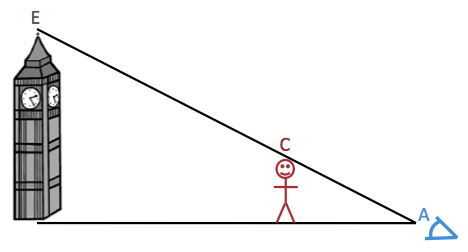
Line up your friend between you and the building. Your friend should be positioned so that when your eyes (A) are as close as possible to the ground, the top of your friend’s head (C) lines up with the top of the building (E). You’re essentially creating the hypotenuse of a large triangle!

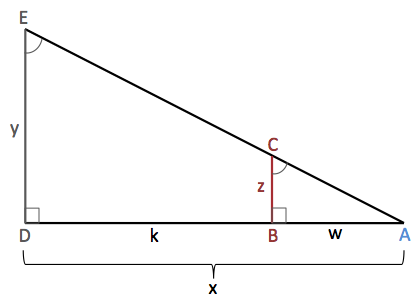
Now, let’s label and identify the other parts of our picture.

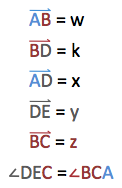
Here are our labels.

Given this picture, geometry tells us that certain relationships exist.

Therefore, three easy estimations must be made in order to get the estimated height of the building (y):

       w = the distance between you and your friend
       x = the distance between you and the building
       z =  the height of your friend 

NOTE: Be sure to use the same units in your estimations (feet or yards, perhaps) or else your calculation will not work. 

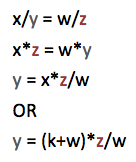
Once you have those three values, just leave the rest to geometry. You have basically created one right triangle inside another right triangle, assuming the building and your friend are both standing up straight. Therefore they have equal angles and therefore equal ratios of their legs, allowing us to make this simple calculation. The result:

Math is fun, right? πŸ™‚

a couple of great commercials

Two great commercials for two different reasons.

In a time when 99.99% of all commercials are excessively loud, irrelevant, and annoying, it’s nice to find two that are creatively fun (and productive). Some businesses should take a lesson.

American Express: Simple, creative, and soft.

State Farm: Quick, funny, and catchy.

perfects, primes, and planets

a simple poem with a significant end
get the result, and perhaps you’re a friend
so riddle me this, riddle me that,
use pen and paper and your best thinking cap…

let’s start you off, here’s one for the money
in chinese it’s death, unlucky but funny

the seventh fibonacci should be easy to see
but if that’s too hard then take two to the three

now keep the dwarf in the orbital loop,
give me a count of our planetary group

a champion of numbers, a winner of sort,
when one has won and they’re top of their sport

then something to fathom, the star is divine
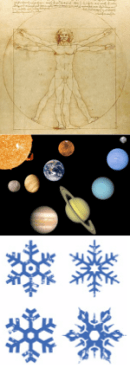
or give me a width of a vitruvian kind

now how bout a gimme, a favorite of mine
this one’s the one only even prime

and last but not least, i hope you’re awake
the first perfect is this keplerian snowflake

now put them together, from bottom to top
a day in my life – big thanks, mom and pop!

restaurant review: rocklands bbq

Rocklands Barbeque and Grilling Company is easy to love, and impossible to hate. Between the food, service, and atmosphere, it’s one of the best when it comes to good ol’ happy barbeque.
I’ve loved Rocklands since I moved to Washington, DC almost three years ago. I spent my first two years going to the Glover Park – Washington, DC location and now frequent the Clarendon – Arlington, VA location (they have locations in Rockville, MD and Alexandria, VA as well). Although the Glover Park spot is much smaller than the Clarendon one, it packs the same punch with food, condiments, service, and experience. The Clarendon location, however, does have a full bar, patio, and TVs for good summer happy hours and better large-crowd accommodations.

1. The Pre-Meal
Free peanuts, quick lines, good soda fountain, sweet tea, fresh lemons, lots of seating. Coat racks, free newspapers, and TVs help add comfort. I usually eat about 15-20 peanuts, walk around and pick out my sauces, and read a few headlines in the paper and the food is already coming out. I think they have a 7 or 9 minute guarantee too…

2. The Meats
Red Oak and Hickory fueled ovens make an awesome smoky flavor. Nothing is frozen, all meat is fresh, making for tender rib meat, flaky brisket, and a perfect chicken char. Lots of variety fits any mood. I have to mention their potato rolls are the best too – always soft and a perfect one-hand pocket for meat and sauce.

3. The Sides
A big variety of fresh sides – some traditional southern ones and other standards, some healthy and some not so healthy. Pair two up with a meat/sandwich for a perfect meal size. Adding two sides is onl $4 making a whole plate around $8-9.

4. The Sauces
So many to choose from. Some hot, some not. Some bold, some light. Some thick, some thin. Some local, some international. Rocklands original homemade sauces are good standards if you are not very good at making a decision.

5. The Atmosphere
Sometimes too smoky where you smell like a fire pit when you get home, but that’s what you should look for in these types of places. It contributes to the meal and the experience. It’s a happy place, the people are happy and the food is happy. You never feel rushed, and always leave full. Good for a solo trip, a first date (she’ll be a keeper), a weekday dinner out, or a weekday dinner to go.

Main Meal Recommendations
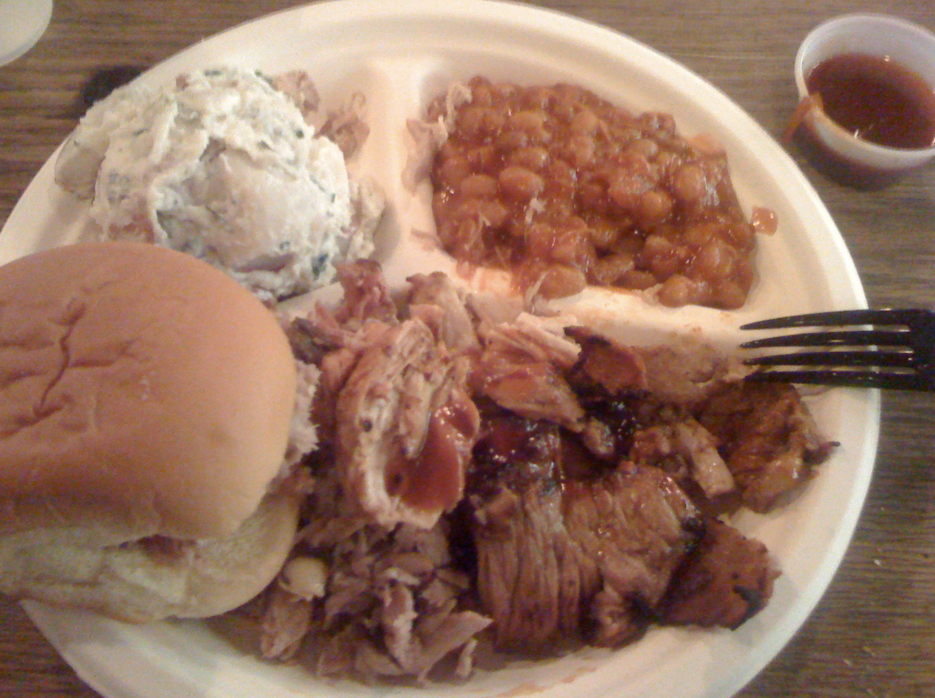
Get the “Three Meats Platter” if you’re starving or the “Pulled, Smoked Chicken” for a moderate amount. For sides, the potato salad and the BBQ baked beans are so very necessary, but go with the mac and cheese if you are feelin’ it.

Sauce Recommendations
Tiger Sauce – Mild heat and mildly sweet. Best flavor.
J.T. Pappy’s Gator Sauce – Different levels of heat, very unique flavor from a zesty mustard-tomato base.
Pickapeppa Sauce – Mild, sweet, and mellow Jamaican sauce.
Rockland’s Original BBQ Sauce – Get it hot out of the barrel, with onions. It’s mild but a perfect sauce for a dip of the sandwich or pouring over potato salad.

the mind as a map

The human mind should work much like modern mapping and camera technology – zoom, pan, adjust, layer, interact – and export too.

At any moment, the majority of minds fall into one of two categories: big and strategic, or focused and tactical. But as changing times require changing minds, the third category has emerged: the dynamic and balanced. This category can be seen as a mix of the first two, instantaneously being able to function based on the attributes of the surrounding medium.

These minds are very much like new cameras, mapping applications, GPS tools, and related emerging technologies. They build a informative picture for a user, based off organized databases and knowledge bases, and allow a level of functional interaction to continuously feed new information to that user. These functionalities, when applied to the human mind, are all essential for continued growth in a rapidly changing (and unpredictable) society.

Zoom

  • Act as a lens. Be able to zoom in and out from a single focal point. For any given topic, the mind must be able to pay attention to the smallest of details while still being able to see the big picture. Understand the color and shape of the individual puzzle pieces while at the same time seeing where that piece fits into the full picture on the puzzle box.
  • Re-focus instantaneously at every level of zoom. Purposely making pictures blurry can provide useful in some instances, but the act of focusing should be natural and automatic. 
  • Like looking at a Magic Eye or a lovely Seurat, be able to find the right level of zoom where the picture is most clear.
  • “Zoom Analytics” as I’ll call it, should be embraced as a common analytical method. It’s always been a mathematical problem solving technique, but not universally taught.

Pan

  • Need to be able to swiftly move from topic to topic, and connect those that are related.
  • Moving back to a previously-visited topic should bring quicker loading of that memory.

Adjust

  • The mind must continuously grow in dimension and adjust for core characteristics. Recognize patterns and contrasts, shapes and sizes, color and form and adjust the view and output accordingly.
  • Toggle perspective and angle to see the infinite sides of any one picture. Perspective is everything.

Layer

  • If the brain consisted of data and memory silos, the main interface should be able to integrate any combination of data and memory into a single comprehensive picture.
  • It should be able to see localized data as well as aggregate data for larger constructs. Filter data and memory based off a set of parameters, re-organize it, and feed it into the common operating picture.

Interact

  • The picture is not static. The brain must by dynamic in nature, allowing a constant influx of new information and updating of old information. 
  • Re-organization of data and memory should be consistent with the changing society in which we live. When a scientific/technological revolution occurs, the way in which our information is processed and stored must be compatible with the changes in society.

Export

  • Not every tool can do every task. That’s why exporting is good. Create a new data set from which you, or someone else, can work. Export a map or a picture that can be analyzed by another set of eyes. For the human, you must be able to transfer stored information to others, and most importantly, communicate it effectively. English is English, math is math, kml is kml.
  • Language is good because it is a standard by which we can effectively communicate. Choosing words wisely is something that should be practiced on top of a common linguistic standard. It’s one thing to speak the same language, but another to foster understanding.

And so, truly finding a balance between big and small perspectives is important. It’s important for making wise decisions, being a team player, being an effective manager, giving valuable advice, and finding optimal direction in life. So as much as you make sure you can get deep in the weeds, make sure you can easily get out.

“It’s not what you’re looking at that matters, it’s what you see.” – Henry David Thoreau

make your own ringtone

Make a ringtone from any mp3 file in iTunes in under a minute.

Personal Note: I say keep it on vibrate most of the time out of politeness for the general public, but use the ringtones for your morning alarm!

1. In iTunes, find the song from which you want to make a ringtone. Write down the interval of time you wish to capture (e.g. the chorus from 1:13 to 1:27).

2. Right-click on the mp3 file and select ‘Get Info’.

3. Go to the tab for ‘Options’, check the boxes for ‘Start Time’ and ‘End Time’, and input the interval you wish to capture in your ringtone. Hit ‘OK’.

4. With that mp3 file still highlighted, go up top to the ‘Advanced’ menu and select ‘Create AAC Version’. This will automatically create a new file in your library (and it should have a length equal to the interval you set previously).

5. Drag and drop this new AAC file to your desktop. It should have a .m4a extension.

6. Change the extension of this file from “.m4a” to “.m4r”.

7. Drag this file from your desktop back into iTunes. It should now be available in your ‘Ringtones’ library on the left. If you don’t see this library, got to Preferences and make sure you have checked the box to show this library in your iTunes.

8. Lastly, you can delete the file on your desktop, and can delete the AAC version of the song in your iTunes music library. Also, remember to change the original mp3 file back to the normal start and end times (just unclick the boxes).

9. Sync your iPhone/ringtones and you’re good to go.

Reference: eHow

Update #4: This Year in Baseball

This post is related to the following previous posts:
Update #3: This Year in Baseball (October 26, 2009)
Update #2: This Year in Baseball (October 5, 2009)
Update #1: This Year in Baseball (July 24, 2009) 
This Year in Baseball (February 22, 2009)

Well it was Yankees in six games. Pretty unreal feeling. Couple notes:

  • Pettitte closed out all three playoff series (Derek Lowe also did it in 2004).
  • I am extremely happy for Joe Girardi, even though I wish Mattingly had his spot.
  • Teixeira gave the last out ball to Johnny Damon who had a few crucial hits this series but went out early with a strained calf.
  • Matsui is a great MVP, going 8-13 with 3 HRs and 8 RBIs in only 3 starts in the World Series. As a note, he was also the MVP of the Japan Series in 2000, going 8-21 with 3 HRs and 8 RBIs in that series (2-2 with 4 RBIs in the game 6 clincher too). 
  • That was the fifth ring for Mariano Rivera, and the fourth time he got the final out. His 39 postseason saves are by far the most all time (#2 is Brad Lidge at 16).
  • Damaso Marte pitched 4.0 postseason innings, giving up 2 hits and 0 ERs with 5 Ks and 0 BBs. Stellar.

“Why wear the pinstripes if you’re not going to win championships?” – Mark Teixeira

“The Yankees won. The world is right again.” – Randy Levine (Yankees President)

math in 2010 and beyond

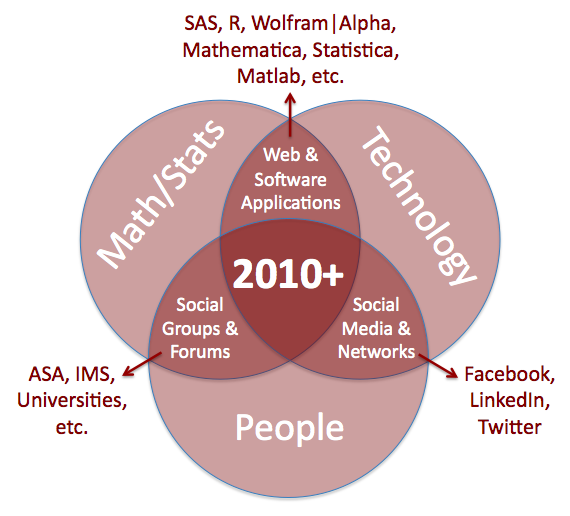
If we want to fuel future growth and innovation in mathematics, three worlds must meet in the middle.

In 2009, we see three distinctly developed worlds:
  • The Communities: Math + People = Associations, Publications, Journals, Groups, Departments (ASA, IMS, WFU Math, etc.)
  • The Connectors: People + Technology = Social Media & Social Networks (Facebook, LinkedIn, Twitter, iPhone Apps, etc.)
  • The Foundations: Math + Technology = Software/Web Applications (Wolfram|Alpha, SAS, R, Matlab, Mathematica, Statistica, etc.)

In 2010, we need these three worlds to mold into one, unified experience. With whom does the responsibility lie and when does it start? You and now.