Math Tricks, Negative Space, and Simple Beauty

Once again we start with two of my favorite things: soccer and math. I’ve talked about them both at length, for example in my “geometry in soccer” post from March 2009. Both are related by a similar underlying, structured framework. Both have rules, methods, and strategies for finding success, whether that’s solving a problem or winning a game.

What most non-players don’t understand is that despite the rules that govern both math and soccer, there are tricks to the game as well. These are the visions and insights that exist not within the simple rules and methods of an operation or a play, but rather in the negative space – the non-obvious space surrounding the operations and plays. You may find, more often than not, that recognizing these tricks in all aspects of life can provide the competing advantage necessary for happiness and success.

The soccer tricks will have to wait until after some knee surgery, so for now, I’ll stick with the math. There are thousands of known tricks in math, and probably an infinitesimal amount of unknown tricks waiting for an epiphany of recognition. Here’s an example:

Squaring Any Number Ending in “5”

Although this works for any number that ends in 5, it’s probably most practical for two digit numbers when no calculator is present. Let’s use 65 as an example, where we try to quickly compute 65 squared, or 65^2.

All you have to do is look at the number to the left of the “5” in the ones place. For our example, we have a “6”. Multiply this number by the number that follows it sequentially, which is “7” for our example. We get 6*7=42. To find our final answer of 65^2, all we have to do is take the result of our multiplication and append a “25” to the end of it, recognizing that the last two digits of the square of any number ending in “5” will always be “25”.

So for our example, we have “42” + “25” which gives us 4,225. The square of 65 is 4,225. Pretty neat, huh? Try it with some others…

25^2:     2*3=6,             “6” + “25”        = 625
95^2:     9*10=90,         “90” + “25”     = 9,025
475^2:   47*48=2,256, “2256” + “25” = 225,625

For a proof, I’ve looked to Dr. Math at the MathForum.org website. Here goes:

Let’s generalize a two-digit number ending in “5” by the representation X5, where X could be 1, 2, .., 8, or 9. Essentially, X5 is really a shorthand notation for the integer represented by

10*X + 5

Let’s go ahead and square X5:

(X5)^2 = (10*X + 5)^2 = (10*X + 5)*(10*X + 5) = 100*X^2 + 100*X + 25

Now factor our the 100 and an X from the first two terms:

= 100(X^2 + X) + 25 = 100*X*(X+1) + 25

Looking at this closely, you can see that this is exactly the product of X and the next sequential integer (X+1) with “25” appended to the end. Pretty cool, huh?

Notice that this trick works for squaring any integer that ends in “5”, not just two-digit numbers. Dr. Math shows us that for the the larger proof would have to be modified a bit (since all integers that end in “5” cannot be represented by 10*X + 5).

Seemingly Complex, But Beautifully Simple

Although the rules and structure of math may at times seem complex and chaotic, in the negative space of math we can find a beautiful simplicity through which things can fall in place. The same can be true for soccer, language, love, astronomy, cooking, and all aspects of life. Sometimes we’ve defined a framework (or have had it defined for us) of rules and methods to follow. But if we take a step back, look between the numbers and think outside the box, maybe we’ll find a simpler route to happiness and success.

String Theory, Email Threads, and Happiness

Our lives are made up of millions of threaded moments in numerous conscious and subconscious dimensions. Identifying these threads – from multiple emails to time volunteering to a loving relationship – and making them last, making them stronger, and weaving them through multiple life dimensions is a key to health and well-being.

String theory attempts to relate multiple disparate concepts about our universe into a more unifying framework. Specifically, it states that subatomic elements (electrons, quarks, bosons, etc) are not three-dimensional objects but rather are one-dimensional strings that vibrate to take on semi-measurable characteristics (mass, spin, flavor, charge). Additionally, string theory posits that our universe is made up of unobservable dimensions that, at the most basic level, provide some sort of logical consistency to the known laws and theories of the physical (and metaphysical) world.

Well on a more macro level, our lives are very much made up of strings and dimensions. For our purposes, let’s just call them threads. Threads are made up of several connected points spanning one to many dimensions of our lives. These threads are our conversations, our friendships, our good deeds, our actions, and our spontaneous thought streams – the basic units by which we live our life. Our life dimensions are our jobs, families, friends, teams, systems, cultures, and countries, as well as our core knowledge, ideas, and feelings  – the encompassing elements by which our lives fundamentally exist. And finally, our lives have outputs too! They are our health and our well-being, our happiness, our faith, our understanding, and the meaning we extract from the world.

Think about some threads of your life:

  • Email Threads – Maintain a steady stream of conversation to build new knowledge, ignite new thought, and establish a strong connection with someone.
  • Volunteering – Show up when you don’t feel like it, encourage others to work harder, and continually establish yourself as a reliable and dependable contributor to society.
  • Love & Relationships – Always give to, and never give up on, the ones you love most in this world.

So now to the crux of my point: these life threads are the critical inputs to ensure our happiness and well-being are properly sustained, cultivated, and shared. By identifying these basic units, making them stronger, tying them together, crossing them through multiple dimensions of our lives, and “vibrating” the heck out of them, we can collectively share happiness and good faith as a society through better relationships, systems, and mutual understandings. Seems chaotic, yes, but in chaos there is a natural simplicity. Said the great thinker and founder of analytical psychology, Carl Jung: “In all chaos there is a cosmos, in all disorder a secret order.”

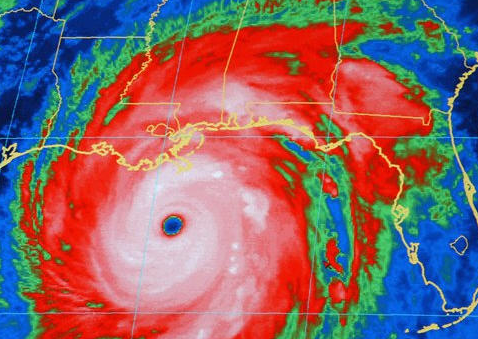
Thanks to Outpatient.com for use of the image.

BBQ Boston Butt (Pork Shoulder) with Peppers and Onions

BBQ Boston Butt (Pork Shoulder) with Peppers and Onions
Difficulty:
VERY Easy
Prep Time:
15 Minutes
Cook Time:
8 Hours

Description

First of all, read up on Boston Butt. It’s essentially a specially-named cut from the upper part of the front shoulder, and it’s the perfect cut for slow cooking. Best bet is to talk to the butcher. Don’t be embarrassed to ask for the best Boston butt he’s got. Virtually no prep here, flavorful as hell.

Ingredients

Pork Shoulder (4-6 lbs)
2 Green Bell Peppers
1-2 Medium Onions
Barbecue Sauce (2 bottles) – I used Sweet Baby Rays Honey Chipotle…
Other Flavors (Bourbon, Hot Sauce, Black Pepper, Mustard, etc.)

Directions

1. Slice the onions and peppers. Put half of them at the bottom of the crock pot, then put the pork on top of them, then put the other half of the peppers and onions on top/around the pork.

2. Throw a full bottle of barbecue sauce all over the pork. I used Sweet Baby Rays Honey Chipotle, but you can use whatever flavor you like best! I added other flavors too such as a little bourbon (or beer is good), fresh ground black pepper, mustard seed, worchestire sauce, and hot sauce. Cover and cook on low in the crock pot for 6-8 hours or until very tender.

3. Drain all the juice from the crock pot (I used a colander to do this) and remove the peppers and onions to whatever extent possible. Shred the pork in the crock pot by pressing a fork against it. I like mine pretty chunky but you can completely shred it if you want.

4. Douse the shredded pork with another half bottle of barbecue sauce and continue to cook on low in the crock pot for at least another hour.

5. Serve on potato rolls with the peppers and onions (and chesse too!) on top, with your favorite hot sauce. Eat as much as possible!

Postulating Possible, Probable, and Preferable Futures

With regards to futurology and future studies, I’ve recently posted on the principles of forecasting as well as the origins of opportunity – two distant yet related topics that exemplify the breadth and depth of the field.

As my own futures research has progressed, I’ve found various sources that have proven to be quite valuable in guiding my curiosity and conjecturing. I think some of these are worth passing along:

  • Acceleration Studies Foundation (ASF) – ASF is an educational 501(c)(3) nonprofit engaged in outreach, education, research, and selective advocacy with respect to issues of accelerating change.
  • Futurology (Wikipedia)
  • Institute for Alternative Futures – The Institute for Alternative Futures (IAF) is a nonprofit research and educational organization founded in 1977. IAF and its for-profit subsidiary, Alternative Futures Associates (AFA), specialize in aiding organizations and individuals to more wisely choose and create their preferred futures. IAF works with clients to create forecasts, scenarios, goals and strategies that are the essential tools for transforming organizations to succeed in times of rapid change.
  • Institute For The Future (IFTF)
  • Principles of Forecasting (ForPrin)
  • Shaping Tomorrow – Online community of futurists and futures research
  • Shaping Tomorrow (Ning Network)
  • “The Time Lords” (Financial Times, 1/30/2007)
  • World Future Society (WFS) – The World Future Society is a nonprofit, nonpartisan scientific and educational association of people interested in how social and technological developments are shaping the future. The Society was founded in 1966 and is chartered as a nonprofit educational and scientific organization in Washington, D.C.
  • World Futures Studies Federation (WFSF) – The World Futures Studies Federation (WFSF) is a global NGO that was founded in the 1960s to encourage and promote the development of futures studies as a transdisciplinary academic and professional field in all parts of the world. WFSF operates as a global network of practicing futurists – researchers, teachers, scholars, policy analysts, activists and others from approximately 60 countries.

In a nutshell, futures studies is exactly that – studies of the future. It’s about the determining the total set of possibilities for tomorrow, finding the most probable of outcomes for tomorrow, and leveraging advanced knowledge to even shape the future.

Wikipedia, as spread across the spectrum of credibility as it may be, provides a pretty decent explanation of the mindset needed to be truly forward-looking. What qualities are required of a futurist, within any organization or for any requirement or need, to fully anticipate the unknown using the set of resources at his/her disposal (data, intuition, logic, technology, vision, science, etc.)?

  • Trend Assessment – The competency to understand trend directions, weak signals and wildcards, assess their likely impact and effect on one another and respond in a timely and appropriate manner
  • Pattern Recognition – The ability to see patterns rather than individual factors
  • System Perspective: The capability to envision the entire system rather than the isolated components
  • Anticipation: To anticipate short and long term consequences over time, novel situations and geography
  • Instinct & Logic: To rely on a combination of instincts and logic rather than purely rational analysis

Yes, there is a plethora of philosophical, political, religious, scientific, and even incomprehensible factors that may give shape to the future (or take that shape away). But that should not deter us from facing it head on. We all need to work smarter not harder, avoid surprises, exploit new opportunities, plug weaknesses, and (where possible) influence the future.

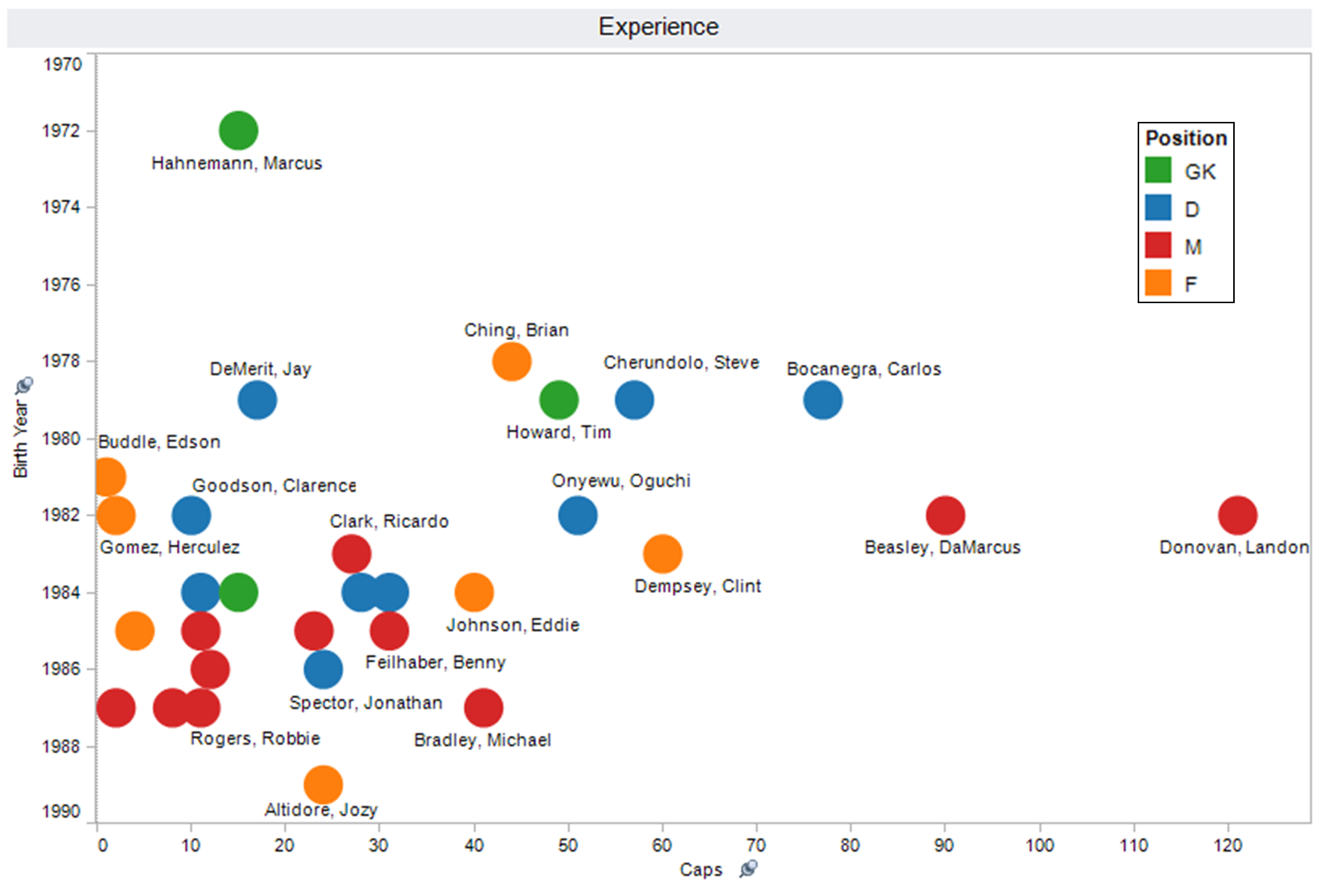
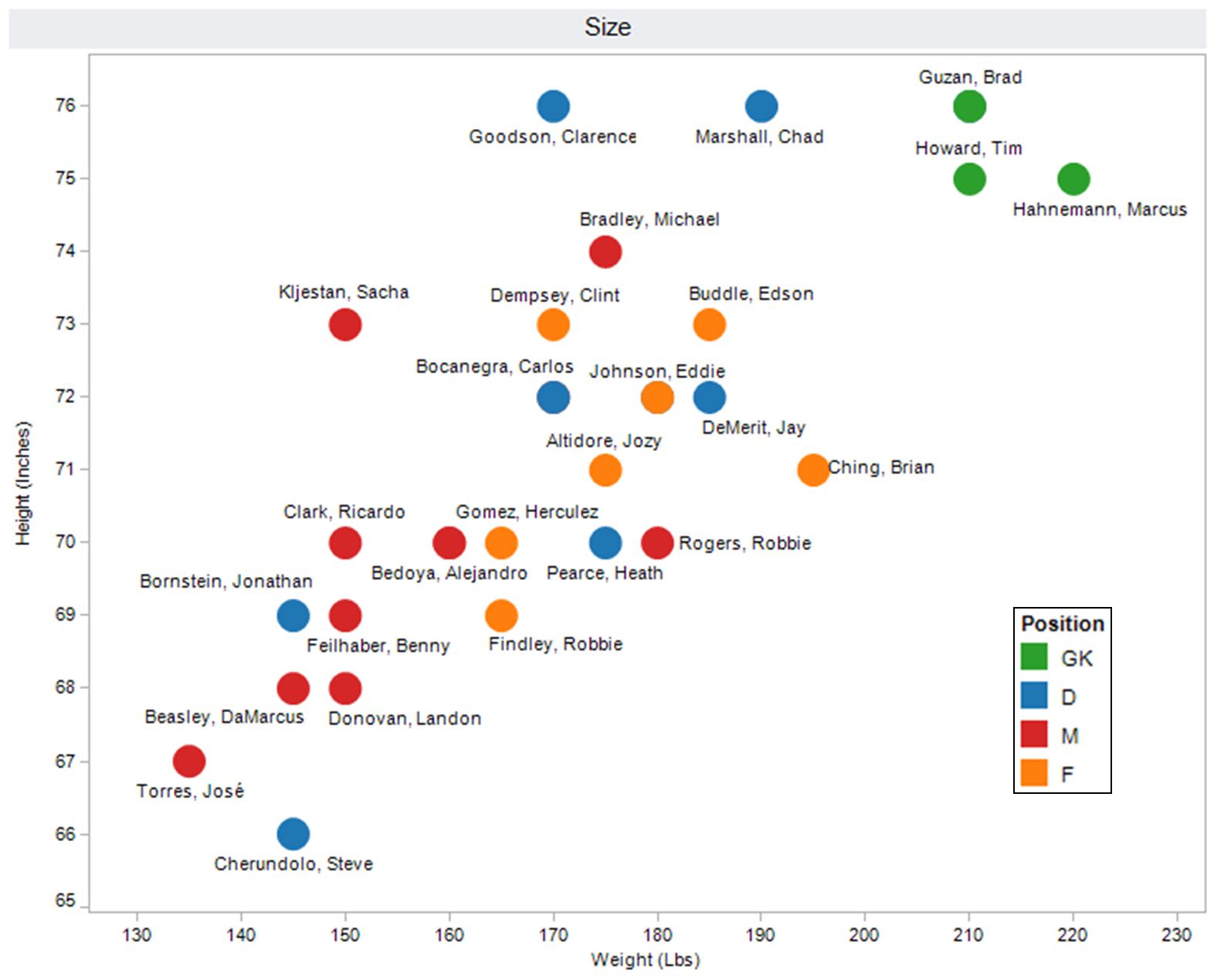
Visualizing the U.S. Men’s National Soccer Team Roster

As the World Cup approaches, countries begin to solidify their rosters, trying to optimize their squad to give the best chance of taking home the FIFA trophy. As the Bob Bradley recently announced the United States’ 30-man roster, we wonder where these players come from and how can their stats be visualized?

Obviously, it would be most valuable to visualize comprehensive stat sheets of the U.S. team players against all other teams and their players, especially the others in Group C (England, Algeria, Slovenia). Unfortunately, I don’t have that much time! So, elementary as these may be, here are some quick visualizations, given the data provided on the US Men’s National Team (USMNT) website.

1. Full 30-Man Roster, with Hometowns, Club Teams, and Total USMNT Goals (by Position)

2. Player Experience (Age vs Total Caps, by Position)

3. Player Size (Height vs Weight, by Position)

Some things to note, although I have not determined an international baseline from which these conclusions can be definitively made, is that our goalkeepers are old and our midfielders are relatively small, young and inexperienced. But I bet you didn’t need me to tell you that!

Regardless, the World Cup is surely a global spectacle and I’m very much looking forward to it. Hopefully the US squad can take Group C and show some true grit and determination on the international stage. Four weeks to go…

The Origins of Opportunity

I’ve been deep into future studies / futurology over the past few weeks. It’s an intriguing field for me at both a professional/academic level and a personal level. How can we better understand the future? Are there core methodologies that we can employ to optimize our current positioning and decision-making? How can we be better prepared for the future? What’s inevitable and what’s not? Where lies the line between info-driven forecasting and innate intuition?

Although the netweb has helped to grow and organize both the futurological information and the community through which that information is developed and shared, it seems as though the field itself remains cloudy. I must hope that at some level I can build upon the existing thoughts of others and contribute new thoughts of my own so that at least the window to the future becomes more clear.

One cornerstone of future studies is in how to evaluate, filter though, and create opportunity from statements about the future. And so I wonder: from where does opportunity arise, and how can this recognition be leveraged to inform (and in some cases, influence) the future? In general, how can we characterize the origins of opportunity?

  1. Is it through early recognition? This is not beating others to the finish line, but rather beating others to the starting line. Can we identify gaps sooner than others?
  2. Is it through resourceful timing? Often opportunity arises in not being first, not being last, but somewhere in between. The earliest adopter may have his/her vision obscured through too many details, the latest adopter may be left with the crumbs. And often we find much opportunity in the failure of others – developing the right trials from the errors of others.
  3. Is it through pure knowledge and intelligence? Can brute force brainpower create the most opportunity? Or is it more dependent on the ability to apply one’s knowledge, no matter how limited it may be? Is it about having the right skill sets and tools, tactics and strategies?
  4. Is it though pure luck? Can being in the right place at the right time govern our ability to find and harness opportunity? Is pure luck within our beyond our control?

It’s simplest to think that opportunity may arise as a result of any combination of these factors. Therefore, to maximize our opportunities, we should focus on being in the right places, having the right tools, being with the right people, understanding timing as an approach, building the right knowledge base, and building an overall recognition for the many faces of opportunity.

If we can learn to recognize opportunity and better understand where it may arise, we can begin to gain a better picture of the future. Then, we can work to inform that picture with data and models to ensure that we take full advantage of those opportunities to better our self, our communities, our world, and that of tomorrow.

Principles of Forecasting

I just finished reading a couple books about future studies and the nature of predictions and forecasts: (1) Future Savvy, by Adam Gordon and (2) The Future of Everything, by David Orrell. From the former of the two, I wanted to pull a good portion of the content from Chapter 11 and structure it here for use in future posts and projects. In Chapter 11 of his book, Gordon outlines the important questions to ask of any forecast. As decision makers and leaders, analysts and synthesizers, and organizations and citizens, it’s critical that we learn to properly evaluate and filter statements about the future so that we can optimize our decisions and, ultimately, our positioning for the future.

With that as a quick intro, here are the questions we should ask of any prediction or forecast. As Gordon states of forecasts: “they are not in themselves valuable, they are only valuable alongside a clear way to separate the wheat from the chaff”.

Purpose

  • What is the purpose of the forecast? Is the forecast upfront about its purpose?
  • Is the forecast future-aligning or future-influencing?
    • Is the forecast widely publicized?
    • Does it specify action to take in the external world?
    • Is it a forecast of extremes?

Specificity

  • Is he forecast mode predictive – spelling out what will happen – or speculative, illuminating possible alternatives?
  • Is there too much certainty?
  • Is there enough certainty? Is the forecast hedging?
  • Is the forecast clear about the pace of change? Does it specify timelines or does it leave the question hazy?

Information Quality

  • How extensive and how good is the base data?
    • Is the data up to date?
    • Does the forecast use secondary data?
    • Is the data real or a projection?

Interpretation and Bias

  • Are the forecast’s biases natural or intentional?
  • What is the reputation of the forecaster and forecast organization? Does the forecaster have anything to lose by being wrong?
  • Are bias-prone contexts at hand?
    • Is the forecast sponsored?
    • Is self-interest prominent?
    • Are ideology and idealism prominent?
    • Does the forecast focus on a “single issue” future?
    • Is editorial oversight bypassed?

Methods and Models

  • Does the forecast specify its methods?
  • Does the forecaster imply the method is too complex, too arcane, or too proprietary to share?
  • Do forecast proponents trumpet their unique or “new and improved” methods?

Quantitative Limits

  • Is the use of quantitative methods appropriate?
  • Is a machine doing the thinking?

Managing Complexity

  • Does the forecast oversimplify the world?
  • Does the forecast acknowledge systemic feedback?
  • Does the forecast anticipate things that could speed up the future, or push it off track? Does it account for triggers and tipping points?
  • Does the forecast expect exponential change?

Assumptions and Paradigm Paralysis

  • Has adequate horizon scanning been done?
  • Are the assumptions stated? Is the forecaster aware of his or her own assumptions? Is the forecaster willing to entertain alternative assumptions?
  • Do the forecaster’s assumptions appear valid and reasonable?

Zeitgeist and Groupthink

  • Is the zeitgeist speaking through the forecaster?
  • Is the forecast jumping on the bandwagon?
  • Does the forecast rely on “experts”?
  • Does the forecast do stretch thinking? Does it allow us to break free from the “official future”?

Drivers and Blockers

  • Are change drivers and enablers identified? Or are trends simply projected?
  • Are blocking forces identified and fully accounted for? Is friction factored in?
    • Have utility questions been asked and adequately answered?
    • Are there proposing or opposing stakeholders, particularly powerful individuals and powerful organizations?
    • Does the forecast challenge social, cultural, or moral norms?
    • Whose side is the law on?
    • Is the forecaster in love with the technology?
    • Does the forecast underestimate the time to product emergence? Does it overestimate the pace at which people’s habits change?
    • Does the forecaster assume change? Does the forecast underestimate the full hump change must overcome? Does the forecaster recognize what doesn’t change?

A List of Some Web Data Sources

Well I needed to pull together a listing of publicly available data sources for a project, so I figured I’d post them here as well. Some descriptions and tag lines have been taken directly from the website, and some I quickly created on my own. This list is by no means comprehensive (I probably have about 100 links in the “Data” folder of my bookmarks…) but it’s a quick snapshot at some useful data sources on the web. That being said, there are a lot of considerations when targeting a data set and tomorrow’s need for data will most likely differ from today’s need for data. Build and execute a target data strategy using the vast sets of search engines, libraries, and social networks on the web and you’ll be just fine.

AggData – The advantage of AggData is that the data is collected into one file that is very raw and portable, which makes it easy to integrate into any application or website. You can browse free data sets or purchase any of the many data sets from public and private organizations for a relatively small fee.

The Association of Religion Data Archives – The ARDA Data Archive is a collection of surveys, polls, and other data submitted by researchers and made available online by the ARDA. There are nearly 500 data files included in the ARDA collection. You can browse files by category, alphabetically, view the newest additions, most popular files, or search for a file. Once you select a file you can preview the results, read about how the data were collected, review the survey questions asked, save selected survey questions to your own file, and/or download the data file.

Census.gov American FactFinder – In American FactFinder you can obtain data in the form of maps, tables, and reports from a variety of Census Bureau sources. Click here for a good listing of available data sets, visualizations, and search functionalities.

CIA World Factbook – Contains a lot of country-level metrics/statistics, although they are not very easily exportable and/or available in table format.

City Population – Gazetteer of global geographic data and limited demographic statistics per location.

Data360 – This is essentially a wiki for data. Data360 is an open-source, collaborative and free website.  The site hosts a common and shared database, which any person or organization, committed to neutrality and non-partisanship (meaning “let the data speak”), can use for presentation of reports and visualizations about the data.

Data.gov – The purpose of Data.gov is to increase public access to high value, machine readable datasets generated by the Executive Branch of the Federal Government. Although the initial launch of Data.gov provides a limited portion of the rich variety of Federal datasets presently available, we invite you to actively participate in shaping the future of Data.gov by suggesting additional datasets and site enhancements to provide seamless access and use of your Federal data. Visit today with us, but come back often. With your help, Data.gov will continue to grow and change in the weeks, months, and years ahead. For more information, view our How to Use Data.gov guide.

Data Marketplace – Buy and/or sell data. You can request data sets for others to build and provide for a small fee.

DBpedia – DBpedia is a community effort to extract structured information from Wikipedia and to make this information available on the Web. DBpedia allows you to ask sophisticated queries against Wikipedia, and to link other data sets on the Web to Wikipedia data.

EconoMagic – A directory of data sets specific to US states.

Factual – Factual is a platform where anyone can share and mash open data on any subject. Factual was founded to provide open access to better structured data.

FedStats – Provides access to all federal statistical agencies (by geographic scope or listed alphabetically) with a search function to discover available data sets across all US federal statistical agencies.

GapminderA non-profit venture that, through a interactive viz tool accompanied by a listing of available data tables, aims to “unveal the beauty of statistics for a fact based world view”.

GeoCommons Finder! – Upload, organize and share your Geographic Data. Then you can use their built in application called Maker! to map/visualize it.

GeoNames – The GeoNames geographical database covers all countries and contains over eight million placenames that are available for download free of charge.

Global Airport Database – Comprehensive set of global airport data (download available for free).

Global Health Facts – Search global data by health topic and/or country. You can also interactively compare data for up to five countries at a time.

Google Public Data – In addition to plainly using the main Google search engine to search for a specific data set, Google has a public data library with some valuable sets available for free.

Guardian.co.uk Data Store – Governments around the globe are opening up their data vaults – allowing you to check out the numbers for yourself. This is the Guardian’s gateway to that information. Search for government data here from the UK (including London), USA, Australia and New Zealand – and look out for new countries and places as we add them. Read more about this on the Datablog. Full list of government data sites here.

Harvard Geographic Information Systems – Contains a highly credible listing of various national and international data providers and data sources, with a strong focus on geographic data.

International Civil Aviation Organization (ICAO) – Global air traffic data available for a fee.

Infochimps – Request data sets, search for existing data sets, or post and sell your own data sets.

International Statistical Agencies
US Census Bureau: http://www.census.gov/aboutus/stat_int.html
US Bureau of Labor Statistics: http://www.bls.gov/bls/other.htm
United Nations: http://unstats.un.org/unsd/methods/inter-natlinks/sd_intstat.htm

MelissaData – Buy comprehensive zip code data for about $150. Tailored for businesses with use in marketing.

NationMaster – NationMaster is a massive central data source and a handy way to graphically compare nations. NationMaster is a vast compilation of data from such sources as the CIA World Factbook, UN, and OECD. Using the form above, you can generate maps and graphs on all kinds of statistics with ease.

National Association of Counties (NACO) – Includes a US county data library.

Numbrary – Numbrary is a free online service dedicated to finding, using and sharing numbers on the web.

OECD Stat Extracts – OECD.Stat includes data and metadata for OECD (Organization for Economic Cooperation and Development) countries and selected non-member economies.

QuickFacts (US Census Bureau Site) – Quick, easy access to facts about people, business, and geography.

StateMaster – StateMaster is a unique statistical database which allows you to research and compare a multitude of different data on US states. We have compiled information from various primary sources such as the US Census Bureau, the FBI, and the National Center for Educational Statistics. More than just a mere collection of various data, StateMaster goes beyond the numbers to provide you with visualization technology like pie charts, maps, graphs and scatterplots. We also have thousands of map and flag images, state profiles, and correlations.

United Nations Development Programme (UNDP) – Includes UN Human Development reports and statistics such as the Human Development Index.

USA Counties (US Census Bureau Site) – A directory of data tables for US states and individual counties. Includes over 6,500 data items.

Weather Underground – Provides free access to historical weather data for cities around the globe.

Wolfram|Alpha – Deemed a “computational knowledge engine”, the W|A search and discovery tool is mathematically-based and tries to turn queries (term-based or data-driven) into actionable knowledge with visualization of in-house data sets and information relevant to your query.

World Gazetteer – The World Gazetteer provides a comprehensive set of population data and related statistics.

World Port Source – Contains extensive data on global sea ports, characterized by size and searchable by shipping liners and other various data fields.


A Profile of Portugal

The love of my life and I are taking a vacation later this year to Portugal! I figured I would organize and share some Portugal facts/stats as we continue to research and solidify our trip…

Major Dates

  • 1143 – Kingdom of Portugal Recognized
  • 1578 – Battle of Ksar El Kebir in Morocco, in which the Portuguese King and (pretty much) the entire Portuguese nobility were lost. That resulted in Portugal being annexed by Spain for 60 years. (info from Rod Carvalho)
  • 1755 – Major, Devastating Earthquake
  • 1803-1815 – Napoleonic Wars
  • 1822 – Independence of Brazil
  • 1910 – Deposition of the Monarchy, Republic Proclaimed
  • 1974 – Left-Wing Military Coup
  • 1975 – Colonial Independence (Angola, Mozambique, East Timor)
  • 1976 – Constitution Adopted
  • 1986 – Becomes Member of EU (formerly the EC)

Fun Facts

  • During the Napoleonic Wars, Portugal was, for a time, Great Britain’s only ally on the continent.
  • Also during the Napoleonic invasions, the Portuguese royal family moved to Brazil and Rio de Janeiro was, albeit for a brief period, the capital of the Portuguese Empire. Such empire was named the United Kingdom of Portugal, Brazil and the Algarves. (again thanks here to Rod Carvalho!)
  • The oldest alliance in the world, still in force, is the Anglo-Portuguese Alliance, signed in 1373.
  • The Vasco de Gama Bridge in Lisbon is the longest bridge in Europe.
  • Portugal is a global leader in renewable energy with its solar energy farm in Alentejo.
  • It is illegal for a bull to be killed in Portuguese bullfighting.
  • The Estoril Casino, 20 km outside of Lisbon, is the largest gambling outlet in Europe.

Famous Portuguese

  • Henry the Navigator (explorer)
  • Vasco da Gama (discovered the sea route to India)
  • Bartolomeu Dias (first person to sail round the southern tip of Africa, which he named the Cape of Good Hope)
  • Ferdinand Magellan (first to complete a circumnavigation of the world, which he did in 1522)
  • Pedro Alvares Cabral (discoverer of Brazil)
  • José Mourinho (soccer coach, Inter Milan)
  • Nelly Furtado (singer)
  • Luis Figo (soccer player)
  • Cristiano Ronaldo (soccer player)
  • Click here for more (via Wikipedia)…

Statistics

  • Total Area: 92,090 sq km (ranked #110, slightly smaller than Indiana)
  • Land Area: 91,470 sq km
  • Water Area: 620 sq km
  • Capital: Lisbon
  • Structure: 18 Districts, 2 Autonomous Regions (Azores, Madeira)
  • Land Boundary: 1,214 km (with Spain)
  • Coastline: 1,793 km
  • Highest Altitude: 2,351 km (Ponta do Pico in the Azores)
  • Population: 10,707,924 (July 2009 est., ranked #76)
  • Population Growth Rate: 0.275% (ranked #178)
  • Population Density: 115 ppl / sq km (ranked #89)
  • Median Age: 39.4 years
  • Life Expectancy at Birth: 78.21 years (ranked #47)
  • HIV/AIDS Prevalence Rate: 0.50% (ranked #74)
  • Religious Breakdown: 84.5% Roman Catholic, 9.0% unknown, 3.9% none, 2.2% other Christian
  • Literacy: 93.3%
  • Education Expenditures (% of GDP): 5.5% (ranked #50)
  • Human Development Index: 0.909 (ranked #34)
  • Happy Planet Index: 37.5 (ranked #98)
  • Euromoney Country Risk Rating (Low=Best): 82.43 (ranked #24)
  • Military Expenditures (% of GDP): 2.3% (ranked #72)
  • GDP: $232.2 Billion (ranked #50)
  • GDP – Per Capita: $21,700 (ranked #56)
  • Exports: $41.42 Billion (ranked #52)
  • Export Partners: Spain (25.6%), Germany (12.6%), France (11.1%), Angola (5.9%), UK (5.3%)
  • Imports: $58.79 Billion (ranked #40)
  • Import Partners: Spain (28.9%), Germany (11.6%), France (8%), Italy (4.9%), Netherlands (4.4%)
  • Unemployment Rate: 9.2% (ranked #103)
  • Total Airports: 65 (ranked #76)
  • Annual Air Traffic (2006): 11,722,211 (ranked #20)
  • Railways: 2,786 km (ranked #59)
  • Roadways: 82,900 km (ranked #55)
  • Internet Hosts: 1.967 Million (ranked #33)
  • Internet Users: 4.476 Million (ranked #45)
  • Cell Phone Users: 14.91 Million (ranked #44)
  • Freedom Press Rating (Low=Free): 16 (ranked #16)

Links