gumdrops

my pet alpaca likes gumdrops
especially the ones with lots of extra sugar crystals
and double extra especially the green ones

to him, the sound they make when they hit the floor
is like a parade of exuberance
amplified by the sense of nothing else matters

that gummy gel glistens bright on the dusty floor
like khufu at high noon
or the luxor on saturday night

his hooves take a spin and head lurches forward
as his trunk tries to keep up

his bubble gum tongue rolls out like tape
coated in anticipatory glue

his thick white fleece flows in the air
as he arrives and gobbles it up

wire talk

we send notes over wires all day
sometimes the notes dash through the air
and phew we can read them from our palm

our pockets buzz with new notes
sometimes the notes are from strangers
who want us to give them money for who knows what

remember the fax?
how magical that a note could teleport like that

it’s nice when we can send one note to many people
except for when we do it by accident
that video of cats falling off tables was not for you

i always sign my notes with my name or my initials
i dont even know why i sign the notes at all
the machine says they’re from me

it’s nice to be able to ignore notes when i want
although that feels weird
you wouldn’t do that in person

good nature

the wind whispers, and the meadows listen
the trees croak, and the stream glistens
songbirds play a tune, and the old man whistles fondly

the sun glares high while the shadows fade
tall grass waves at the hills
the buzz of cicadas cuts through the humid air

the woodpecker’s knock fades to a tap
the breeze turns chill
the sun simmers with violety glow

the trees breathe a sigh
the stars, a dim lit sky
night laid bare with no moon

rest well, good nature

parrot blabber

hello! please sorry my english
i’m a parrot of many few words
just simple ones to go by here now
are you give me your papaya?

please forgive my clumse
i also wobble a lot
i grew on ships as a tot, hello!
the seawaves still give me sick
ohh noo. what was i say?

please forgiven my words
i learned english from a seal
he taught many few words to me
and was much better good at art

so i beg this pardon for me now
do excuse my tongue, hello!
i’m a parrot of many few words
and i need your papaya to eat

bosons

may i please borrow some bosons?

because without particulate matter i am dead
in fact i will cease to be
my mind will be clear and my spirit quite free
but the world will be minus a fred

i don’t need that many, but i do need a few
just a handful perhaps, how ’bout three?
one to laugh, another to sing,
and third so i can ask all the questions i ask all the time to everyone i see wherever i am

that will complete what is me.

aversions

i once knew a calico cat
he spent all his time chasing rats
rats eat garbage and carry diseases
i don’t want to be a cat

i once tried to mimic a frog
by sitting all day on a log
it was so boring i thought i might croak
i don’t want to be a frog

i once shared a bus with an owl
we hooed at the riders who scowled
knowing only one word is really boring
i don’t want to be an owl

i once toured the sea with a shark
we didn’t find much it was dark
you can’t even see the stars at night
i don’t want to be a shark

Some Statistics on Constitutions

Constitution: “A body of fundamental principles or established precedents according to which a state or other organization is acknowledged to be governed.” (New Oxford American Dictionary)

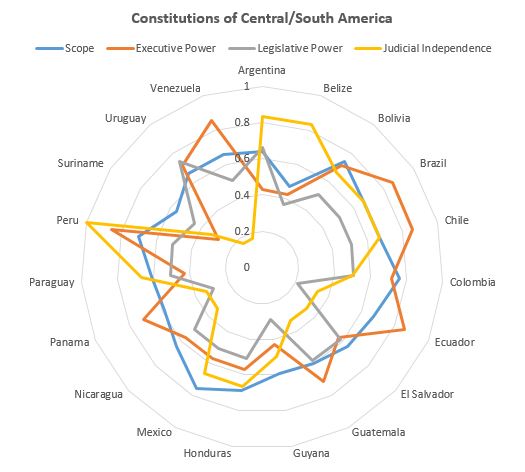
Last week The Economist had an interesting article referencing Constitute, a project (and pretty slick web application) that aims to provide the world’s constitutions for people to read, search, and compare. At the most basic level, the site breaks down 189 national constitutions into common topics, themes, and provisions for easy comparison of the most powerful governing documents across the world. It also ranks the constitutions by overall scope, executive power, legislative power, and judicial independence. Below is a quick graphic comparing the constitutions of 19 countries in Central and South America.

Constitutions

Some interesting statistics (from a variety of sources referenced at bottom):

  • Every year around 5 new constitutions are written and between 30-40 constitutions are amended or revised. Since 1789, more than 900 constitutions have been written. Only about half of all written constitutions last more than 19 years (this was predicted by Thomas Jefferson in 1789 that a constitution “naturally expires at the end of 19 years”).
  • The longest constitution is India’s at over 146,000 words (117,000+ using English-language translation). The shortest is Jordan’s at 2,270 words using the English-language translation. The U.S. Constitution has 4,543 words (original, unamended) and 7,762 (full text).
  • The oldest written set of documents still governing a sovereign nation is San Marino’s “Leges Statutae Republicae Sancti Marini”, written in 1600. The oldest surviving one-document constitutional text governing a sovereign nation is widely considered to be the U.S. Constitution, written in 1789.
  • There are 27 amendments to the U.S. Constitution. Since 1789 there have been over 11,500 measures proposed to amend the U.S. Constitution. That’s over 50 measures per year (the rate has actually been closer to 100 measures per year more recently). Over 500 of the 11,500 measures have been proposed to amend the Electoral College. (Senate.gov)

References/Links

3 Rules for Decision-Making

Aside from luck and fate, a substantial portion of one’s life follows the decisions one makes. So while the internet is already littered with tips, tricks, and guidelines on better decision-making, I figured I’d add my own two – or three – cents to the mix. With that, here are three rules for good decision-making:

  1. Trust your gut, but don’t always follow it. Intuition is a powerful thing, but it does not always trump pure thought and logic.
  2. In general, a decision’s impact should be correlated with: a) the time to make the decision, and b) the thought that goes into making the decision. Prompt decisiveness is a valuable quality only when the decision (and the potential impact of such a decision) warrants it.
  3. Consider competing alternatives, outside perspectives, and downstream effects. Decisions can be very complex, but there’s often a wealth of data available to support the decision-making process to include, but not limited to: a finite set of possible options, known effects on others, and expected secondary/tertiary outcomes.

calvin leading

Related Links/Articles