2011 MLB Baseball Season Predictions

Well, actually got them in on time this year! Here are my annual pinstriped-biased predictions for the 2011 MLB season… LET’S GO YANKEES!!!

AL East Final Standings

Boston Red Sox 100-62 (61.73%)
New York Yankees 97-65 (59.88%)
Toronto Blue Jays 82-80 (50.62%)
Baltimore Orioles 78-84 (48.15%)
Tampa Bay Rays 76-86 (46.91%)

Post-Season Predictions
AL East: Red Sox
AL Central: Twins
AL West: Rangers
AL Wild Card: Yankees

NL East: Phillies
NL Central: Reds
NL West: Giants
NL Wild Card: Brewers

ALCS: Yankees over Red Sox
NLCS: Phillies over Reds

World Series: Yankees over Phillies in 7

Best of luck to Don Mattingly in his first year coaching the Dodgers!

Project Management Body of Knowledge (PMBOK) Notes – Project Life Cycle and Organization (Chapter 2)

Project Management Body of Knowledge (PMBOK) Guide 4th Edition
Chapter 2 – Project Life Cycle and Organization

Core Definitions

  • Project Life Cycle: A collection of generally sequential and sometimes overlapping project phases whose name and number are determined by the management and control needs of the organization or organizations involved in the project, the nature of the project itself, and its area of application. The project life cycle provides the basic framework for managing a project, regardless of the specific work involved.
  • Project Phases: Divisions within a project where extra control is needed to effectively manage the completion of a major deliverable. Project phases are typically completed sequentially, but can overlap in some situations.
  • Stakeholders: Persons or organizations (e.g. customers, sponsors, the performing organization, the public) who are actively involved in the project or whose interests may be positively or negatively affected by the performance or completion of the project. Stakeholders also may exert influence over the project, its deliverables, and the project team members.
  • Organizational Process Assets: These include any or all process related assets, from any or all of the organizations involved in the project that can be used to influence the project’s success. Organizational process assets can be categorized as either processes and procedures (e.g. SOPs, guidelines, templates) or corporate knowledge base (e.g. measurement databases, project files, lessons learned, configuration management databases, issue management databases, financial databases).


General Notes

  • (2.0) It is important to remember that projects and project management take place in an environment that is broader than that of the project itself.
  • (2.1) Every project has a definite start and a definite end.
  • (2.1.1) Generic life cycle structure: starting the project, organizing and preparing, carrying out the project work, closing the project.
  • (2.1.1) Stakeholder influence, risk, uncertainty, and ability to influence the final characteristics of any/all outputs are high while cost and staffing levels are low at the beginning of the project life cycle.
  • (2.1.2) Project life cycles occur in one or more phases of a product life cycle, and the two can be very much intertwined.
  • (2.1.3.2) The three basic types of phase-to-phase relationships are: sequential, overlapping, and iterative.
  • (2.2) Operations work supports the business environment where projects are executed. As a result, there is generally a significant amount of interaction between operations departments and a project team as they work together to achieve project goals.
  • (2.3) Common stakeholders include: customers/users, sponsors, portfolio managers, program managers, the project management office (PMO), project managers, project team, functional managers, operations management, and business partners.

National Information Exchange Model (NIEM) Practical Implementer’s Course Notes – XML Conceptual Review (Lesson 2)

NIEM Practical Implementer’s Course
Lesson 2 – XML Conceptual Review

Core Definitions

  • Elements: The tags that exist within an XML document, collectively termed the “markup”. Types of elements include root, parent, and child.
  • Attributes: Part(s) of an XML element that provide(s) additional information about that element. Attributes are defined and written as a name/value pair (e.g. name=”value” ).
  • Instance: A document containing XML tags and content that results from use of XML schema rules.
  • Well-Formed Instance: An XML instance is “well-formed” if it uses the correct syntax and structure as defined by XML standard(s) being used and meets the minimum criteria for XML parsers to read the document.

General Notes

  • Rules/Guidelines for XML Elements
    • Can contain letters, numbers, and other characters.
    • Must not start with number or punctuation.
    • Must not start with xml, XML, or Xml.
    • Cannot contain spaces.
    • Should be descriptive to contained information.
    • Avoid dashes, colons, and periods (allowed, but usually are reserved for namespaces).
    • Avoid non-English letters/characters (allowed, but may not always be supported).
  • XML Prolog & Processing Instructions
    • Prolog specifies the version and the character encoding used for the XML instance and should always come first in every document.
    • Processing instructions are used to associate presentation and/or transformation files with the data.
  • XML Comments
    • Start with “<!– ” and end with ” –>”
    • Can include linebreaks.


Note: Information is being shared under the Creative Commons Attribution-ShareAlike 2.0 (CC BY-SA) license. Original content was created by NIEM course instructors Jenness, Owen, and Carlson.

National Information Exchange Model (NIEM) Practical Implementer’s Course Notes – Anatomy of an XML Exchange (Lesson 1)

NIEM Practical Implementer’s Course
Lesson 1 – Anatomy of an XML Exchange

Core Definitions

  • XML: eXtensible Mark‐up Language used to define and serialize data as well as define schemas, transformation rules, web services and visual presentation.
  • Message: One or more XML documents containing the data to be shared.
  • Publisher: An entity / software program that initiates a “One Way” exchange.
  • Subscriber: An entity / software program that receives messages in a “One Way” exchange.
  • Requestor: An entity / software program that initiates a “Two Way” exchange.
  • Responder: An entity / software program that receives “Request Messages” and returns “Response Messages” in a “Two Way” exchange.
  • Web Service: A type of program that allows a remote system (client) to interact with a program on a local system (server) using XML messages.
  • XML Document (.xml): A file that contains actual data and conforms to the rules of XML syntax (also known as an “Instance Document”).
  • XML Schema Document (.xsd): A set of rules to which an XML document must conform in order to be considered “valid”.
  • Web Service Description Language (.wsdl): Pronounced “wiz‐dull”, a document (containing XML) that describes the functionality of a Web Service (like a “Service Contract”).
  • XML Stylesheet (.xsl): An XML document that describes how XML data should be visually rendered.
  • XML Stylesheet Transformation (.xslt): An XML document that defines the rules by which a file defined by one schema is transformed (mapped) to a file defined by another schema.

General Notes

  • One-Way (Two-Party) Exchange Pattern (Publish/Subscribe)
    • Messages are pushed by a publisher directly to oneor more subscribers
    • Messages can be transactional or batch
    • Messages are transport neutral (web service, FTP, email, etc.)
    • Messages are essentially “fired and forgotten”
    • Pattern is very scalable as publisher is insulated from diverse subscriber interfaces
  • Two-Way Exchange Pattern (Request/Response)
    • Requestor sends an XML message requesting specific information
    • Responder replies with an XML message containing the requested information
    • Typically implemented via web services
    • Response is typically synchronous (occurs at about the same time)
  • Federated Query
    • Single request message may yield numerous response messages
    • Not all respondents may have data for every request
    • Typically built using a “Message Broker” device, insulating requestor
    • Message Broker aggregates multiple responses to requestor


Note: Information is being shared under the Creative Commons Attribution-ShareAlike 2.0 (CC BY-SA) license. Original content was created by NIEM course instructors Jenness, Owen, and Carlson.

Project Management Body of Knowledge (PMBOK) Notes – Introduction (Chapter 1)

Project Management Body of Knowledge (PMBOK) Guide 4th Edition
Chapter 1 – Introduction

Core Definitions

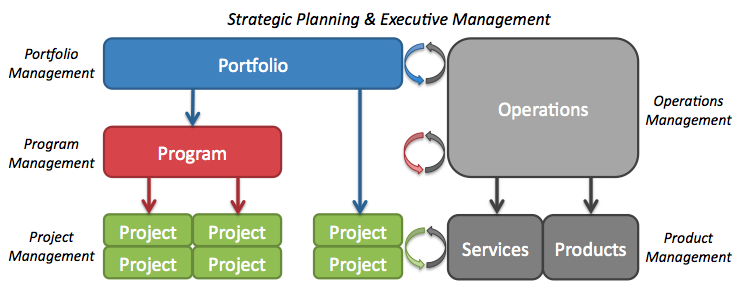
  • Project: A temporary endeavor undertaken to create a unique product, service, or result. Projects, within programs or portfolios, are a means of achieving organizational goals and objectives, often in the context of a strategic plan.
  • Project Management: The application of knowledge, skills, tools, and techniques to project activities to meet project requirements.
  • Project Management Office (PMO): An organizational body or entity assigned various responsibilities related to the centralized and coordinated management of those projects under its domain. The responsibilities of a PMO can range from providing project management support functions to actually being responsible for the direct management of a project.
  • Program: A group of related projects managed in a coordinated way to obtain benefits and control not available from managing them individually. Projects within a program are related through the common outcome or collective capability.
  • Program Management: The centralized coordinated management of a program to achieve the program’s strategic objectives and benefits. Program management focuses on project interdependencies and helps determine the optimal approach for managing them.
  • Portfolio: A collection of projects or programs and other work that are grouped together to facilitate effective management of that work to meet strategic business objectives.
  • Portfolio Management: The centralized management of one or more portfolios, which includes identifying, prioritizing, authorizing, managing, and controlling projects, programs, and other related work, to achieve specific strategic business objectives.
  • Operations: Permanent endeavors that produce repetitive outputs, with resources assigned to do basically the same set of tasks according to the standards institutionalized in a product life cycle.
  • Enterprise Environmental Factors: Both internal and external environmental factors that surround or influence a project’s success, to include, but not limited to: organizational culture, government/industry standards, infrastructure, existing human resources, personnel administration, marketplace conditions, stakeholder risk tolerances, political climate, and PM information systems.

General Notes

  • (1.2) Projects can have social, economic, and environmental impacts that far outlast the projects themselves.
  • (1.5) Projects require project management while operations require business process management (BPM) or operations management.
  • (1.6) Effective project management requires that the project manager (PM) possesses the following characteristics:
    • Knowledge: What the PM knows about project management
    • Performance: What the PM can do when applying project management knowledge
    • Personal: Behavior, attitude, leadership, balance and other core characteristics of the PM
  • (1.8) Enterprise environmental factors are considered inputs to most planning processes.