life optimization through estimation

The ability to accurately estimate a target value is an asset to any brain. Learn to hone this ability, embrace it, and use it to optimize your life.

Our lives are surrounded by invisible data – most of it in units of time, energy, space, and money. Essentially, our brains are huge folded databases that store this data, and use it to make decisions, plan ahead, and live each day. But as with many types of data, there exists some uncertainty about that data. Unknowns about how long, how big, how much, from where, until when, should i, almost enough, maybe tomorrow… well you get the picture. Our life data is filled with unknowns.

That’s why estimation is essential. Without it we’d get lost, fall behind, and lose our sense of security and awareness. Whether we know it or not, our brains constantly work to estimate and approximate values, given set of life data at that moment in time. And whether we know it or not, our brains run predictive models to assess hypothetical scenarios, basically using present life data to predict future life outcomes.

These are important realizations, and strong connections of human nature to an innate mathematical realm. Estimation is both an art and a science, as it takes creativity and thought supported by various numerical methods. Having the mathematical ability to estimate proves useful in most situations, but without the artistic component, you lose the ability to understand and contextualize your estimation.

The main point here is that estimation should be embraced as part of human nature, supported by numerical methods. This is how we can optimize our life – by recognizing the units with which our lives are measured each day, and reducing as much uncertainty in those values as humanly possible. It will not make you completely successful and happy and secure, but it will get you close.

Examples

Here are some random examples of estimation from my life. The methods of estimation vary, but the fundamental questions being asked all have outcomes of an unknown nature.

1. Shopping: Budgeting $150 for a dinner party, break budget down to categories of purchases then allocate funds accordingly. Estimate totals and percent of total budget category to make decisions on necessity.
Outcome: Go bigger on the dinner and ask a couple guests to bring desserts.

2. Sports: Ten minutes left in the game, down by 2 goals. Have two full lines of players so will sub soon and again with 4 min left. Need at least 1 goal every 4 minutes leaving a 2 min buffer to protect the tie and go for a win, should allocate 60% of strategy to offense and 40% to defense for next 8 minutes. If I’m in for 6 min and need 60% offensive mindset, how inclined should I be to make a run towards the goal, leaving my defensive position?
Outcome: Win

3. Personal Finance: How much to take out at the ATM? Need to estimate expenses for the week – lunch, happy hour, gas, dinner, cab to meeting, etc. How often will I use my credit card? Am I more inclined to spend if I have cash? Will I be near another ATM this week if I need more cash? How conservative should I be in my spending given the holiday season is arriving?
Outcome: Take out $60 and bring lunch.

4. Daily Planning: Got a hour-long meeting at 3:30pm, soccer game at 6:30pm. Assuming there will be traffic, it will take me 35 minutes to get home then 5 minutes to change, 10 to heat up leftovers, 10 to eat, and 15 to switch and fold laundry. Need 25 minutes to get to field and 15 min to warm up. Will I have enough time if my 3:30pm meeting goes long or do I need to put off the laundry and/or dinner?
Outcome: Always put off laundry, but never dinner 😉

Links

Estimating how much gold there is in the entire world
Estimating how much money there is in the entire world
Estimating the height of anything using geometry
A bit about estimation in statistics
cents and sensibility

The negative mentality around nickels and dimes needs to “change”.

Today at Starbucks I ordered a grande regular coffee which came out to $2.01. As I reached for my cash, the barista quickly said, “Don’t worry, I’ve got a penny. You don’t want 99 cents and I don’t want to count it.” My immediate reply was, “Well thanks, but it’s all the same.”

I laughed to myself as I left and thought about this some more. Why do people truly hate getting change? If you think about it, 99 cents is just a penny less than a dollar bill. And what do you do with the change you get? Don’t most people collect it in a secure place (jar, jug, can, pouch, piggy bank, etc.) to grow and cash it in later? It’s a nice, indirect way to save money (see Bank of America’s “Keep the Change” program).

I started to really embrace coins about five years ago when i began putting every penny from my pocket, the floor, the couch, or the street, in an empty Carlo Rossi jug. I’d save up change from the entire year and put it toward groceries used for that year’s St. Calzone’s Day celebration (it’s averaged $50-250 per year).

And to this day, I still enjoy getting change. I like not only the compact weight, circular shape, grooved edges, pressed terrain, and aging color, but also the curiosity around a coin’s travels. Dollar bills seem to always be accounted for whereas it seems as though 10% of coins are lost at any moment in time.

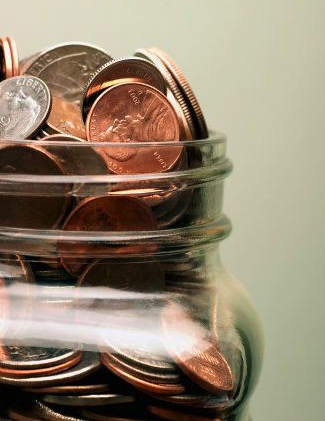
I think that negativity around change exists mostly due to disorganization (people feel they will forget where they put it, will lose it in a couch, or are not good at collecting it) as well as due to psychological effects (people think that collectively it’s less valuable than any dollar bill equivalents). I wonder if people, when estimating the total value of coins in a jar/bottle, commonly undershoot the actual value?

There have been some interesting economical studies that suggest (and support) a related theory – that people are more inclined to spend coins rather than dollar bills. Called “The Denomination Effect”, it supports the idea that maybe people want a dollar bill because they’ll be more inclined to save it rather than immediately spend four quarters on some Fun Dip at the gas station. Interesting studies.

Regardless, my point is that we should all learn to love change. The concept itself is a universal framework for brewing mathematical juices and collecting change can provide both a direct and indirect mechanism for saving money.

geek speak

Modern investment in math and science education requires the subjects to evolve. Most of that evolution should be in the language and culture to make it more connected to society.

Historically, math and science have had their own language, so to speak. Geek speak – complex phrases and nerdy nomenclature have made it a world in which one must be “admitted” (no pun intended, although it surely can be crazy).

I’ve spent the past three years in a technical and scientific environment, and the majority of my academic years with strong focus in math and science. It’s clear to me that bubbles form from which the admitted can rarely escape. That’s because there is a standard by which many professors, scientists, mathematicians, and researchers live and it includes living the language of their subject. But for me, the teachers and mentors that have had the greatest impact on me were those that could speak plain English to me while still teaching the concepts and theorems without loss of transmitted information. They successfully connected plain English with geek speak.

Naturally, within any subject, company, or even group of friends, it’s expected for a lexicon to be developed and learned. It’s important for that standard dictionary of terms and phrases to exist as it creates the social networks and communities that fuel collaborative innovation. But again, those bubbles need to have a more permeable film, to allow a constant admission of newbies no longer deterred by a language barrier.

A recent Sept 2009 Wired Magazine article talks about this, particularly for those in middle and high school. Author Daniel Roth states, “If we want to reform education, we have to make it cool to be a geek.” This is exactly the point. Connect the notion of fitting in with the realms of math and science by connecting the languages and the culture at specific educational levels. If nerdiness can become a part of everyday life, the bubble will not only expand but the film will become more permeable. The positive results will be seen in technological advancement, discovery, and common understanding.

To conclude, the ability to communicate complex concepts and theorems in a way that’s easily understood by a new learner is essential. It’s essential for building a more connected society – one with greater educational opportunity and understanding. In other words, the societal congruence at time t will optimize the combinatorial pathways for achievement at time t+1.

ranking cereals

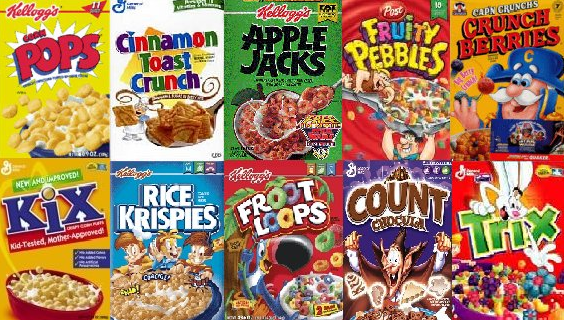
I just bought my first box of cereal in a while. At the grocery store, an entire side of an aisle was completely filled with cold cereal – every brand and flavor and shape and color you could imagine. Very nice variety for a common breakfast food and afternoon snack – a lot more than I remember.

I really wish I could see some data on which cereals do best for which age groups, during which months of the year, and purchased at what time of day. It’d be interesting to compare marketing campaigns too. Does anyone buy the big box of Kelloggs Smacks cereal? I didn’t think so.


Anyways, all this got me thinking… what are the qualities of a good cereal? Would the output of a cereal ranking algorithm be similar to my instinctive ranking of cereals? Let’s find out.

Here are the parameters by which I scored a list of 26 different cereals, including 3 hot cereals:
Healthiness – Sugary cereals, chocolate cereals, etc. If they leave the milk tasting like melted ice cream, chances are it’s not too healthy. (1=Healthy, 2=Intermediate healthiness, 3=Not healthy)
Texture – Everyone loves a crunch. I’m not talking the texture that hurts your gums when you eat it dry, but the texture where pieces clump nicely in the spoon and are accepting to a big chomp. (1=Great texture, 2=Okay texture, 3=Boring texture)
Fun Factor – The box, the games, the toys, the colors, the shapes, the mascots, the commercials, etc. (1=Very fun cereal, 2=Intermediate fun, 3=Not very fun)
Good w/ Fruit – For me, this is key. I enjoy adding banana, strawberries, and/or blueberries to my cereal. (1=Good with fruit, 2=Not good with fruit)
Needs Sugar – Despite it’s probable inherent healthiness, if it’s bland, it stinks. If you have to add sugar to make it hit the spot, we have to drop its ranking. (1=Does not need sugar, 2=Needs sugar)

Scores were summed up across all parameters. The cereals were then sorted from lowest score to highest score to retrieve the final ranking of cereals. As a note, the ‘Good w/ Fruit’ and ‘Needs Sugar’ fields were weighted slightly lower than the other three by simply giving them a lower maximum score of 2 versus a 3. You’ll also notice no column for ‘Flavor’. It’s too hard for me to score based on flavor as that is pretty mood-dependent, and hopefully that information is covered by the other columns anyways.

Results
Note: Lower score is better.

6 – Crispix
7 – Honey Bunches of Oats
8 – Cinnamon Toast Crunch
8 – Frosted Flakes
8 – Life / Cinnamon Life
9 – Captain Crunch
9 – Froot Loops
9 – Fruity/Cocoa Pebbles
9 – Lucky Charms
9 – Trix
9 – Rice/Cocoa Krispies
9 – Cheerios (all types)
10 – Cocoa Puffs
10 – Oatmeal (non-instant)
10 – Cream of Rice
10 – Cream of Wheat
10 – Raisin Bran
10 – Special K
11 – Apple Jacks
11 – Corn Pops
11 – Golden Grahams
11 – Kix / Berry Berry Kix
11 – Cookie Crisp
11 – Honeycomb
11 – Frosted Mini-Wheats
11 – Wheaties

Full Data

Discussion

The results are interesting, but still expected. You’ll notice that the fun and texture of the fruity cereals clusters them in the middle, dragged down by their lack of healthiness. Only a few cereals really get to the top of the list, and I’m delighted to see Crispix and Honey Bunches of Oats up there (and next to Cinnamon Toast Crunch which is probably the best flavor). With some cut banana and/or berries, those first two are the most satisfying cereals, down to drinking the last drop of milk. Finally, we see the hot cereals in the middle of the pack as well, high on health but low on fun and texture.

I acknowledge that this list is not comprehensive. For example, it has been pointed out to me that I am missing Raisin Bran Crunch which is a pretty popular cereal of choice these days. I also forgot Clusters / Honey Nut Clusters which I was huge on for a while as a kid. Whoops!

I also acknowledge there is some bias built into this scoring, as what I believe is “fun” or “good texture” is different from what you will think is “fun” or “good texture”. However, it’s a quick algorithm that you could apply to anything to help understand not only the elements being measured but also about the person doing the measuring.

Oh, and if you were wondering, I bought Honey Bunches of Oats.

measuring the balance of human life

Can we measure the balance of human life? Perhaps not with 100% confidence, but we can certainly think about the factors contributing to the state of the system at any moment in time and see where the scale might be tipped.

Overview

As students, we learn about the critical role of balance in science, economics, politics, art, and every other subject. Think about chemical equilibrium, energy conservation, supply and demand, political checks and balances, atomic neutrality, mathematical parity, and artistic symmetry. As individuals, we constantly stress the need for a balance in our personal lives. Think about work and family, business and pleasure, excitement and relaxation. Physical components such as those in the first list are measurable, giving us the ability to understand, track, and predict the state of the system. On the other hand, the second list is quite abstract and is mostly qualified by our own personal well-being, the well being of those around us, and the influence on our surroundings as a whole.

So how close can we get to measuring the balance of our personal well being? Let’s run with Ockham’s Razor and try and make it as simple as possible. Consider this statement: the optimal balance of life is when what you take from it is equal to what you give to it. What does that look like?


What You Give
Contributing Factors: Advice, Assistance, Business Opportunity, Care, Directions, Donations, Empathy, Feedback, Friendship, Guidance, Hard Work, Philosophical Thought, Prayer, Product Innovation, …

Notes: It’s all good. There is an infinite amount of mechanisms by which you can give to society, environment, others, and life in general.

What You Take
Contributing Factors: Awareness, Consumption, Control, Crime, Emissions, Faith, Goods, Greed, Growth, Land, New Ideas, Pain, Reflection, Self-Satisfaction, Understanding, Vacations, Waste, …

Notes: There are many bad ones here, but some are obviously necessary and should take the majority of the weight, such as awareness, reflection, and understanding.

Analysis

Units of Measurement: There are concrete and abstract units through which we might measure what we give and what we take.
–Money – Something upon which we are all dependent.
–Time – Something by which we are all bound even though it is out of our control.
–Text, Speech, and Emotions – Can we measure the impact of our words by the resulting sentiment of readers and listeners?
–Acquaintances, Friends, Colleagues, Contacts, Followers – For certain personality types, does the size of an audience have any relevance?
–Quality of Life Factors (Ambition, Happiness, Health, Life Expectancy, Strength, Well-Being) – The toughest to measure, but the most important to global well-being.
–Dreams – Can you measure balance in life by analyzing what your dreams are about?

Deviations from Zero & Tipping the Scale: What does imbalance mean?
–Positive Case – If we give more than we take, we are left with an internal hole. Perhaps we are absent of understanding or self-awareness, or of our purpose in the world.
–Negative Case – If we take more than we give, our impact is diminished and it leaves our surroundings with less to gain.

Collective Balance: Perhaps balance is not to be determined at the individual level but at the level of societal groups and organizations.
–Family – Does your family collectively balance the give and take of life? Is your family happy, stable, and sufficiently contributing to the well-being of other families?
–Work – Does your work collectively balance the give and take of life? Does it contribute to the well-being of society as much as it takes for business growth and distributable profits?

Conclusion

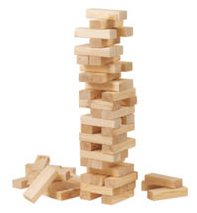
Balance is important. We know that. But perhaps because it’s difficult to measure, the real importance falls on understanding the contributing factors to the state of the system. Like a Jenga tower, pulling pieces must still keep the tower standing.

Finally, we must think about at which organizational level we can best understand balance in human life, and where the ideal equilibrium should exist. By breaking it into its simplest components and visualizing harmony, hopefully that’s exactly what will result.

“Happiness is not a matter of intensity but of balance, order, rhythm and harmony.” – Thomas Merton

one minute for happiness

There are 1,440 minutes in a day. All it takes to make a difference is just one of those. One minute. That’s all it takes to make someone change their state of mind. One minute. That’s all it takes to make happiness contagious…

One minute. That’s all it takes.

One minute represents approximately 0.07% or about a fourteenth of a percent of the entire day. What else does it represent?

  • The time it takes to brush your teeth.
  • The time it takes to sing a national anthem.
  • The time it takes to check the weather.
  • The time it takes to heat up leftovers.
  • The time it takes to download and install Firefox.
  • The time it takes to write the Schrödinger equation, twice.
  • The time it takes to build a Jenga tower.
  • The time it takes to take out cash at the ATM.
  • The time it takes to pump gas.
  • The time it takes to derive any non-relativistic, Newtonian equation of motion.
  • The time it takes to chug 2 sodas.
  • The time it takes a space shuttle to go about 300 miles when in orbit.
  • The time it takes to make a sandwich.
  • The time it takes to take your temperature.
  • The time it takes to stretch your hamstrings.
  • The time it takes to watch two commercials.

Okay so I got a little carried away with that one. But that’s a good creativity exercise! Anyways, it really does put into perspective what you can do with a minute of time. So if you could take one minute each day and devote it to making someone else happy, could you do it?

Happiness is truly contagious. You see a man smiling on the bus and it makes you happy. An elderly woman making a wise crack about the speed of her shopping cart in the condiments section and you’re chuckled (that happened yesterday). Two people hugging on the street and you feel a rush of comfort. And that’s the funny thing: happiness comes in such simple forms. It doesn’t take money or success or fame or victory but just a simple act of kindness, show of emotion, compliment, or generally positive vibe.

With that I do want to be clear of one thing. Happiness is not always something gained or transmitted through external means, but on some days that minute is surely well spent through internal reflection and thought. That’s not selfish – that’s normal. But in a balanced world what you take is what you should give – double the amount you give back the next day.

So obviously transmissible happiness can be for yourself or for someone else, for a group of people, for a company, for a stranger, for an imaginative thought, for a spiritual state, etc. So what are some examples of transmission routes?

  • Make a phone call or send an email.
  • Give feedback on a paper, post, product, service.
  • Offer directions to someone lost.
  • Read an article and write your thoughts.
  • Carry something.
  • Smile at a stranger.
  • Give up your seat.
  • Laugh at yourself.
  • Double your tip.
  • Doodle.

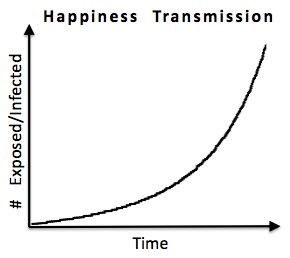
The constant transmission and contagiousness of happiness. Mathematically, that makes me think of epidemic models. Well, that’s not far off. I’d propose that happiness could easily follow a modified epidemic model:

S = Susceptible = those who aren’t aware of how contagious it is
E = Exposed = those infected but keeping it internal
I = Infected = those hit by the smiling bug and actively passing it along
Standard Contact Rate (Susceptible –> Infected/Exposed) = 1 per day

Everyone starts as Susceptible, and the Exposed and Infected can toggle as they generate happiness internally some days and expose others the next day. You could take into account the doubling of internal happiness to double the Contact Rate on a subsequent day for the Exposed group. A new Susceptible population would emerge each day through birth, and most everyone would die happy. A pretty fun, dynamic model of happiness transmission.

Note: If happiness started with one person and simply doubled each day, it would only take a little over a month to infect or expose happiness to the entire global population (obviously ignoring geographic and other constraints).

In the end, my main point is that you can do something every single day to create happiness, and the mechanisms by which you can create happiness are very simple ones. It only takes one minute each day to give that purest gift of all. Because with a heart and a smile, the world’s happiness is truly in the palm of your hands.


Quotes/Links

  • “Happiness is the meaning and the purpose of life, the whole aim and end of human existence” – Aristotle
  • “Thousands of candles can be lit from a single candle, and the life of the candle will not be shortened. Happiness never decreases by being shared.” – Buddha
  • “Happiness always looks small while you hold it in your hands, but let it go, and you learn at once how big and precious it is.” – Maxim Gorky
  • The Happiness Epidemic – by David Hernandez
  • Bhutan and the measuring of quality of life through Gross National Happiness

dynamically-weighted surveying

There are plenty of websites that try to characterize you based off a set of responses. Some surveys come via email and ask you to tally up your own score and see how you compare to the rest of the world. Some just try and answer a simple question such as what personality type or how happy or how outdoorsy you are. They’ll give 10 questions and based off how many you answer correctly, you fall into some category. Some more sophisticated applications may weight questions by importance and mathematically calculate a percentage that represents your characterization. For simplicity sake, I guess they do the job.

But here’s another idea…
One more method of weighting questions in a survey might be based off global survey or consensus results. For example, if I was to compute a score that asked, “How much of a Yankees fan are you?” two questions might be:

1) Do you hate the Red Sox?
2) Have you been to a game this year?

If a large survey was given, possible/expected results for these questions might be:
1) 99% Yes, 1% No
2) 20% Yes, 80% No

Based off these responses for a relatively large population, we can weight how much each question should factor in to the final result. For our example, since practically everyone hates the Red Sox, responding Yes should not play a majority factor in calculation of the final characterization. But since going to a game this year is a bit more of a rarity, perhaps it should contribute a higher amount to your final score. The trick is that for binary responses, you must denote which response increases the score and which decreases (it would be smart to gear the questions so that the affirmative case is always the increaser).

Taking this a step further, a lot of times the consensus of a larger group may not be known. In that case, your answers should become dynamic inputs to the weighting algorithm. They start at 50/50 and dynamically shift based on each new, incoming response. In a sense, the sensitivities are set by each new instance of that survey. Additionally, for non-binary / categorical / multiple choice responses, it would just require a bit more careful examination of weighting constituents.
Ill hopefully have an example of this weighted implementation in a near-future post.

connections of seemingly unrelated phenomena

Math has been a nice provider to the world with many of the building blocks for new scientific hypotheses, discoveries, technologies, and philosophical conjectures. It is a glue between science and nature, nature and theory – elegantly describing the physical world while evoking new thoughts about the metaphysical one.
That broad application of math is what I like about it most. Some say it’s still not “cool” enough (and I’ll agree to a degree). However, there is a constant flow of new scientific research that expands the boundaries of human intelligence every day, inevitably getting us all on the path to coolness.
One realm I find most compelling and rewarding is in hidden mathematical relationships, or the statistics of seemingly unrelated phenomena. Maybe it started with the golden ratio popping up in places you wouldn’t imagine. Or maybe it was in Freakonomics and discussion of the legalization of abortion and its impact on crime rates. Either way, new junctions are formed and unique insights are gleaned that push science into a exciting land of interconnectedness.

Here is a recent example of such seemingly unrelated phenomena, by a group of researchers from the Czech Republic. You can access the full paper here or the Technology Review summary article here.
From the abstract…
“Using measured data we demonstrate that there is an amazing correspondence among the statistical properties of spacings between parked cars and the distances between birds perching on a power line. We show that this observation is easily explained by the fact that birds and human use the same mechanism of distance estimation. We give a simple mathematical model of this phenomenon and prove its validity using measured data.”

Spacing between parked cars related to distances between birds perched on a power line. Now that’s something interesting. This makes me think of bathroom behavior too. Man code says there is an optimal urinal/stall to choose based on the permutation of available and occupied units (order matters!). To test your knowledge of man code, try the online game or download the iPhone app called UrinalTest.
The science employed here involves a branch of mathematics known as random matrix theory. In my opinion, bundling the subject matter is important so it can be documented, taught, learned, and applied. On the other hand, unbundling of the subject matter is just as important so new relationships can be formed and interconnectedness can be exploited.
In the end, these new explorations are important for science, education, and a better understanding of our world. And somewhere along the way we learn not to park under the birds, thereby minimizing the probability of off-white, splotchy, automobilistic accents.
Figure 1: From Flickr, birds on power lines.
Figure 2: From the paper, data points represent the probability density of the distances between the parked cars (crosses) and perched birds (squares), compared with the theoretical prediction (solid line) where the mean distance is normalized to 1.

early childhood math education

“Evidence shows that early success in math is linked to later success in both math and reading. Given the increasing importance of science and technology in everyday life and for gaining entry into many careers, it’s crucial that we give all children a strong foundation in math and that we start many years before they enter formal schooling.”

With the recent publication by the National Research Council on early childhood mathematics, I thought I’d post a little summary with some thoughts of my own. I have always had interest in education policy, curriculum development, and ways to close the educational gap in the United States and around the world.
I believe even the smallest steps can lead to vast improvements, and the general idea is awareness then action, fueled by collaboration. Make the problems fully known and understandable, and then provide mechanisms through which those problems can be addressed at the individual, family, community, local/town, state, regional, national, and international levels.

I have particular interest in mathematics, science, and technology education and hope to stay involved in this realm for my entire life. Since it is quite high on today’s national policy agenda, hopefully action will be expedited to show progress domestically. Then in fixing our national education system, we can serve as a good example to developing nations in how to structure early education and community programs to maximize intellectual growth.

Click here for a Science Daily article about the report.

Here’s an excerpt from the report description:

“Early childhood mathematics is vitally important for young children’s present and future educational success. Research has demonstrated that virtually all young children have the capability to learn and become competent in mathematics. Furthermore, young children enjoy their early informal experiences with mathematics. Unfortunately, many children’s potential in mathematics is not fully realized, especially those children who are economically disadvantaged. This is due, in part, to a lack of opportunities to learn mathematics in early childhood settings or through everyday experiences in the home and in their communities. Improvements in early childhood mathematics education can provide young children with the foundation for school success.”

Some more highlights:

  • Math education must start at the earliest possible age. A coordinated national early childhood mathematics initiative should be put in place to improve mathematics teaching and learning, particularly for ages 3 to 6.
  • We must engrain mathematics and statistics as an environment and a behavioral necessity at an early age. Analytical processing, spatial thinking, and problem solving skills should become part of every day life at a very young age. The report says mathematics experiences in early childhood settings should concentrate on: A) numbers (whole numbers, operations, relations), and B) geometry, spatial relations and measurement. “How should I cut the cake so that everyone gets a piece?”
  • Mathematical process goals should be integrated in other content areas. Math should not be a stand-alone subject but should be a part of the curriculum for history, english, art, music, and other subjects/classes.
  • We must improve the technical and scientific literacy of the general public. This should be done by promoting “number comfort” from early education through adolescence and making math and science education a family, real life, and every day thing.
  • There need to be revised professional development initiatives for educators reflecting science/technical/mathematical curriculum needs.
  • Early childhood education partnerships should be formed between family and community programs to work together in promoting children’s mathematics.
These highlights offer just a glimpse of what is in the comprehensive report, which includes full-scale curriculum, professional development, and implementation recommendations.

In my own point of view, I think there needs to be some sort of accreditation program for mathematics and statistics education, covering preschool, elementary school, middle school, and high school (truly, high school is a different story, but certainly some aspects by which the Pre-8 schools might be evaluated are applicable to grades 9-12 as well). A stepwise and gradated approach to evaluation of statistical/mathematical initiatives should help schools work from their current status to a desired and achievable one.

I am aware of accreditation programs that do currently exist at the state and regional levels (although it seems as though most are for a school as a whole and not individual subject areas). On the contrary, I am unaware of the steps these types of evaluation programs take to ensure that systematic inequalities don’t impact evaluation results. Subject-level evaluation programs should not reward schools but rather provide valuable feedback and awareness for all types of early education programs. It should provide a framework for schools to understand their relative status, in conjunction with possible areas for improvement, on a local, national and international level.
I believe evaluation of mathematical/statistical initiatives should take place at these core levels:
  • Administration/Management – Quantitative methods should be made operational in the management and evaluation of educators within the school system. It not only promotes understanding of such methods, but is also an engine for measurable results, positive reinforcement, professional development, and recognition. In some sense, schools are run like a business that should employ quantitative methods to ensure profitable return, an optimized allocation of resources, and quality control. Employ the DIS cycle and school administration will certainly find it easier to know what works, and what does not.
  • Culture/Community – As stated in the NRC report, partnerships must be formed between the student, school, family, and local community. Evaluation should occur on how well a school takes steps to forge and maintain these relationships. How much do children hear about math in school as opposed to out of school?
  • Curriculum – The most obvious one involves evaluation of the process by which a school teaches math and statistics. Does the school sustain its process equally over time? Do educators use a wide array of techniques to teach mathematical concepts?
In the end, something needs to be done and the NRC report is the right first step towards awareness. With the use of some simple quantitative methods and collective brainpower, we can take action to decrease inefficiencies and close the national and international education gaps in mathematics and science, and in turn, many other subjects… Use data to evaluate, support, and improve!

gaining strength from weakness

One of my favorite exercises is to take a quote, phrase, idiom, or saying and digest it in every way possible. It’s an exercise that builds upon existing cognition to create new ideas and thoughts. The internal lines of thought leave the individual with a new network of philosophical pathways from which some amazing self-realizations can be gleaned. From a quote comes a new concept, from that concept comes a good memory, from that memory a connection is made, and from that connection an appreciation is built. That’s the breadcrumb trail of thought.

“Our strength grows out of our weakness.” – Emerson

Although not complex in structure, vocabulary, or tone, I enjoy this quote because its simplicity allows diverse interpretation. Emerson connects two antonyms as if they were a pair, complements to each other, one needing the other. And so it goes…

Immediate questions: What are my weaknesses? When did I realize they were weaknesses? Am I weak compared to others or compared to my own understanding of standards? How does one define standards in relation to characteristics? Have my standards changed with my changing abilities or with my realization of new weaknesses? What is my most recent weakness? What is my biggest weakness? Are all weaknesses able to be improved upon? Are there universal weaknesses or only individual ones? What is the most common weakness?
Let’s integrate: If I can somehow build upon the set of all my weaknesses from the time I was born until yesterday (or up to a second ago for purposes of true continuity), with what would I be left at this exact moment? Emerson says it’s strength, and I wholeheartedly agree, simply because I know we all have the capacity to learn. Our greatest trait is our capacity to learn. Learning gives us reason to try again. Learning gives us reason to move on. Learning gives us reason to find possibility. Learning gives us hope for tomorrow. Learning trumps failure.

Here’s a scenario: Consider a set of X functions, abilities, processes, and tactics with which we are all equally born. On day 1, they all exist as unrealized weaknesses. With each experience had and the capacity to learn, an individual has two possibilities: turn an unrealized weakness to a realized strength, or realize weakness and create a new realized strength. Over time, the original set of X expands as new strengths are added and the overall dynamic changes as weaknesses grow into strengths. The result is that from day 1, the number of realized strengths will always equal or exceed the number of realized weaknesses. In other words, as a result of their complementary nature, the proportion of strength to weakness almost always increases.

Wow – what a great realization that is! Rather than despise that which we cannot achieve, instead we must harness our weaknesses, grow to accept them and adapt to them, and find ways to learn from them. With that alone we’ll grow stronger every day.

Image 1: Chet Phillips – “Thought Process”