Curiosity, Passion, and Quantifying Human Characteristics

“You can’t light the fire of passion in someone else if it doesn’t burn in you to begin with.” – Thomas Friedman

In his The World Is Flat, Friedman speaks to the growing need for curiosity and passion in today’s job market. Core intelligence, as historically measured by the Intelligence Quotient (IQ), is and will always be important, but in a flat world it’s the curiosity and passion that will matter most.

Friedman references a Curiosity Quotient (CQ) and a Passion Quotient (PQ) that purportedly parallel the common IQ framework for scoring a person’s intelligence. More specifically, he expresses a comparative relationship between the three variables: CQ + PQ > IQ. But can curiosity and passion be measured like intelligence? More generally, can other individual characteristics be measured?

Traditional measurement is the process of obtaining a magnitude for a quantity. Things are measured by counting, and not by observation or estimation. It’s supported by strong criteria that support that measured value, such as a universal frame or scale of reference. By traditional measurement, we cannot really find CQ, PQ, or even IQ. However, there are other types of measurement…

In representational theory, measurement is defined as a correlation of numbers with entities that are not numbers. In information theory, measurement is actually a component of estimation with the uncertainty reduced infinitesimally to zero. Measurement means estimating through support of any number of measurable or unmeasurable parameters, and reducing uncertainty through various means until reaching a high-confidence end value. By the extended definitions of measurement, we can practically quantify anything!!!

So what do we get by measuring traditionally-unmeasurable human characteristics, emotions, abilities, and qualities? What do we get by identifying any new particular Qualitative Quotient (QQ) such as the CQ or PQ? Well, Friedman is on the right track here. We become smarter by surpassing our current understanding of intelligence. And as our QQs surpass the IQ, so does our ability to flatten the world, innovate, grow and succeed as a civilization and society.

The process of trying to quantify characteristics helps us realize the underlying factors that contribute to a specific quality. What makes someone passionate? How can we tell if someone is curious? Is it genetic, demontrated by experience, and exhibited sub-consciously? Can it be determined through the collective interpretation of dreams? Examining the underpinnings of qualities makes us more intelligent as individuals, organizations, and societies. Once quantified, we can look for patterns and trends in our data across different geographies, demographics, and slices of traditionally-measurable data.

What we’ll learn then, well, I’m curious to find out.
Learning In The Clouds

No, I’m not talking about daydreaming although I have previously expressed my love for and interest in daydreaming as a necessary practice. But here, I’m talking about education and the internet.

It is well understood that education as a discipline has made positive strides in recent decades, but still has many leaps to take. There exists an issue of a profound educational gap between demographics, an issue of comprehensive standards through which student understanding can be measured, and an issue of standards and processes by which teachers can be evaluated for feedback and professional growth, to name a few.

But for this topic, let’s set these issues aside and assume internet access is available for all students and schools. How can the internet be leveraged as an enabler of quality education? How does the existing cyber framework and status of collaborative tools enable efficient and effective education?

Key Themes

  1. Writing/typing enables memory and understanding: As stated in my previous post “Spectrum Logic”: “To put something on paper and organize the information as to make visual sense – in words, lines, colors, and curves – is to recognize some understanding and to create a basis for new insight and discovery.”
  2. Differing opinions and verbiage, on any topic, provide full-spectrum input, fuel discussion, and parallel what’s to be expected in the professional world.
  3. Technical skills are essential. This includes understanding technical concepts, the digital organization of information, social networking, and collaboration.
  4. Relationships are a key to happiness and provide a medium for professional growth. Digital relationships formalize relationships and provide concrete structure between multiple people, enabling this growth in an organized manner.
  5. Exploring and understanding the depths of the internet and related technologies forges new intellectual connections, and more importantly, personal interests.

Core Components

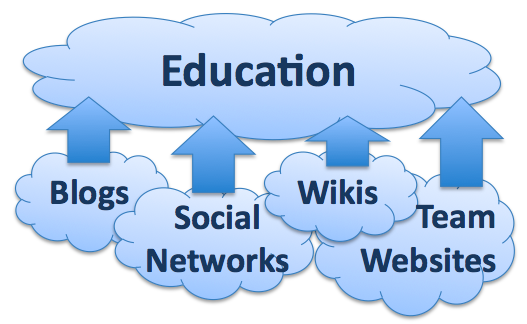
Blogs – As a central medium for information exchange, blogs can be used as a fantastic teaching tool. Imagine a class where after each lesson, different students memorialize class notes, in their own words, in blog posts for the rest of the class to see. Posts can be categorized, commented on, and used as a fantastic medium for discussion. Come test time, the notes are in there for all to see and use as study material.

Wikis – At their core, wikis provide a semi-structured environment for the capture of knowledge. Yes, Wikipedia seems complete, but that’s not the point. Imagine a class that started with a blank wiki, and had an objective to create a new knowledge framework around class material. This would not only prove to be great study material, but would also teach students a good deal about Web 2.0, digital organization of information, and parallel the growth and interconnectedness of new knowledge through links, references, and version control.

Social Networking – Private and/or public, social networks establish relationships, organize contact information, and provide a framework through which individuals can learn about other individuals and interact with them. Whether on a similar interest or topical matter, social networking for a class could be incredibly useful for building new relationships, and easier interaction with peers and professors. You can never replace a hallway conversation or a whiteboard tutorial, but this could better enable those circumstances to take place.

Personal/Team Websites – Personal and/or team websites enable individuals to provide some level of scope to their interests and personal attributes while teaching hands-on technical skills. Building a website teaches organization, visualization, data management, marketing, and a whole boat load of other concepts. Whether as a class or as individuals, website creation forges new intellectual connections and practical skills that directly translate to the professional world.

In the end, there’s a world of opportunity on the web, and as education tackles its outstanding issues as a whole, it’s only beneficial to use and leverage the internet as a medium to foster new learning and create new opportunity for students across the US and the world.

Links

Spectrum Logic

The visual representation of information is critical for both learning and teaching. To put something on paper and organize the information as to make visual sense – in words, lines, colors, and curves – is to recognize some understanding and to create a basis for new insight and discovery.

Logic is the study of reasoning, the systematic approach to reaching a conclusion, or the examination of competing arguments with regards to a central issue or question. Logic can be broken down into deductive and inductive reasoning, one drawing conclusions from specific examples and the other drawing conclusions from definitions or axioms. Logic can also be broken down into analysis and synthesis, one examining individual component parts and the other combining component parts into a whole. In any event, logic is a way to get from questions to answer, disbelief to belief, and data to insight.

One such type of logic is visual logic, or what I’ll call “spectrum logic”. It’s the combination of the visual representation of information and the many realms of logic. The reason I use the term “spectrum” is two-fold. First of all, it’s by definition the representation of a full range of possible values/conditions for a given topic. And second of all, it suggests continuity along its range and therefore implies a high level of seamlessness and efficiency.

So in the world of analysis and problem solving, how do we apply spectrum logic? Well, just follow every possible visual path from any origin within your visual space and try to optimize your path to the result. Place your problem in the center of a sphere/cube and run the full spectrum of paths to that center point. Left to right and right to left, bottom-up and top-down, outside in and inside out, spiral inward and spiraling out. Think about the component parts that make up the visual space, and the conditions that fall along each path. Why is your problem so complex? What makes it so complex? Can you qualify your problem in color, words, shape, and text? Can you quantify it and its components? Is it made up of many unknown dimensions or a few known ones? Picture your problem, logically break it apart, and put it back together. Take a diverse set of paths to and from your problem, and find out which one gives you an optimal set of insights in return. Hopefully, if the answers and conclusions are not clear, you’ll at least have learned something in the process.